
Diorite is a coarse-grained, intermediate plutonic, or intrusive igneous rock. It has mainly plagioclase feldspar, biotite, hornblende, sometimes pyroxenes, and other minerals.
This rock’s composition lies between gabbro, a mafic rock, and granite, a felsic rock with 52-63 wt.% silica content. It forms from the slow cooling of magma deep inside the Earth’s crust.
René Just Haüy first applied the name diorite in 1822. This name comes from an Ancient Greek word dioritas (διορίζειν), which means to separate or distinguish and infer to this rock’s dark and white speckles, which are easily distinguishable.
Today, we will be talking about diorite in detail. We will start our discussion by looking at diorite color and textures, followed by chemical and mineral composition.
Afterward, we will discuss how diorite forms, its uses, and where it is found. Also, there are parts on how this rock differs from granite, gabbro, andesite, and much more.
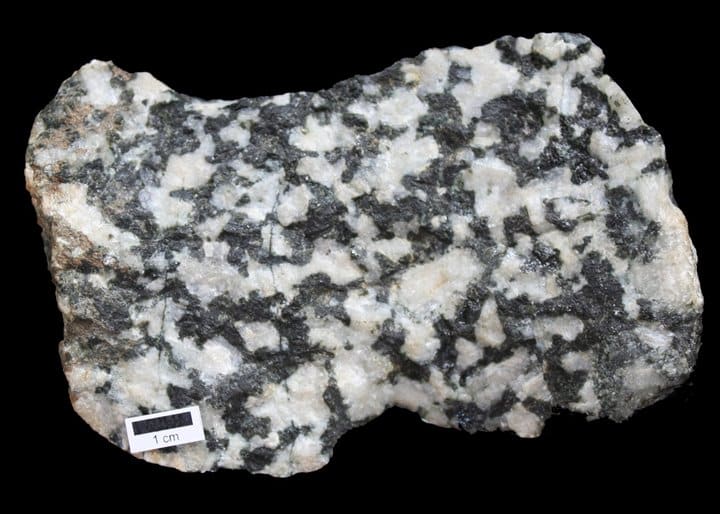
Quick facts and properties
- Name: Diorite
- Pronunciation: /daɪəˈraɪt/ or dahy-uh-rahyt
- Rock type: Igneous
- Origin: Plutonic or intrusive
- Texture: Phaneritic or coarse-grained. However, some may be porphyritic, rarely pegmatitic.
- Grain size: 1/16mm to 3 cm (0.0025 to 1.18 inches) but can have larger phenocrysts if porphyritic.
- Chemical composition: Intermediate, i.e., between mafic and felsic
- Silica content: 52-63 wt. %
- Color: Mostly light to dark gray with darker and lighter speckles but it may have a brownish, bluish, or greenish tint.
- Appearance: Salt and pepper
- Hardness: 6-7 on a Mohs hardness scale
- Density: 2.8-3.0gm/cm3
- Melting point: 800 and 1000°C (source) at atmospheric pressure
- Mineral composition: Mainly plagioclase feldspar with lesser amount of biotite, hornblende, and less often pyroxene, among other minerals.
- Cooling history: Slow
- Equivalent volcanic or extrusive: Andesite
- Tectonic environment: Convergent plate boundaries – volcanic arcs, especially continental.
What does diorite look like?
The speckled appearance, color, and texture are vital in distinguishing this rock from other look-alikes, including gabbro, monzonite, syenite, and other plutonic rocks.
Usually, diorite is a massive, coarse-grained, holocrystalline off-white, light gray to dark gray or sometimes greenish, brownish, or bluish-hued rock. It has nearly equal amounts of speckles of light and dark colors, giving it a salt-and-pepper appearance.
The minerals present give diorite its unique appearance or colors. For instance, white, off-white and light gray interlocking mineral crystals are mostly plagioclase feldspars. In contrast, the darker (black, dark-gray, brown, or greenish) minerals are mafic like biotite, hornblende, pyroxenes, opaques, and rarely olivine.
These mineral crystals will have a random orientation, and you are unlikely to notice quartz as it often fills interstitial spaces when present.
Besides a coarse-grained texture, this rock may have other textures, including porphyritic, poikilitic, or myrmekitic.
Let us now talk more about diorite texture (porphyritic, pegmatitic, microdiorite, or orbicular textures), comb layering, mantling, leucodiorites, and melodiorites.
1. Porphyritic diorite
Some diorites may have a porphyritic texture. Such rocks will have conspicuously larger crystals or phenocrysts in a finer but coarse-grained or phaneritic matrix.
Usually, porphyritic diorite may have phenocrysts of plagioclase and sometimes biotite, hornblende, clinopyroxene, or magnetite in a groundmass of these minerals.
This texture indicates two-stage cooling, i.e., 1) an early one that formed the large phenocrysts and 2) a later one that formed the matrix.
A good example is the Henry Mountains in Utah, USA, which has mainly diorite porphyry laccoliths. Also, Coos County in New Hampshire has porphyritic hornblende diorite.
2. Diorite pegmatite
Pegmatitic diorites have abnormally larger phenocrysts, often 3 to 4 inches or larger, especially plagioclase feldspar in a coarse-grained matrix or groundmass. This texture forms when prevailing conditions favor rapid crystal growth over nucleation.
Geologists believe that pegmatitic texture forms during crystallization of the last portion of magma melt high in volatile. The high volatiles depolymerize silica until supersaturation. Once supersaturated, any nucleation will result in the fast growth of crystals forming this texture.
3. Leucodiorites and meladiorites
Leucodiorites and meladiorites are rocks with dioritic composition but have a color index ‘M’ that is less or more than the normal range.
Usually, leucodiorites will have a color index of 10-25 due to less hornblende and other dark minerals, while this color index will be about 50 for meladiorites, notes Le Maitre (2002).
However, note that the prefixes ‘leuco’ and ‘mela’ can apply to any other rock with such a property.
4. Microdiorites
Microdiorite rocks have a composition like diorites but with medium-grained instead of the usual coarse grains (phaneritic). The prefix ‘micro’ may apply to any other igneous rocks, i.e., mafic, intermediate, or felsic with medium-grained texture.
5. Comb layering
Comb layering happens when layers have elongated crystals that resemble the teeth of a comb. These crystals are usually hornblende or plagioclase and lie perpendicular to the layering direction.
Also, the crystals may broaden or branch as they grow into the intrusion’s interior. Causes of comb layering are probably conditions that favor crystal growth but not nucleation and do occur in granodiorite and quartz monzonite.
6. Orbicular diorite
Orbicular diorite has spheroidal bodies or orbiculates with a few to tens of inches in diameter. These orbiculates have cross-sections showing alternating concentric bands of amphibole or biotite (darker) and plagioclase (lighter) around a central core.
They form due to the radial growth of an acicular of these darker and lighter crystals. Sometimes, they may occur within a matrix of porphyritic diorite, an example is at Corsica Island in France.
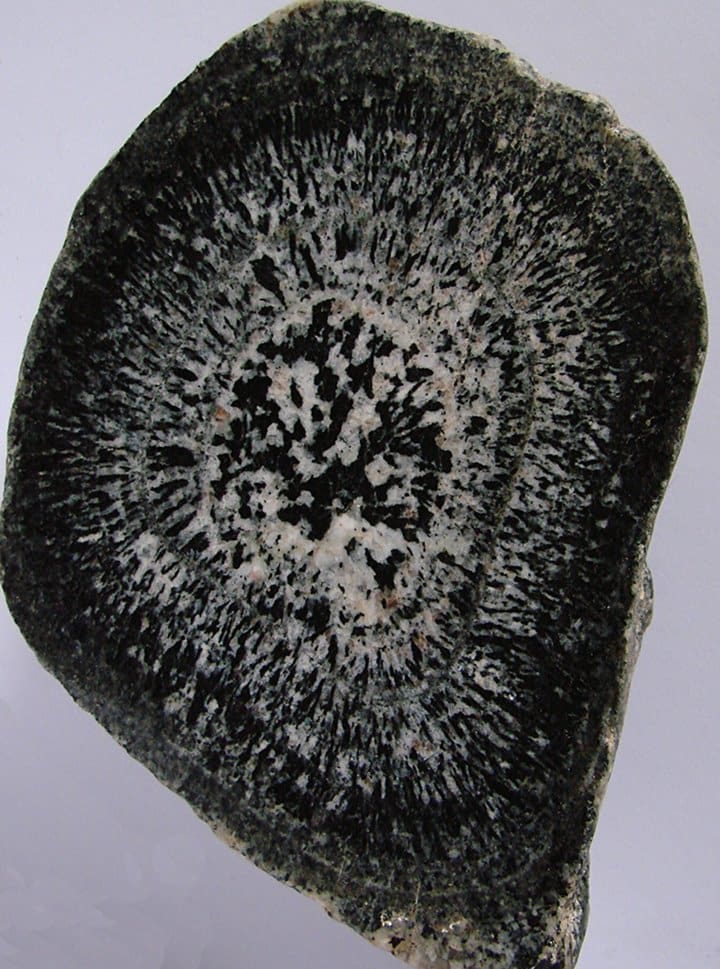

Orbicular diorite rock: Photo credit: Vassil, Public domain, via Wikimedia Commons.
7. Mantling or rimming
Some diorites may show hornblende mantling augite. This rim reaction may occur due to changes in temperature or water’s partial pressure, favoring hornblende formation to augite. Also, slower cooling could have changed augite to hornblende.
Sometimes, hornblende can mantle orthopyroxene, resulting from a late-stage liquid reaction.
Gabbro composition
With an understanding of gabbro’s appearance, texture, and color, let us look at its chemical and mineral composition.
1. Chemical composition
Diorite is an intermediate rock, i.e., between felsic (acidic) and mafic (basic) rocks. It has a moderate silica composition of 52–63 wt.% and intermediate amounts of light-colored felsic (aluminum, sodium, and potassium) and dark-colored mafic elements (magnesium and iron).
A typical diorite wt.% chemical composition from Le Maitre (1976) data is SiO2: 58.34%, TiO2: 0.96%, Al2O3: 16.92%, Fe2O3: 2.54%, FeO: 4.99%, MnO: 0.13 %, MgO: 3.77%, CaO: 6.68%, Na2O: 3.59%, K2O:
If you compare the composition of the mafic and felsic content, these rocks are indeed intermediate.
2. Mineral composition and classification
Diorite has mainly sodium-rich-calcium-poor plagioclase feldspar, hornblende, biotite, and sometimes pyroxene. Also, it may have small to no quartz, muscovite, olivine, and alkali feldspar, and some samples may have metamorphic mineral xenocrysts.
Accessory minerals are sphene (titanite), zircon, ilmenite, magnetite, apatite, or sulfides.
Usually, the plagioclase in diorite is andesine, and less often oligoclase, and is the main mafic mineral. Also, this rock may have alkali feldspar, usually microcline or orthoclase and quartz.
On the other hand, mafic minerals are hornblende, biotite, and sometimes olivine or pyroxenes. Pyroxenes may be augite (a clinopyroxene) or orthopyroxene.
In diorites, olivine is usually less abundant than orthopyroxene since it will react with magma to form orthopyroxene during the early crystallization stages.
Also, quartz and biotite crystals often fill interstices by crystalizing from the residual liquid in early-formed minerals’ spaces. Thus, they will have smaller crystals, often invisible to the naked eye.
Sometimes, minerals in diorite may undergo these alterations reactions: pyroxene → biotite or amphibole, hornblende → biotite, biotite → sphene or chlorite, plagioclase → epidote, kaolinite (clay mineral), sericite, or zoisite.
Let us dig deeper into diorite/dioritoids QAPF classification and thin section.
1. Dioritoid and diorite on the QAFP Diagram
Dioritoids are a group of rocks with less than 20% quartz or 10% feldspathoids of QAPF content by volume and plagioclase accounting for more than 65% of total feldspars. They plot in the same area as gabbroids.
Important! Note that foids don’t coexist with quartz.
On the other hand, diorite is one of the dioritoids with quartz less than 5% of the QAPF content by volume, and plagioclase is more than 90% of the total feldspars. It plots at the same spot as gabbro and anorthosite.

An increase in quartz to 5-20% of QAPF content by volume grades this rock into quartz-diorite, while those with up to 10% foids are foid-bearing.
On the other hand, an increase of alkali feldspar to 10-35% of total feldspar grades this rock into a monzodiorite. Those with 5-20% of the QAPF content by volume are quartz monzodiorite and those with up to 10% foids, are foid-bearing.
Here is a definition of the other dioritoids:
- Quartz diorite: In this plutonic rock, quartz is 5-25% of the QPAF content by volume, and plagioclase is more than 90% of the total feldspars. An increase of quartz to over 20% of the QAPF content by volume grades this rock into tonalite, a granitoid.
- Foid-bearing diorite: Foids are up to 10% of the total QAPF content by volume and plagioclase is over 90% of the total feldspars in this intrusive rock.
- Monzodiorite: in this intrusive rock, quartz is up to 5% of the QAPF content by volume and plagioclase is at least 65% of the total plagioclase.
- Quartz-monzodiorite: A monzodiorite in which quartz is 5-25% of the total QAPF content by volume.
- Foid-bearing monzodiorite: In this monzodiorite, foids are up to 10% of the QAPF content by volume.
Other related rocks are ferrodiorites and epidorites. A ferrodiorite is an iron and titanium-enriched dioritoid common in the lower crusts of oceans.
On the other hand, epidorite is a massive metamorphosed dolerite or gabbro, where augite (clinopyroxene) is replaced by fibrous amphibole, usually uralite. It may show schistosity.
2. Diorite on a thin section
According to MacKenzie et al. (2017), a diorite thin section will show mostly plagioclase feldspar (up to 75%). Some of these plagioclase crystals may show twinning and zoning. Also, there will be brownish biotite crystals with good cleavage and pyroxenes.
Usually, pyroxenes are distinguishable by birefringence. Orthopyroxene has first-order gray interference colors, and clinopyroxene has first- and second-order (red and blue) colors.
That is not all. The thin section may also show tiny quartz crystals that appear clearer than feldspar with some cloudy alteration and have lower reflective indices.
Lastly, considering crystal structure and colors, biotite is brown euhedral to somewhat poikilitic) and hornblende euhedral to prismatic, greenish, or brownish. Orthopyroxene or augite is brown/green/black subhedral, poikilitic, or prismatic.
Gabbro vs. similar-looking rocks
How does diorite differ from gabbro, granite, anorthosite, granodiorite, and andesite?
1. Gabbro
The QAPF diagram plots gabbro and diorite in the same spot since the IUGS classification of plutonic rocks doesn’t consider which plagioclase a certain rock has.
Usually, gabbro and diorite differences lie in color, silica content, mafic content, and the kind of plagioclase or other minerals present.
By definition, gabbro is a mafic rock with more than 35% mafic minerals and lesser (45-52 wt. %) silica. It has mainly calcium-rich (anorthite-rich) plagioclase, pyroxene, and smaller amounts of olivine, hornblende, and accessory minerals.
In contrast, diorite is an intermediate rock with mostly less than 35% mafic minerals as Blatt et al. (2006) note, and more silica (52-63 wt. %). This rock has more sodium-rich plagioclase (more than 50%), hornblende, biotite, muscovite, and little or no pyroxene or olivine.
However, since we cannot distinguish the sodic-rich and calcium-rich plagioclase, we consider the relative abundance of mafic or darker and lighter minerals.
Usually, gabbro has darker minerals, i.e., more than 35% by volume, while diorite has lesser, i.e., less than 35% mafic minerals.
This conclusion is consistent with Parsons (1989), who considers diorite to have 50-75% of the mineral composition plagioclase, meaning mafic minerals are < 50%, considering this rock may have quartz, muscovite, or alkali feldspar.


Note: Silica, sodium, and potassium content increase to the left while iron, calcium, and magnesium and melting temperatures increase to the right.
2. Anorthosite
Diorite is an intermediate rock with more mafic minerals (up to 35 vol. %) and mostly sodic plagioclase. In contrast, anorthosite is a felsic rock with 90 % calcium-rich plagioclase (usually labradorite or bytownite) and 0-10 vol % mafic minerals.
The main mafic minerals in diorite are hornblende, biotite, and sometimes muscovite, with little or no pyroxene or olivine, while anorthosites have mainly clinopyroxene, olivine, magnetite, ilmenite, and orthopyroxene.
3. Granite
Diorite is an intermediate rock with more mafic minerals, a darker color, and no visible quartz minerals. In contrast, granite is a felsic rock with less mafic minerals, lighter colors, and visible quartz minerals.
Compositionally, diorite has 52-63 wt. % silica, mostly sodic plagioclase, and mafic minerals like hornblende, biotite, and sometimes pyroxenes or olivine, while granite has > 69 wt. % silica, mainly alkali feldspar, quartz, and less plagioclase with minor hornblende and mica.
4. Granodiorite
Diorite is slightly darker than granodiorite since it has more mafic minerals and no visible quartz minerals. In contrast, granodiorite is a lighter rock with visible quartz minerals.
Considering their compositions, diorite has 52-63 wt.% silica, more plagioclase (> 90% of total feldspars), with quartz less than 5% of the QAPF content by volume. Granodiorite, on the other hand, has intermediate to felsic composition with 63-69 wt. % silica, 20-60% quartz, and less plagioclase (65-90% of total feldspars).
4. Andesite
Andesite is the extrusive equivalent of diorite. These rocks form from the same magma and at the same tectonic settings or places. Their differences lie in grain size due to cooling rate.
Andesite forms on or near the Earth’s surface where the magma cools fast, giving little time for minerals to grow thus, it has an aphanitic or fine-grained texture. In contrast, diorite forms deep inside the Earth’s crust where slow cooling allows minerals to grow larger, forming a coarse-grained phaneritic texture.
How is diorite formed, and where?
Diorite forms from the slow cooling of andesitic magmas deep inside the Earth’s crust, i.e., inside magma chambers. This slow cooling allows larger crystals to grow.
These evolved, differentiated magmas are from mostly partial mantle melting in subduction zones and sometimes magma mixing (granitic and basaltic) or, as Stern et al. (2020) say, fractionation of basaltic magma from deep crust mash zone.
Usually, diorite forms above convergent plate boundaries where oceanic plate subducts beneath the continental crust, i.e., Andes subduction type. This subduction causes the partial melting of mantle rocks to form basaltic magma.
As the basaltic magma rises into the continental plate, it melts granitic rocks or mixes with granitic magma. This forms the evolved or differentiated magma of andesitic composition.
Finally, the resulting intermediate magmas will crystallize slowly inside the Earth’s crust, forming diorite and related rocks. If it erupts on the surface, it will cool faster, forming andesite rocks.
Where is diorite found?
Diorites occur mostly in cordilleran orogenic or mountain-building belts and continental volcanic arcs.
These rocks are found mainly in sills, dikes, and margins of granitic or granodiorite batholiths. Also, they may occur as stocks that intrude below large calderas or smaller massifs.
Usually, they occur with dioritoids, some gabbroids, and granitic rocks. However, dioritic rocks are a minor component of intrusive igneous rocks, a larger percentage being granites and granodiorites.
Going to specific locations, hornblende diorite occurs in the USA at La Sal, Henry, and Abajo Mountains in Utah as laccolith.
Also, these rocks are present in the Rocky Mountain region, and many other places in Arizona, California (especially in Yosemite Valley), Washington, New England, etc. See geologic units with diorite.
Dioritic rocks also occur in Canada (Victoria and Vancouver Island) and the Andes Mountains in Argentina, Chile, Bolivia, Colombia, Peru, Ecuador, and Venezuela in the Americas.
Outside the Americas, these rocks occur in the UK (Aberdeenshire and Leicestershire), Germany (Saxony and Thuringia), Romania, Sweden (central),
What is diorite used for?
Diorite uses range from prehistoric making of carvings and sculptures to modern use in construction, architecture, paving, landscaping, etc.
Here is more on these uses.
1. Early uses
The unique coloration made the diorite stone of choice from prehistoric times to the historic Middle Ages.
For instance, it made Le Dolmen du Mont Ubé (Jersey) passage grave in the Middle Neolithic and sculptures of Sargon of Akkad in the Akkadian Empire, i.e., the first Mesopotamia Empire.
Also, skilled artisans made diorite vases in the bronze age, with Egyptians getting shaping skills of this stone as early as 4000 BCE.
A notable example is the 1700 BCE diorite stela at the Louvre Museum with the Code of Hammurabi inscription (Babylonian laws). However, the Egyptian Khafre statue was made using anorthosite gneiss related to but not the same as diorite.

_at_the_National_Archaeological_Museum_of_Athens_on_October_6,_2021.jpg)


Besides sculptures, diorite also served as a structural stone from the Inca civilization in Peru and made water fountains in Crimea. Later it was a cobblestone in England with steps in St Paul’s Cathedral in London, made of Guernsey diorite.
However, its large grains, hardness, and varying composition don’t favor it for carving or making sculptures.
2. Modern uses
Diorite is a less common stone, thus not commonly used unless in areas where it exists. In the stone market, it is often sold as black granite. Paler ones may be called white granite.
Modern diorite uses include making aggregate or crushed stone like other trap rocks (granite, gabbro, basalt, diabase, or peridotite). This gravel is used to construct roads, parking lots, patios, buildings, drainage, and soil erosion control. However, the high silica makes it not the best option for concrete.
Besides aggregate, diorite is a dimension stone industry sold as black granite. It is cut and sometimes polished to make tiles, slabs, facing stones, ashlars/blocks, pavers, etc., for curbing, countertops, stairs, foyers, construction, and other architectural uses.
3. Gemstones
Some diorites may be cut into cabochon and polished to make cheap gemstones. An example is the pink marshmallow stone in Australia that has pinkish feldspar phenocrysts.
Prices
Crushed diorite stones will cost about US$ 20-50 per yard, depending on your location. If you need a rock specimen, you will get it for between 3-50 US dollars from various online vendors. However, if you need cut and polished diorite dimensional stones, including tiles, countertops, ashlars, etc., their price is comparable to granite.
Finally, contrary to what many assume, this rock isn’t rare but less common. Also, it isn’t more expensive than others, like granite, and with comparable hardness.
References
- Winter, J. D. (2014). Principles of igneous and Metamorphic Petrology. Pearson Education.
- Blatt, H., Tracy, R. J., & Owens, B. E. (2006). Petrology: Igneous, sedimentary, and metamorphic (3rd ed.). W.H. Freeman and Company.
- Parsons, I. (1989). Volcanic glass. In Bowes, D. R. (ed.). The encyclopedia of igneous and metamorphic petrology. New York: Van Nostrand Reinhold.
- Gill, R. (2010). Igneous rocks and processes: A practical guide (1st ed.). Wiley-Blackwell.
- Le Maitre, R. W. (2002). Igneous rocks – a classification and glossary of terms. Cambridge Press
- Diorite. (2023, June 12). In Wikipedia. https://en.wikipedia.org/w/index.php?title=Diorite&oldid=1159823580
- Haldar, S. K., & Tisľjar, J. (2014a). Introduction to Minerology and petrology (1st ed.). Elsevier.
- MacKenzie, W. S., Adams, A. E., & Brodie, K. H. (2017). Rocks and minerals in thin section (2nd ed.). CRC Press.
- Stern, R. J., Ali, K., Asimow, P. D., Azer, M. K., Leybourne, M. I., Mubarak, H. S., Ren, M., Romer, R. L., & Whitehouse, M. J. (2020). The Atud gabbro–diorite complex: Glimpse of the cryogenian mixing, assimilation, storage, and homogenization zone beneath the Eastern Desert of Egypt. Journal of the Geological Society, 177(5), 965–980. https://doi.org/10.1144/jgs2019-199
- Klein, C., & Philpotts, A. R. (2017). Earth materials: Introduction to mineralogy and petrology (2nd ed.). Cambridge University Press.
- Le Maitre, R. W. (1976). The chemical variability of some common igneous rocks. Journal of Petrology, 17(4), 589–598. https://doi.org/10.1093/petrology/17.4.589