
Dunite is a coarse-grained, pale green to olive-green, ultramafic intrusive igneous rock with more than 90% olivine. It also may have smaller amounts of pyroxene, spinel, pyrope, chromite, and other minerals.
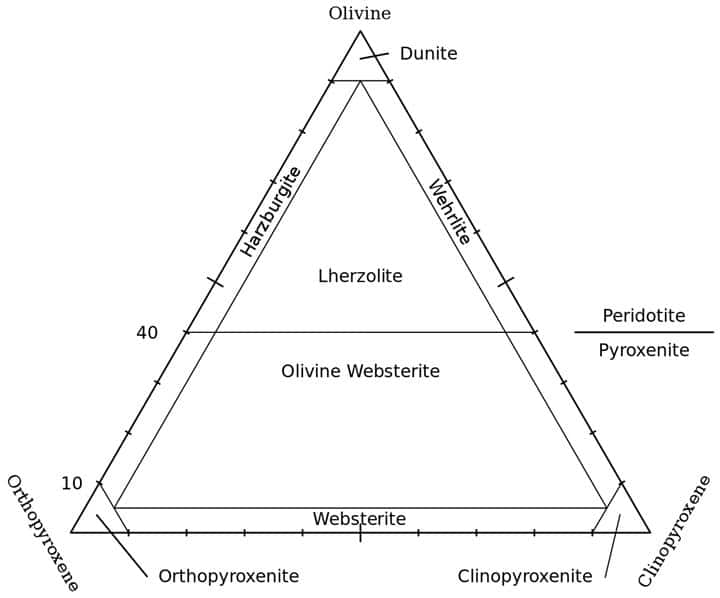
This rock is an olivine-rich endmember of the mantle-derived peridotite rocks. Other peridoties are kimberlite and pyroxene, hornblende or pyroxene-hornblende peridotites. Pyroxene peridotites are further divided into harzburgite, wehrlite and lherzolite.
Where did it get its name? Dunite was named after its type locality, Mount Dun, in New Zealand by Ferdinand von Hochstetter, an Austrian geologist, in 1859. The word Dun describes the tan, reddish-brown, or brown color formed from the oxidation of iron in olivine found in ultramafic rocks at this ophiolite mountain.
Usually, dunite occurs as part of layered continental intrusion and ophiolites. These dunitic bodies can be less than a meter to tens or hundreds of kilometers.
For instance, Näränkävaara intrusion in Finland has an area of about 5×30 km2 with dunite 1.5-2 km thick. Others like Stillwater, Muskox, and Great Dyke are also massive. Surprisingly, all these large intrusions are of the Proterozoic age.
This post is about dunite rock. It will discuss what it is, its properties, chemical and mineral composition. Also, it will cover where dunite occurs, how it forms, and some of its uses.

Olivine-rich (> 90%) olive green dunite rock sample. Photo credit: Pikarl at de.Wikipedia, CC BY-SA 3.0, via Wikimedia Commons.

Quick Overview
- Rock name: Dunite
- Pronunciation: /ˈduːnaɪt/ or /ˈdʌnaɪt/
- Other names: olivinite (not the same as the mineral olivenite) or hortonolitite
- Rock type: Igneous
- Rock Origin: Intrusive or plutonic
- Subcategory: Olivine-rich peridotite endmember
- Color: Fresh dunite is olive green to straw-green
- Texture/grain size: Phaneritic or coarse-grained
- Mohs hardness: 6.5-7 (1)
- Specific gravity (density): 3 (3g/cm3)
- Chemical composition: Ultramafic (has less than 45% silica, is rich in magnesium and iron, and low in aluminum, sodium, and potassium)
- Mineral composition: > 90% olivine (Mg, Fe)2SiO4), often with small quantities of chromite, pyroxene, pyrope, magnetite, etc.
- Tectonic environment: Upper Earth’s mantle and obduction zones
What is dunite?
Usually, dunite is mostly an olive-green, light green to dark green rock, which, according to Haldar & Tisľjar (2014), has a pearly to greasy look and a typical magnesium-to-iron ratio of 9:1.
However, when oxidized, it will turn to tan or reddish brown, i.e., dun color. Also, those near or exposed to the surface will undergo retrograde metamorphism or alteration, forming serpentinite and soapstone.
Dunite composition
Here is the chemical and mineral composition of dunite rock:
1. Chemical composition
Dunite is a basic, ultramafic rock that is poor in silica (< 45 wt. %) and high in magnesium with considerable iron. This rock is low in felsic elements like sodium, potassium, and aluminum. Also, it is low in calcium.
Typical data from Le Maitre (1976) shows that the wt. % chemical composition of dunite is SiO2: 41.04%, TiO2: 0.10%, Al2O3: 1.95%, Fe2O3: 3.85%, FeO: 10.05%, MnO: 0.13 %, MgO: 40.66%, CaO: 1.08%, Na2O: 0.21%, K2O: 0.09%, and P2O5: 0.21%.
Observing this data, it is indeed true that dunite is a silica-poor, magnesium-rich ultramafic rock with considerable iron and low in alkalis (sodium and potassium oxides), aluminum, and calcium oxide.
2. Mineral composition
Mineralogically, dunite has over 90% magnesium-rich olivine (Mg, Fe)2SiO4 by volume. Also, it may have smaller amounts of chromite, spinel, pyroxene (orthopyroxenes and clinopyroxenes), and pyrope, a garnet.
Sometimes, dunitic rocks may have magnetite, hornblende, picotite, ilmenite, and pyrrhotite. However, it doesn’t usually have feldspars (plagioclase or orthoclase).
Also, this rock may have platinum, magnesium, nickel, or copper ores.

On a thin section, dunite will reveal an abundance of high birefringence pale-green grains of olivine. These minerals have a slightly lower relief, lack cleavage, and interlock at three 120-degree junctions.
Also, the thin section may reveal a few smaller, nearly opaque brownish-black chromite and deep brown spinel grains.
How does dunite form?
Dunite is nearly pure magnesium-rich olivine with a considerably high melting point, about 1800°C, rarely achieved in the lithosphere. Also, this rock is relatively high in density.
Geologists believe that ultramafic rocks comprise a significant portion of the upper Earth’s mantle. Ophiolite composition and dunitic xenoliths in basaltic and kimberlitic intrusion are evidence.
Also, basaltic magma intrusions with differentiated layers such as dunite, pyroxenite, and anorthosite are evidence of magma modification. Some may have only olivine, pyroxene, and plagioclase in basaltic intrusion. No magma of a single mineral (monomineralic) is known to occur.
Possible ways in which dunite forms include cumulates via fractional melting and extraction or progressive olivine enrichment.
Let us look at how each of these ways may form dunitic rocks.
1. Dunite cumulates
Dunite can form when denser olivine crystals sink to the bottom of large picrobasaltic (picritic) or basaltic chambers. Picrobasaltic magmas are magnesium-rich olivine basaltic magmas containing very high amounts of olivine.
Once olivine sinks and accumulates at the bottom of magma chambers, it will form a base layer. Other layers can form on top of it, including layers of other peridotites. Any melt trapped in interstitial spaces may cool and crystallize under equilibrium conditions so long as no further fractional crystallization occurs within the tiny pockets.
Lastly, dunites formed from an accumulation of olivine will have thick layers in layered intrusions. Also, they often exist with other ultramafic cumulates, especially layers of harzburgite, wehrlite, olivine pyroxenite, or chromitite.
2. Fractional melting and extraction
Dunites, harzburgite, and some peridotites that occur in lowermost sections of ophiolites and massifs of alpine peridotite may be refractory (not meltable) residuum of basaltic magma generation in the upper mantle.
These highly depleted peridotites are crystalline remains or residues after fractional or partial melting and extraction of basaltic magma with a lower melting point. The differential cooling, crystallization, and solidification will form layered rocks arranged with peridotite or ultramafic rocks. These layers form according to melting temperatures.
Evidence supporting this hypothesis is the existence of dunites and other ultramafic rocks, xenoliths, or nodules in basaltic rocks. Magmas with these heavier xenoliths rose fast to keep them suspended, giving little time for fractionation.
3. Progressive olivine enrichment
Dunites most likely form in the mantle by progressive olivine enrichment. It happens when percolating silicate melts interact with lherzolite or harzburgite, dissolving orthopyroxenes present. This leaves behind a residue that will progressively be enriched by olivine.
Where does dunite occur?
Dunite and other peridotite rocks form a major constituent of the upper mantle at depths above 400km (250 miles)
On and inside the Earth’s crust, dunite occurs in 1) ultramafic ophiolites and alpine peridotites massifs sequences resulting from island arc or continental collisions or 2) layered continental igneous intrusion of any age, including dikes, sills, lenses, or pipes.
Usually, this rock is associated with harzburgite and subordinated by layered pyroxenite, lherzolite, wehrlite, and other peridotites, or sometimes gabbro.
Some places in the United States with dunite rocks include Twin Sisters Mountain in Washington, Chugach Mountains in Alaska, Triassic Palisades Sill in New York, and Stillwater igneous complex in Montana.
Elsewhere, it occurs in Dun Mountain in New Zealand, Näränkävaara intrusion in Finland, Bushveld Igneous Complex in South Africa, Troodos mountains in Cyprus, Dongwanzi ophiolite in China, and Muskox intrusion in Canada.
More places are Gusdal Olivine Pit Åheim in Norway, Frostviken, Jämtland in Sweden, Eocene Skaergaard complex in Greenland, Great Dyke in Zimbabwe, and Ultramafic complex near Tulameen community in British Colombia, Canada.
What is dunite used for?
Dunite has many uses, including magnesium oxide source used in flux in metallurgical blast furnaces, architecture or construction, making statues or carvings, as fertilizers, and possibly use in carbon dioxide sequestration.
Here is more detail on these and many other uses.
- Finely ground dunite may work as a carbon dioxide sequestration agent. i.e., react with atmospheric carbon dioxide. This use has the potential to mitigate global climate change. The respective equation for sequestration is Mg2SiO4 (olivine) + 2CO2 = 2MgCO3 (magnesite) + SiO2 (silica), and the resultant silica and magnesite can be sold.
- This rock is a source of magnesium oxide used as a flux in metallurgical blast furnaces, foundry or refractory, filler, or filtering media.
- Dunite cumulates often have a chromitite or chrome spinel layer (reef) with a host of valuable minerals like platinum, chromium, nickel, and copper ores which are of great economic value. Also, some may have garnets. However, it is unknown why chromitite has little olivine, though they often crystallize early in basaltic magmas.
- A study shows it may work as a fertilizer that promotes plant growth. Also, its use will correct soil pH or acidity.
- Dunitic rocks may have some uses in architecture and construction, including making roads and as a dimensional stone or aggregate.
- These rocks can also make ornamental items like statues, curving, bowls, vases, etc.
- One lab study concluded that dunite subproducts and mining waste could help stabilize polluted soils.
References
- Blatt, H., Tracy, R. J., & Owens, B. E. (2006). Petrology: Igneous, sedimentary, and metamorphic (3rd ed.). W.H. Freeman and Company.
- Winter, J. D. (2014). Principles of igneous and Metamorphic Petrology. Pearson Education.
- Haldar, S. K., & Tisľjar, J. (2014a). Introduction to Minerology and petrology (1st ed.). Elsevier.
- Le Maitre, R. W. (1976). The chemical variability of some common igneous rocks. Journal of Petrology, 17(4), 589–598. https://doi.org/10.1093/petrology/17.4.589
- Best, M. G. (2013). Igneous and metamorphic petrology (2nd ed.). Blackwell Publishers.
- Dunite. (2023, March 11). In Wikipedia. https://en.wikipedia.org/w/index.php?title=Dunite&oldid=1143947330
- Kubo, K. (2002). Dunite formation processes in highly depleted peridotite: Case study of the IWANAIDAKE peridotite, Hokkaido, Japan. Journal of Petrology, 43(3), 423–448. https://doi.org/10.1093/petrology/43.3.423
Soo helpfull
At which temperature does “true” dunite crystallize from magma ?