
Trachyte is fine-grained, usually light-colored volcanic or extrusive igneous rock. It has an intermediate composition with its essential alkali feldspar, lesser plagioclase, and minor mafic minerals. Also, it may have none to a small amount of quartz.
The common minor mafic minerals in this are biotite, pyroxenes, amphiboles, and sometimes olivine.
The name trachyte comes from the Greek word trachys, which means rough. It describes the rough nature of a broken trachyte surface caused by minute, irregular vesicles.
Here is a detailed discussion on trachyte. It will describe what the rock looks like and its chemical and mineral composition. Also, there are parts on how it forms, where it is found, uses, etc.
_3.jpg)
Quick overview and properties
- Name: Trachyte (not the same as tachylite or tachylyte)
- Rock type: Igneous
- Origin: Extrusive
- Texture: Fine-grained, often porphyritic and trachytic, less often pumiceous or glassy
- Colors: Gray, pinkish, reddish, and sometimes greenish, bluish or darker
- Chemical composition: Intermediate to felsic
- Silica content (SiO2): 57- 69 wt. %
- Mohs hardness: ~ 6
- Intrusive equivalent: Syenite
- Tectonic settings: Volcanic arcs, continental rift zones, hotspots, and bark arc basins
What does trachyte look like?
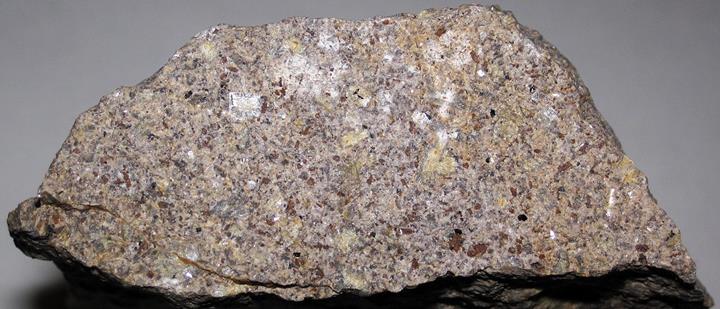
Trachyte is usually light-colored with typical colors gray, pinkish, and reddish, with some specimens greenish, bluish, or dark gray. It appears more like rhyolite, as Bonewitz (2012) notes. However, glassy varieties tend to be darker – dark gray to black.
Besides color, a trachyte hand specimen will have a fine-grained or aphanitic texture, with many being porphyritic. Its newly broken surface will appear rough due to tiny or microscopic vesicles. Also, it may be banded or streaky.
Furthermore, the trachytic texture type is common in this rock. Other specimens may be orthophyric, pumiceous (vesicular), or glassy. However, they are less common.
Let us now discuss these textures a bit more.
1. Trachyte porphyry
A porphyritic variety will have larger crystals (phenocrysts) set in a fine-grained holocrystalline or sometimes hypocrystalline (partially glassy) groundmass.
Usually, porphyritic trachyte will have phenocrysts of sanidine, plagioclase, and less of pyroxenes, biotite, and amphibole in a groundmass of these same minerals.
Sanidine phenocrysts are well-formed, elongated, or tubular, sometimes as large as 1-2 inches, though most are smaller. Also, plagioclase forms tubular phenocrysts.
On the other hand, mafic phenocrysts are less conspicuous.

,_Pleistocene,_700_ka_to_1.4_Ma;_northern_end_of_Lake_Magadi,_Kenya_Rift_segment_of_the_East_African_Rift_Valley).jpg)
2. Trachytic texture
The trachytic texture is another distinctive texture this rock shows, characterized by strongly aligned subparallel sanidine microlite laths. These microlites swirl or bend around phenocrysts, notes Gill (2010).
According to Blatt & Tracy (2006), these elongated narrow or rod-shaped alkali feldspar microlites aligned to a common direction infer magma flow during crystallization. Also, they may indicate compaction.
3. Orthophyric texture
Some trachytes may have orthophyric texture, characterized by alkali feldspar or sanidine forming microlites with quadratic or short, stubby rectangular or squarish prisms.
4. Glassy and pumiceous trachyte
Rapid quenching of trachytic magma will form a trachytic obsidian, a rare glassy rock known in Iceland. Another common example is Pu’u Wa’awa’a trachytic glass deposits in the Big Island of Hawai’i, USA.
Unlike others, trachytic obsidian will have little to no crystallites or minute crystals. Also, it is often darker in color.
On the other hand, explosive eruption of volatile-rich trachytic magma will form pumiceous trachyte. It occurs in Tenerife (Canary Islands) and other places.
Trachyte composition
Let us now look at the chemical and mineral composition of trachyte.
1. Chemical composition
Trachyte is an intermediate to felsic or acidic rock. It is high in alkali oxides with Na2O + K2O > 7 and low in iron and magnesium.
Data from Le Maitre (1976) from 534 samples has an average weight % of chemical composition to be SiO2: 62.31%, TiO2: 0.71%. Al2O3: 17.27%, Fe2O3: 3.04%, FeO: 2.33%, MnO: 0.15%, MgO: 0.94 %, CaO: 2.38%, Na2O: 5.57%, K2O: 5.07% and P2O5: 0.21%.
2. Mineral composition
Trachyte rock has mostly alkali feldspar and lesser sodic plagioclase minerals. Also, it may have no or minor quartz and minor mafic minerals, especially augite, biotite, hornblende, and sometimes olivine.
Accessory minerals in this rock include magnetite, ilmenite, apatite, zircon, and sphene or titanite.
Plagioclase, the most abundant felsic mineral, is usually sanidine, sometimes orthoclase or anorthoclase. Sanidine occurs as tubular alkali phenocrysts to microlites in the groundmass. Also, it may show Carlsbad twinning, chemical zoning, and perthitic (cryptoperthitic) texture.
The other lesser felsic mineral is sodic plagioclase. It is usually oligoclase or a more sodic variety. Also, it varies in size from phenocrysts to microlites. However, labradorite may occur in some Italian trachyte varieties.
Depending on silica saturation, trachyte may have felsic minerals like quartz, tridymite, or cristobalite if silica is saturated. In older samples, quartz may recrystallize from tridymite.
In contrast, silica-undersaturated trachytic rocks will be foid-bearing. Such rocks will have foids like nepheline, sodalite, leucite, etc.
On the other hand, augite is the most common mafic mineral. Also, this rock will commonly have biotite and hornblende. The other mafic minerals present depend on the varieties or type.
For instance, peralkaline trachyte will have sodic amphiboles like riebeckite, arfvedsonite and eckermannite. Also, these rocks may have sodic pyroxenes like diopsidic augite or aegirine.
The less common mafic minerals in trachytic rocks include amphiboles like katophorite, oxyhornblende, and kaersutite. Also, these rocks may have pyroxenes like diopside (monoclinic) and bronzite or hypersthene (rhombic)
Lastly, olivine, including iron-rich olivine, is rare. However, trachytic samples from Arso in Ischia, Italy, have olivine.
1. Trachytoids and trachyte on QAPF diagram
Trachytoids or trachytic refers to a collection of rocks sharing the trachyte base name. These rocks may have up to 10% foids and 20% quartz of QAPF volume, with alkali feldspar accounting for over 65% of feldspars.
However, in a strict sense, trachyte is a volcanic rock in which alkali feldspar accounts for 65-90% of total feldspar and quartz 0-5% of the QAPF composition by volume. It has no foids.
Increasing foids to up to 10% in trachyte grades this rock into foid-bearing trachyte, while those with 5-20% quartz are quartz trachyte.
On the other hand, an increase in alkali feldspar to over 90% grades trachyte into alkali feldspar trachyte. This rock can be foid-bearing if it has foids up to 10% or quartz alkali feldspar trachyte if quartz is 5-20%.

2. TAS diagram
The aphanitic texture of trachyte makes it impractical to classify this rock using QAPF, the preferred IUGS approach. In such a case, a TAS (Total Silica Alkali) classification is the way to go.
Based on the TAS diagram, trachyte is a volcanic rock with 57-69 wt. % SiO2 and K2O + Na2O > 7%. It occupies the same spot as trachydacite. But trachydacite has > 20% normative quartz, while trachyte has less than 20%.

Varieties and related rocks
Based on the alumina saturation index (ASI), you have metaluminous and peralkaline trachytes. Other related rocks we will look at are kenyte and rhomb porphyry.
1. Peralkaline
Peralkaline trachyte is alumina deficient relative to sodium and potassium oxides, with an ASI index of less than 1. Such rocks will have sodium pyroxenes and amphiboles as mafic minerals and their peralkaline index (Na + K)/Al greater than 1.
2. Metaluminous
Metaluminous trachyte is also aluminum undersaturated. However, it has more aluminum oxide than alkali oxides (Na2O + K2O). Such a rock will have minor phenocrysts of calcic pyroxene, hornblende, iron-rich olivine, and Fe-Ti oxides, notes Frost (2014).
3. Kenyte
Kenyte is a porphyritic trachyte or phonolite variety. It has rhomb-shaped anorthoclase, with or without variable amounts of augite and olivine phenocrysts set in a glassy groundmass. The glassy matrix may be devitrified.
4 Rhomb porphyry
Rhomb porphyry refers to volcanic rocks ranging from porphyritic latite to trachyte. It has rhombus-shaped ternary feldspar phenocrysts, usually, anorthoclase set very fine reddish-brown matrix.
How is trachyte formed?
Trachyte rocks form by fast cooling of highly evolved, silica-rich magma, high in alkali metal near or on the Earth’s surface. The rapid cooling favors the formation of fine grains, i.e., impedes the growth of large grains.
Magma origin is from fractionating slightly alkaline basaltic magmas, i.e., transitional between tholeiitic and alkali magma. A typical fractionation sequence is alkali basalt → trachyandesite → trachyte or phonolite.
These slightly alkaline magmas may be from subcrustal rock’s partial melting or mantle-derived basaltic magmas.
Fractionation removes much iron and calcium, leaving a silica-enriched magma with a composition of predominantly alkali feldspar. This final magma can be slightly silica-saturated or undersaturated.
How does this rock eruption?
Trachyte can erupt effusively or explosively. Effusive eruptions will form blocky flows flow, plugs, or domes (e.g., on the island of Tenerife).
On the other hand, explosive eruptions like the Vulcanian and Plinian will result in pyroclastic rock deposits. Also, it can result in pyroclastic flow and surges, which can be hazardous.
Lastly, the eruption of volatile-rich magma will form pumiceous trachytic rocks.
Where is trachyte found?
Trachyte rocks may occur as lava flows, in shallow dikes, or as pyroclastic deposits, including tuff.
Its tectonic settings, age, and specific location are as follows.
1. Tectonic settings
Trachytic rock occurs in continental rifts, volcanic arcs, hotspots, and bark arc extensions. Also, it can occur anywhere where alkali basaltic magma fractionates.
Some continental rifts with this rock include East Africa Rift Valley, Gardar, Rio Grande, etc. Here it usually occurs with alkali basalt, phonolite, and carbonatite (less common) and sometimes with plutonic equivalents like syenite and nepheline syenite.
Volcanic arcs with trachytic rocks include Aeolian, Aegean, and Campanian arcs. For instance, Vulcano in Aeolian Island, Italy, has Palizzi and Punta del Roveto trachytic lava flow.
Lastly, in hotspots, it is common in oceanic islands associated with oceanic island basalts, OIBs.
2. Age
Age-wise, most of the trachyte rocks are of the Cenozoic age. However, older ones, known as orthoclase-porphyry or orthophyre, occur. They include Permian to Carboniferous and, less often, Archean.
Most Archean trachytic rocks are rift-related and occur around continental shield perimeters.
3. Places it is found
In the US, trachytic rocks occur in Texas (Davis and Chisos Mountains and around Big Bend), the Black Hills in Dakota, and southern Nevada.
In Europe, they occur in Skye, Central Valley Scotland, Exeter in the UK, and Rhine, Eifel, Saar, and Thuringia in Germany. Also, these rocks occur in Auvergne, France, and Bohemica, Czech Republic.
The other place these rocks are found in Europe is at Euganean Hills, Naples, the Islands of Ischia, and Pantelleria in Italy.
Elsewhere, trachytic rocks are found in Iceland (Azores, Tenerife, and Ascension), East Africa, Yemen, Madagascar, Australia (Cambewarra and Main ranges), and Ulleung Island (south Korea).
Also, it occurs in Society Hotspot, Mount Murphy (Antarctic), and Erta Ale Volcanic Range (Ethiopia).
Lastly, besides Earth, trachytes also occur on Mars at Gale Crater.
Frequently Asked Questions (FAQs)
Trachyte uses are in building and making dimensional stones for paving, facing, curbing, or foyers. For instance, the cathedral in Morelia, Mexico, was made using pink trachyte.
Also, it was historically used as a decorative dimensional stone in many Roman Empire and Venice Republic structures and buildings.
Although they occur on the same spot on the TAS (Total Alkali-Silica) diagram, trachyte has less than 20 wt % normative quartz and trachydacite more than 20%.
References
- Blatt, H., Tracy, R. J., & Owens, B. E. (2006). Petrology: Igneous, sedimentary, and metamorphic (3rd ed.). W.H. Freeman and Company.
- Winter, J. D. (2014). Principles of igneous and Metamorphic Petrology. Pearson Education.
- Frost, B. R. (2014). Essentials of igneous and metamorphic petrology. Cambridge University Press.
- Gill, R. (2010). Igneous rocks and processes: A practical guide (1st ed.). Wiley-Blackwell.
- Best, M. G. (2013). Igneous and metamorphic petrology (2nd ed.). Blackwell Publishers.
- Le Maitre, R. W. (Ed.) (2002). Igneous rocks: A classification and glossary of terms (2nd ed.). Cambridge University Press
- Bonewitz, R. (2012). Rocks and minerals (1st ed.). DK Pub.
- Le Maitre, R. W. (1976). The chemical variability of some common igneous rocks. Journal of Petrology, 17(4), 589–598. https://doi.org/10.1093/petrology/17.4.589