
Kimberlite is a potassic to ultrapotassic ultramafic rock with inequigranular texture. It is a rare type of peridotite with many xenoliths and xenocrysts, including, on rare occasions, diamonds. For this reason, some authors refer to it as a complex hybrid rock.
This rock was named after Kimberly in South Africa, where in 1887, Henry Carvill Lewis, an American geologist, described and applied the name kimberlite. What he described was a brecciated, serpentinized phlogopite-bearing kimberlite specimen from Kimberley, South Africa.
However, Lardner Vanuxem, another American Geologist, had earlier described a kimberlite rock from Ludlowville, near Ithaca, New York, USA. However, he didn’t use the name.
Kindly note that the origin of the name is not Kimberleys, Western Australia, which was named after a British colonial secretary. This place coincidentally had diamonds in the 1970s, a possible reason for confusion.
As you will notice while researching, Kimberlites have been exhaustively and extensively studied, including diamonds and xenoliths they host. One reason is that they are diamondiferous rocks. Also, it could be because they reveal much about the mantle since they have most mantle-derived xenoliths. Therefore, information about these rocks is plentiful.
Today, we will discuss kimberlite rock. We will start with its appearance or identification and include chemical and mineral composition.
Afterward, we will look at the types, how kimberlite forms (facies, kimberlite pipes, dikes, and sills), and where it forms. Also, there is a part of kimberlite & diamonds, significance, and much more.

_2.jpg)
Quick facts and properties
- Name: Kimberlite
- Rock type: Igneous
- Origin: Plutonic or intrusive
- Subcategory: Peridotite
- Associated rocks: Eclogites and carbonatites
- Texture: Inequigranular or porphyritic, rarely poikilitic.
- Color: Slate blue, blue-green, dark-gray, or black if unaltered, yellowish when weathered and oxidized.
- Chemical composition: Ultramafic or ultrabasic
- Mohs hardness scale: 6-7
- Density: 2700-2900 kg/m3.
- Magma viscosity: Low, 10-2 – 102 Pa s
- Magnetism: It is weakly magnetic
- Tectonic environment: Continental intraplate
- Age: Varies, Precambrian to Cretaceous (2.5Ga to 60-100 Ma)
How to identify kimberlite
Color, texture, and brecciation are key to identifying this rock in the field. However, a chemical analysis and thin section are necessary to know if it is diamondiferous.
Usually, kimberlite is potassic to ultrapotassic ultrabasic rock with inequigranular texture. It has large angular to rounded macrocrysts (0.5-10mm) and megacrysts (1-20cm) set in a fine-grained or sometimes medium-grained groundmass. However, unlike true volcanoclastic rocks, kimberlite’s groundmass or matrix is never glassy.
Secondly, kimberlite may occur as a massive rock if in sills or dikes or brecciated if in pipes. However, it is most likely the specimen you find will be the brecciated type unless it is from a sill or dike. So, expect a lithified rock with angular to subangular fragments.
Thirdly, non-altered kimberlite will be slate-blue, dark-blue green, greenish, and dark gray to black. Miners call the unaltered kimberlite blue ground due to the bluish color. In contrast, decomposed, weathered, and oxidized specimens will be yellowish due to magnetite to limonite oxidation, often known as yellow ground.
Furthermore, you can also test its magnetism. Since it has some magnetite, kimberlites will be weakly magnetic. For altered ones, heating it should make limonite magnetic.
Lastly, if you want to be certain that the rock is kimberlite and whether it is diamond-bearing, send the sample for a thin section and geochemical analysis. Many companies in Europe, the US, the Middle East, Asia, etc., can do these tests for you. Also, some universities do them in-house. For these tests, expect to meet a cost of US$ 200 to US$ 400.
Kimberlites and xenocrysts/xenoliths
Before we go to chemical and mineral composition, we need to talk about xenocrysts and xenoliths, as they are plentiful in these rocks.
Usually, kimberlitic rocks have megacrysts or macrocrysts, which can be phenocrysts (phase crystals) or xenocrysts (not derived from magma). Also, these rocks have xenoliths (country rock fragments).
These xenoliths and xenocrysts may be round or subangular. Some may have broken edges. Usually, they originate from the mantle (websterite, lherzolite, eclogite, or harzburgite) and lower cratonic (granulite and gneiss).
Lastly, some xenoliths may come from lower, still buried, or crustal rock at the preservation level or past eroded formations. Also, some crustal xenoliths may be from granite, gabbro, diorite, shale, etc.
Kimberlite rock composition
Let us now look at the chemical and mineral composition of kimberlite. We will also discuss group I and group II composition.
1. Kimberlite chemical composition
Kimberlite is a potassic to ultrapotassic magnesium oxide-rich (15-27 wt. % MgO), silica-poor (20-36 wt.% SiO2) ultramafic rock. This rare rock is rich in volatiles, incompatible elements, and rare Earth elements (REE) and has considerable iron and calcium oxides. However, it is low in aluminum oxide relative to alkali oxides.
Potassic rock has a molar or weight of K2O > Na2O. Those that are ultrapotassic have a K2O to Na2O ratio of more than 3.
Also, sometimes kimberlite is described as a ‘complex hybrid’ rock. It is a complex hybrid rock because it is impossible to know the amount of cumulates and xenoliths disaggregated and integrated that weren’t part of the original melt.
Put differently, you cannot determine the constituent components of the original melt and what has been incorporated as it moved to the surface.
Also, unlike other ultramafic rocks that crystallize from relatively dry magma, the high volatile content makes it hard to know the original magma composition.
However, we can have a rough estimate. Using data from Nixon, P.H. (1980) of kimberlites from Lesotho, South Africa, Yakutian (Russia), India, and Rile Co. USA, here are typical kimberlite weight percentage composition ranges.
| Mineral | % weight composition range |
|---|---|
| SiO2 | 24.15-36.09 |
| MgO | 22.78-27.9 |
| Fe2O3 | 4.77-10.5 |
| FeO | 1.85-10.5 |
| CaO | 3.50-15.87 |
| Al2O3 | 2.03-4.9 |
| TiO2 | 1.50-5.10 |
| H2O+(oxoniumyl) | 5.9-13.05 |
| CO2 | 0.72-12.04 |
| P2O5 | 0.65-2.31 |
| K2O | 0.30-2.1 |
| N2O | 0.19-0.32 |
| MnO | 0.10-0.1 |
Also, samples from Lesotho had 2.66% H2O.
Besides the above chemical composition, kimberlites have compatible trace elements like nickel, zinc, scandium, vanadium, chromium, cobalt, and copper, which show that magma originates from the mantle.
Also, these rocks have incompatible elements like barium, hafnium, tantalum, uranium, zirconium, niobium, thorium, and rare earth elements (REE). However, amounts may depend on the group or type.
Lastly, note that significant component composition may vary due to contamination, differentiation, fractionation, or coalescence of different melts. Also, fractionation may concentrate macrocrysts and phenocrysts, resulting in evolved carbon-rich residual rock.
2. Mineral composition
Blatt et al. (2006) note that it is difficult to know which mineral formed from kimberlite magma and which came as xenolith or xenocrysts. Some kimberlitic intrusions have >75% xenoliths, and much comminution and granulation occur. Thus, their mineralogy will vary greatly.
Usually, unaltered kimberlites will have mainly macrocrysts to megacrysts of olivine (anhedral to rounded) or phlogopite macrocrysts, depending on the type. Also, they may have megacrysts or macrocrysts of diopside, garnet, magnesium-ilmenite, magnesium chromite, etc.
These minerals are set in finer-grained (fine to medium-size grains) groundmass of olivine, phlogopite, spinel, apatite, rutile, perovskite, and primary carbonates.
Unlike most igneous rocks, kimberlite rock doesn’t have plagioclase. Instead, it has spinel or garnet and leucite, melilite, or nepheline.
However, the above is a generalization since kimberlites fall into two broad groups, i.e., groups I and II. The two types show isotopic differences, meaning their origin varies. Also, they have varying mineral compositions.
In the case of alteration, calcite or serpentine stores volatiles when olivine and orthopyroxenes are altered. Other alteration and weathering products are tremolite, zeolites, vermiculite, limonite, chlorite, etc.
Let us now look at the two groups or types of kimberlitic rocks.
i. Group I kimberlites
Group I or archetypal kimberlites are potassic, ultramafic rocks with CO2 as the predominant volatile. Also, they have macrocrysts with some megacrysts, including xenocrysts, and represent the diamond-bearing diatremes first described in Kimberly, South Africa.
Anhedral olivine is the dominant mineral in the group I kimberlites (except if fractionated). Also, these rocks may have pyrope, magnesium-ilmenite, phlogopite, enstatite (green in color), titanium-poor chromite, and diopside (some subcalcic) in a groundmass.
A second-generation groundmass will have euhedral-to-subhedral olivine plus one or more other minerals. These minerals include monticellite, perovskite, spinel (magnesian ulvospinel-magnesium-chromite-ulvospinel-magnetite solid solutions), apatite, or serpentine.
What about accessory minerals? Some of the accessory minerals in these rocks are nickeliferous sulfides and rutile, while the late-stage groundmass will have poikilitic barium-phlogopite-kinoshitalite mica series.
However, some of the most evolved members are poor or lack macrocrysts. Also, they have second-generation olivine, serpentine, calcite, magnetite, and minor amounts of perovskite, apatite, and phlogopite.
In group I kimberlites, diuretic secondary minerals are serpentine and calcite, replacing some monticellite, apatite, olivine, and phlogopite that formed earlier.
Some of the xenolithic macrocrysts in these rocks include forsterite, almandine-pyrope, chromium-diopside, chromium-pyrope, phlogopite, and magnesium-diopside. In rare cases, diamonds may be present.
These xenoliths are from disaggregation of the mantle eclogite, metasomatized peridotite, lherzolite, and harzburgite, which are the sources of some xenolithic macrocrysts.
Lastly, magnesium-ilmenite, olivine, enstatite, titanium-pyrope, and relatively chromium-poor enstatite form megacrysts whose origin is unknown.
ii. Group II (micaceous, lamprophyritc) kimberlites or orangeites
Group II kimberlites are ultrapotassic (K/Na >3), peralkaline volatile-rich rocks with water as the dominant volatile. Their age is Cretaceous to early Jurassic. However, some are older than group I types but occur only at Orange Free State of South Africa’s Archean Kaapvaal craton.
Group II kimberlites have phlogopite macrocrysts and microphenocrysts as the dominant mineral and lesser quantities of rounded olivine macrocrysts in a tetraferriphlogopite to phlogopite groundmass. However, unlike group I, they lack monticellite.
Usually, the primary minerals in group II kimberlite groundmass are diopside (zone to mantled by titanian aegirine), spinel (magnesium-bearing chromite to titanium-bearing magnetite), REE-rich and strontium-rich perovskite and strontium-rich apatite.
More primary minerals in groundmass are REE-rich phosphate (daqingshanite and monzanite), potassium-barium titanate to the hollandite group, niobium-bearing rutile, and manganese-bearing ilmenite. These minerals occur in a mesostasis with ancylite, dolomite, calcite, and REE carbonates.
Late-stage groundmass has zirconium silicate (zircon, wadeite, calcium-zirconium silicate, and kimzeyitic garnet).
Lastly, evolved members have potassium richterite and sanidine, while barite is the diuretic secondary mineral.
Kimberlite and diamonds
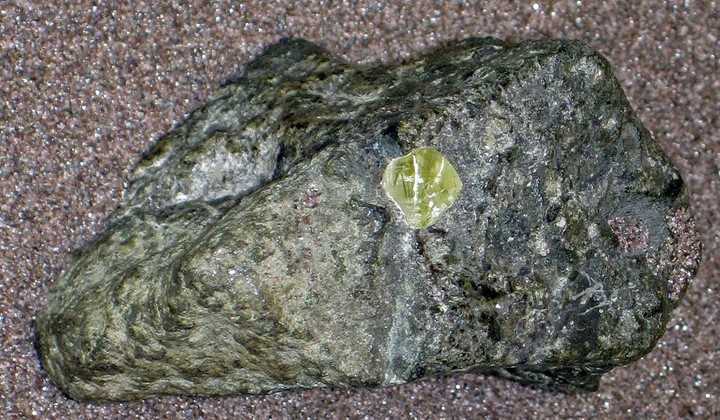
Kimberlite is the principal diamond-hosting (diamondiferous) rock. Diamonds occur both in weathered sediments and unaltered rock. However, lamproites are also diamondiferous.
Furthermore, in extremely rare cases, graphite pseudomorphs after diamonds or diamonds may occur in alkali basalts, alpine peridotites lamprophyres, or ultra-high pressure metamorphic crustal rock terranes, notes Winter (2014).
.jpg)
Contrary to what most assume, diamonds are macro to megacrysts xenoliths (inclusions) in kimberlites. Isotopic evidence from Sr-Nd and U-Pb dating shows they are older than kimberlite. Therefore, they don’t form from kimberlitic melt. Instead, these melts only pick up diamonds as they rise.
In kimberlitic rocks, diamonds are hosted by eclogite, garnet harzburgites, or garnet pyroxenite. These precious minerals rarely occur as isolated megacrysts in these rocks.
Where do they originate from? Diamond origin is in depths of at least 150 km or no less than 4.0GPa pressure. Otherwise, they would revert to graphite.
Furthermore, some inclusions in diamonds, such as peridotites, eclogitic, magnesium-perovskite, and ferropericlase, indicate diamonds formed at high pressure. Such pressure is available at great depths, some exceeding 670km.
Also, inclusions like low calcium pyrope garnet or ultra-high chromium chromite indicate reduced oxidation in forming environments.
However, since diamonds in kimberlites resemble those found in meteorites, their origin is possibly primordial.
Where do they occur? Usually, diamond-bearing kimberlites are mainly on the Archean cratons and Proterozoic mobile belts on the craton’s margin. However, most of the Proterozoic mobile belts are barren except in the Archean craton in South Africa.
Going to specific locations, diamond-bearing kimberlites occur in Arkansas, Wyoming, and Colorado in the US, South Africa, Russia, DRC Congo, Brazil, China, Botswana, Canada, Zimbabwe, Angola, and Australia.
Usually, diamonds are present in kimberlite in meager amounts. Typical grade-tonnage is 0.25-5.7 carat per ton (0.05-1.14g/ton) of rock. Also, only a small amount of these rocks bear diamonds (less than 1%).
Lastly, diamond mining is mainly via opencast. However, deep mining is the alternative method where conditions prevent opencast mining.
Where do kimberlites form?
Kimberlite occurs mainly on the thick, ancient, or Archean continental stable cratons without significant deformation since Precambrian. But they may form on younger Proterozoic in accreted terrains. However, there are no known occurrences in oceanic belts. Perhaps they exist but are concealed.
These rocks form when melt injection occurs along zones of broad or elongated weakness due to epeirogenic movements that go to basement terrains.
However, unlike most igneous rocks, kimberlitic rocks don’t have an apparent association with subduction zones, hotspots, continental rifts, or transform fault extensions. Also, these intrusions are more anorogenic (unrelated to mountain building).
Where do they form? Kimberlites form in diatremes or pipes, dykes, and sills with plugs known. Let us look at facies and each of these places they form.
1. Facies
Kimberlitic rocks have three main facies, i.e., craters, diatremes, and hypabyssal (dikes and sills).
Hypabyssal facies kimberlites have massive, unaltered green, dark gray to black blocks with macrocryst texture. Their intrusion is non-explosive and may be associated with domes or swell structures.
On the other hand, diatreme facies will have angular to rounded clasts, lapilli, and fragments of altered kimberlites (olivine and pyroxene have undergone partial to full serpentinization) and xenoliths. They represent the material that fell back into the pipe during the eruption.
What about crater facies? Crater facies will have brecciated kimberlite, including ash and xenoliths from country rock formed during the eruption and lake sediments. These sediments are often layered. Crater facies originate from reworked deposited kimberlite tuff and wall rock.
These facies confirm that kimberlitic eruption happened near the surface, among many ways, via phreatomagmatic upon meeting underground water.
2. Kimberlite pipes or diatremes
Kimberlite pipes are subterranean funnel or carrot-shaped, breccia-filled geological structures. Most are overlain by maars (shallow crater lakes), taper at 80-85°C downward, and go as deep as 300-400m above the surface. They then terminate at root zones with irregularly shaped intrusions that transition to hypabyssal facies.
These pipes form from explosive, near-surface eruptions. The rapidly rising and expanding gas-charged magma creates an upward flaring or conical explosion crater by tearing the surrounding country rock. The resulting fragmental materials fall back into the crater, and others fall around to form a tuff ring from pyroclasts.
Kimberlitic pipes hardly have lava flows except in Igwisi Hills, Tanzania. Igwisi is also the youngest kimberlite by at least 30 million years. It is a late Pleistocene-Holocene with an age of 11,200 to 11400 ± 4,800 to 7,800 on cosmogenic helium-3 and 0 ± 29 million years with U-Pb (poorly constrained).
Usually, kimberlite pipes are 50-500 m (a few meters to a few hundred hectares) on the surface and narrow downwards. However, their size depends on depth and magma quantities. Also, their surface plan varies, and their cross-section is circular to elliptical.
These pipes may occur alone or clustered along elongated areas. Some coalesce at depths; others may connect to one or more dikes or have dikes on their roots. Also, they can intrude on dykes as they flare upward.
Lastly, kimberlite eruption may have eroded hills or mountains over millions of years by near-surface processes. These rocks are relatively soft and susceptible to erosion. Erosion and weathering may form the lake, and overburden may conceal it. However, some are not eroded, like Nwadui in Tanzania and Orapa in Botswana.
2. Dikes
Dikes have non-fragmental kimberlites and a lenticular section and plan, including ring dykes like the one in Sierra Leone. They can be single or a swarm, some parallel, and form from a single or many melt injection phases.
These dikes are usually 1-3 meters thick but can occur over extensive lengths. Usually, most dikes pinch towards the surface and thicken with depths. However, some form pods or blows (lenticular enlargement near their top 10-20 times thicker and can be up to 100 meters long).
Lastly, some may be rootzones for diatremes.
3. Sills
Like dikes, sills have massive (non-fragmental) kimberlites and can be several hundred meters thick. However, they are uncommon, perhaps because they are only visible if erosion coincides with the injection level.
How is kimberlite formed?
Kimberlite magma forms from the partial melting mantle peridotites, especially carbon-bearing, hydrous lherzolite or other peridotites below cratons. This partial melting occurs when volatiles (CO2 and H2O) reduce mantle solidus temperature, generating kimberlitic melt.
Usually, the prevailing oxygen fugacity favors stable magnesite (MgCO3) and dolomite (CaMg(CO3)2) minerals to occur. However, these minerals will rapidly decompose as the magma rises.
Typical mantle rocks that melt are phlogopite-magnesite garnet lherzolite enriched with barium, titanium, and potassium. However, those deeper in the mantle have potassium-titanium richterite.
Let us look at kimberlitic magma origin and characteristics, emplacement, and an alternative theory that explains their formation.
1. Kimberlitic magma origin and characteristics
Kimberlite magma originates in the mantle or at depths of at least 150km. There is overwhelming evidence that supports these depths.
Firstly, xenoliths like diamonds and mantle peridotites like lherzolite and harzburgite originate from great depths and are only plucked during the ascend. Also, these magmas are enriched with these and other macro to megacrysts and xenoliths, which are not typical in the Earth’s crust.
Secondly, electron microbe analysis of Al2O3 content in orthopyroxene coexisting with garnet can further prove the depths.
Thirdly, kimberlitic magma lacks most silicic minerals and is high in orthopyroxene, which doesn’t occur in continental mantle lithosphere (CML). This also proves its deep origin.
Another peculiar thing about kimberlite melts is that they ascend quickly, preventing diamonds from reverting to graphite. Also, other unstable mantle minerals will dissolve if these melts move slowly.
Sparks et al. (2006) put kimberlitic magma speed at >4-20m/s, unlike other volcanic eruptions where magma moves much more slowly.
The entrained mantle xenoliths, milled crustal xenoliths, and kimberlite pipe geometries are evidence of this ascend.
Lastly, these melts are volatile-rich (CO2 and H2O) and have no glass matrix (common in rapidly quenched volcanic glasses).
2. Emplacement
Many theories explain kimberlitic magma emplacement. These theories include explosive volcanism, fluidization, hydrovolcanic, and embryonic pipe theory. We will not talk about them in detail.
However, the general idea is that gas-charged magma rapidly ascends through weakness or fissures in the continental crust. As it climbs, it will mill more xenoliths and megacrysts from surrounding rock.
Also, more carbon dioxide is exsolved from the melt during the ascend due to pressure drops. This, together with more crystallization, accelerates the magma speed by reducing buoyancy.
Some magma will cool inside the Earth’s crust, forming sills and dikes. However, some magma will move near the surface.
At the near surface, pressure drops and sudden gas release or interaction with water (hydrovolcanism) cause a volcanic explosion.
This explosion blasts a hole, i.e., pipe or diatreme, with resulting pyroclasts filling it. Also, it will throw some into the air, and no more magma will intrude into the diatreme.
Lastly, emplacement likely occurs at a lower temperature. Hence, the rocks formed are higher in carbonates than the original mush.
3. Alternative theory
Russell et al. (2012) proposed a slightly different model. It states that kimberlite forms from carbonatitic melts and has nearly isometric (~40 wt. %) carbon content. These carbonatite magmas have high CO2 and H2O solubility compared to silicic magmas.
Usually, CO2 and water give the melt buoyancy to ascend quickly. The fast-ascending magma will entrain xenoliths from the mantle, which disaggregate along the way. Also, it mills more xenoliths from the cratonic crust.
This carbonatitic melt favors orthopyroxene dissolution compared to other silicates. Orthopyroxene dissolution raises the silica amount, which will consequently cause more CO2 to exsolve, further lowering buoyancy. This process gives the melt even rapid ascent.
As more CO2 exsolves, the process causes acceleration, and the magma evolves to kimberlitic composition before emplacement.
Where is kimberlite found?
According to Mindat.org, an outreach project of the Hudson Institute of Mineralogy, there are over 6500 known kimberlite occurrences. However, only a few, i.e., about 900, are diamondiferous. Of the diamondiferous occurrences, less than 1% have commercially viable diamond deposits.
In the United States of America, Kimberlite occurs in Arizona, Arkansas, Colorado, Kansas, Michigan, Montana, New York, Pennsylvania, Tennessee, Utah, Virginia, Wisconsin, and Wyoming states.
Around the world, it occurs in many countries. Notable ones are Angola, Australia, Bolivia, South Africa, Botswana, Brazil, Canada, China, DR Congo, Eswatini, and Finland.
Other places are Greenland, India, Ireland, Israel, Ivory Coast, Lesotho, Namibia, Pakistan, Russia, Solomon Islands, Sweden, Tanzania, Ukraine, Venezuela, and Zimbabwe.
Kimberlite significance
Kimberlites are the main diamond hosting rocks, a highly valued precious gemstone. Also, they provide geologists and other scientists with more information on the subcontinental mantle.
For instance, studying xenoliths like diamonds (and their inclusion), lherzolite, and harzburgite can give a glimpse of the mantle composition or components.
Also, kimberlites give information about processes and conditions (temperature and pressure) deep in the Earth without drilling to such depths.
For instance, calcium oxide content in xenoliths with clinopyroxene coexisting with orthopyroxene can give an insight into ambient temperature just before their entrainment by rising magma. The CaO coexistence content of these two at different temperatures is experimentally known.
How do you identify kimberlite locations?
Kimberlites are rare rocks. Also, most of their diatremes or pipes are not readily visible since some are weathered and eroded, and others are hidden by subsequent overburden.
The primary way to identify kimberlite pipe location is by looking at kimberlite indicator minerals. These dense minerals are chrome diopside, pyrope garnet, and magnesium olivine ilmenite, which will hardily weather. Check for them in heavy mineral concentrates in streams, rivers, or glacial tills.
Also, colorful minerals like purple-red pyrope (mg-rich garnet) and green chromium-rich clinopyroxene common in type I kimberlites can serve as indicator minerals.
A recent study by Haggerty (2014) has a promising way to identify kimberlite pipes using Pandanus candelabrum, a palm-like plant known to grow only in these places. The preference for this plant may be due to the unique mineralogy of the soils on these pipes.
Once found, the geochemical study may reveal if the specific kimberlite has economically viable diamond deposits.
How do kimberlites and lamproites differ?
These two rocks show some similarities, and both host diamonds and have depleted dunites and harzburgites. However, they have several differences, including mineralogy, formation, and morphology.
For instance, kimberlites have CO2 as the dominant volatile, silica-undersaturated mineral, mainly occurring on continental cratons. In contrast, lamproites have silica-saturated minerals, more H2O than CO2, and occur in adjacent Proterozoic belts.
Another difference is the morphology of their bodies. Kimberlite forms pipes that go deep with no lava flow, while lamproites have subvolcanic bodies with lava flow. Also, lamproites have priderite and wadeite accessory minerals not seen in kimberlites.
Lamproites are closer to group II but have less CO2, nickel, and chromium. However, they have more titanium, rubidium, zirconium, and barium.
References
- McCall, G. J. H. (2005). Kimberlite. In Selley, R. C., Morrison, C. L. R., & Plimer, I. R. (Eds.). Encyclopedia of geology (vols. 1-5, pp. 247-260). Elsevier Academic.
- Best, M. G. (2013). Igneous and metamorphic petrology (2nd ed.). Blackwell Publishers.
- Winter, J. D. (2014). Principles of igneous and Metamorphic Petrology. Pearson Education.
- Kusky, T. M., & Cullen, K. E. (2005). Encyclopedia of Earth and space science. Facts on File.
- Le Maitre, R. W. (Ed.) (2002). Igneous rocks: A classification and glossary of terms (2nd ed.). Cambridge University Press.
- Gill, R. (2010). Igneous rocks and processes: A practical guide (1st ed.). Wiley-Blackwell.
- Blatt, H., Tracy, R. J., & Owens, B. E. (2006). Petrology: Igneous, sedimentary, and metamorphic (3rd ed.). W.H. Freeman and Company
- Frost, B. R. (2014). Essentials of igneous and metamorphic petrology. Cambridge University Press.
- Deer, W. A., Howie, R. A., & Zussman, J. (2013). An introduction to the rock-forming minerals (3rd ed.). The Mineralogical Society.
- Nixon, P.H. (1980). The morphology and mineralogy of diamond pipes. In: Glover JE and Groves DI (eds.) Kimberlites and Diamonds, pp. 32 47. Nedlands: University of Western Australia, Geology Department, and Extension Service.
- Haggerty, S. E. (2015). Discovery of a kimberlite pipe and recognition of a diagnostic botanical indicator in NW Liberia. Economic Geology, 110(4), 851–856. https://doi.org/10.2113/econgeo.110.4.851
- Russell, J. K., Porritt, L. A., Lavallée, Y., & Dingwell, D. B. (2012). Kimberlite ascent by assimilation-fuelled buoyancy. Nature, 481(7381), 352–356. https://doi.org/10.1038/nature10740
- Sparks, R., Baker, L., Brown, R. J., Field, M., Schumacher, J., Stripp, G., & Walters, A. (2006). Dynamical constraints on Kimberlite volcanism. Journal of Volcanology and Geothermal Research, 155(1-2), 18-48.