
Rhyolite is a highly silicic, fine-grained, light-colored volcanic or extrusive igneous rock. It is a felsic rock with mainly quartz, alkali feldspar, plagioclase, and minor ferromagnesian minerals content.
The word rhyolite comes from the Greek word rhýax, which means a stream of lava, while the suffix lite means a rock. Ferdinand von Richthofen, a German traveler and geologist, introduced the name in 1860. Before 1860, these rocks were known as liparite.
Learn more about rhyolite, including what it is, its mineralogy, chemical composition, colors, and how it forms. We will also discuss occurrence (where it occurs), uses, and some of its structures like domes.

Quick facts and properties
- Name: Rhyolite
- Pronunciation: rahy-uh-lahyt
- Rock type: Igneous
- Origin: Extrusive or volcanic
- Color: Pinkish, light gray, buff, reddish, or bluish gray, with black or dark ones rare.
- Texture: Aphanitic or fine-grained (with grains >1/16 mm in size) or glassy and is often porphyritic
- Mohs hardness scale: 6-7
- Specific gravity (density): 2.4 (2.4gcm3)
- Eruption temperature: 800-1000°C at atmospheric pressure.
- Cooling history: Fast to relatively fast near or on the Earth’s surface
- Chemical composition: Felsic
- Mineral composition: Dominant minerals are quartz, sanidine, and plagioclase, with minor augite, fayalite, biotite, and rarely hornblende.
- Magnetism: Nonmagnetic
- Tectonic environment: Convergent boundary (Andean-type subduction zones), intracontinental hot spots, and rifts
- Associated rocks: Pumice, obsidian, and tuff
- Intrusive equivalent: Granite
What does rhyolite look like?
Rhyolite is a light-colored, fine-grained, or glassy volcanic (extrusive igneous) rock. It is a silica-rich, felsic rock (high in light-colored minerals like quartz and feldspars) and low in mafic minerals.
Rhyolite rock is usually pinkish to light gray but can be buff (pale brownish yellow), yellowish, reddish, bluish-gray, or reddish purple. Even black rhyolite does occur. The light colors are due to abundant felsic or light-colored silicates.
Rhyolite has a fine-grained texture, often holocrystalline, but can be glassy. Some may show porphyritic (see next part) and pegmatitic texture. The slow cooling will form rhyolite with aphanitic or fine-grained texture, while glassy varieties like rhyolitic obsidian are from superfast cooling.
Some specimens, like lithophysae, will have spherulitic structures. Other perlitic with concentric fractures. Some may show flow banding on weathered surfaces or an inter-banding between layers of varying crystallinity and vascularity.
Fabrics or varieties depend on eruption type formation and cooling rates. However, not all perlite, pitchstone, or obsidian rocks are from rhyolitic magmas.
Rhyolite is less common than granite because the highly viscous magma will solidify deep in the Earth’s crust, forming plutons or intrusive granitic rocks unless it is very hot. Those that reach the surface will either erupt violently or effusively.
Also, granite is less voluminous, just like granite, except for areas with extensive deposits, such as those seen in Yellow Stone Nation Park that resulted from thick lava flows.
Porphyritic rhyolite
Rhyolite is often a porphyritic rock characterized by consistently larger crystal phenocrysts in a glass or fine-grained (aphanitic) matrix or groundmass. Porphyry (pronounced POR-fə-ree) is a textural term and doesn’t imply mineral or chemical composition.
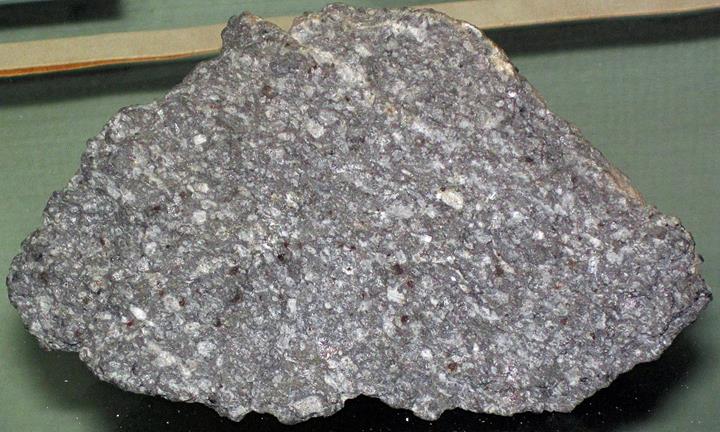
Porphyritic texture implies that the phenocrysts crystallized deep inside the Earth’s crust and had time for crystals to grow larger while the matrix formed on or near the Earth’s surface.
Porphyritic rhyolite (rhyolite porphyry) consists of quartz, oligoclase (plagioclase feldspar), K-feldspar, and less commonly, amphibole, biotite, and pyroxene phenocrysts in a glass or fine-grained (aphanitic) matrix of mainly quartz and feldspar or equivalent glassy composition.
Nevadite is an example of highly porphyritic rhyolite with mainly quartz phenocrysts, which some inexperienced people may confuse for granite.
Lastly, sometimes true porphyritic rhyolites are those predominant with alkali feldspar and oligoclase and have biotite, no amphibole or pyroxene. If present, it is alkaline rhyolite.
Rhyolite composition
Rhyolite is a potassium-rich felsic rock with mostly quartz, sanidine, and plagioclase. Here is more on its composition.
Chemical composition
Rhyolite and its magma are felsic (silica-rich 69-80 wt.%), sodium and potassium-rich, and low in the darker ferromagnesium elements, i.e., calcium, magnesium, and iron. Typical percentage weight chemical composition of rhyolite from Ragland (1989), Le Maitre (1976), and Nockolds (1954)
| Data source | (Ragland,1989) | (Le Maitre,1976) | (Nockolds,1954) |
| SiO2 | 71.5 | 74.00 | 73.66 |
| TiO2 | 0.3 | 0.27 | 0.22 |
| Al2O3 | 14.1 | 13.53 | 12.45 |
| Fe2O3 | 2.8 | 1.47 | 1.25 |
| FeO | – | 1.16 | 0.75 |
| MgO | 0.5 | 0.41 | 0.32 |
| CaO | 1.1 | 1.16 | 1.13 |
| Na2O | 3.4 | 3.62 | 2.99 |
| K2O | 4.1 | 4.28 | 5.35 |
| MnO | – | – | 0.03 |
| P2O5 | – | – | 0.07 |
| LOI | 1.4 | – | – |
| Total | 99.2 | 99.9 | 100 |
From the above data and many others, we can conclude that rhyolite volcanic rocks or their lava chemical composition is at least 69% silica (SiO2), Al2O3 (aluminum oxide) >12%, Na2O (sodium oxide) + K2O (potassium oxide) >7% with relatively low amounts of mafic elements like CaO (calcium oxide), iron oxide (Fe2O3) and MgO (magnesium oxide). Also, they may have very small amounts of phosphorus pentoxide (P2O5) and titanium oxide (TiO2).
USGS classifies rhyolites into low silica rhyolite (LSR) with 69-74% silica and high silica rhyolite (HSR) with 75-80% silica or >75 wt.%. The HSR are the most evolved igneous rocks with a water-saturated composition close to granite eutectic.
Also, HSRs are extremely enriched with incompatible elements but depleted of strontium, europium, and barium. They are products of subsurface repeated granite freezing and melting and often erupt in a large caldera.
Lastly, rhyolite is highest in silica, more than dacite, andesite, or other intermediate to mafic rocks, including basalt.
2. Mineral composition
Rhyolite has predominantly quartz, sanidine, plagioclase, and minor amounts of mafic (ferromagnesian) minerals like biotite (mica), augite (amphibole), fayalite (olivine), and less commonly, hornblende (pyroxene). Other less common mafic compounds are hypersthene, magnetite, and ilmenite.
Quartz may occur alongside higher-temperature silica polymorphs like tridymite and cristobalite.
1. QAPF
To classify rhyolite rock as an extrusive granitic or rhyolitic magma-origin, it must meet the following conditions:
- Quartz should account for 20%-60% of QAPF (quartz, alkali feldspar, plagioclase, and feldspathoid) by volume, and its plagioclase should be sodium-rich (andesine or oligoclase).
- Alkali feldspar should account for 30-90% of the total, which is often sanidine but may less often be orthoclase and rarely anorthoclase and may occur as phenocrysts.
- The rhyolite shouldn’t contain feldspathoids.


2. TAS diagram
The International Union of Geological Sciences (IUGS) recommended that volcanic rock be classified based on mineralogy. However, using minerals to classify glassy or volcanic rocks with extremely fine grains is impractical. An alternative way is using the TAS (Total Alkali-Silica) since silica and alkali proportion influences actual and normative mineralogy.
Using the TAS (Total Alkali-Silica) diagram, which requires chemical classification of igneous rock based on the silica and relative alkali (K2O and Na2O) weight content, rhyolite is a silica and oxides of alkali metals, making it appear at the end of the TAS diagram after dacite and trachyte. With a decrease in silica, you have dacite and trachyte.


Peralkaline rhyolite
Peralkaline rhyolites, including comendite and pantellerite, are usually high in alkali metals (sodium and potassium). The alkali metals are more than what feldspar needs but are deficient in aluminum. Peralkalinity affects the mineral composition and the morphology of lava flow. Aegirine (sodium pyroxene) or riebeckite (amphibole) indicate peralkalinity.
Peralkaline rhyolite shows 10-30 times more fluidity, making it able to form lava tubes, thin dikes, or flow folds on a small scale. Also, they erupt at a higher temperature of more than 2,190 °F (1,198°C).
These rocks form part of bimodal eruptions (basalt and rhyolite) in shield volcanoes, especially at continental hotspots and rifts. Examples are in central Kenya’s part of the Rift Valley, Glass House Mountains (Australia), and Rainbow Range (Canada).
Lastly, pantellerite is lower in aluminum and higher in iron than comendite. In contrast, comendite is often light blue-gray with mainly sodic sanidine as the main phenocrysts and fewer bipyramidal quartz and albite.
How is rhyolite formed?
Rhyolite rocks form from highly viscous, silica-rich rhyolite or granitic magmas low in iron and magnesium near or on the surface. Magma that reaches the Earth’s surface may erupt explosively, effusively, or both (hybrid). In subglacial or subaqueous conditions, eruptions form hyaloclastite (glass accumulation).
These magmas can produce various rhyolitic rock types, including boulders, breccia, perlite, ash deposits, and obsidian vitrophyre. Also, they can form pumice, welded tuff, or ignimbrites with different heteromorphic fabrics but with the same chemical composition.
The rock types formed depend on the eruption, i.e., is it effusive, explosive, or hybrid? Eruptions occur at relatively lower temperatures of about 800-1000°C (1,470 to 1,830°F). These temperatures are lower than intermediate, mafic, or ultramafic magma eruption temperatures.
Let us look at explosives, effusion, hybrid eruptions, and magma origin.
1. Explosive eruptions
The high viscosity favors explosive eruption over the effusive eruption. Explosive eruptions occur in volatile-rich (4-8 wt.% volatile) silicic granitic/rhyolitic magmas and cause the largest and most devastating volcanoes known on Earth. Luckily, they are not common.
During the eruption, explosive gas release and expansion will blast a voluminous plume of pyroclasts, i.e., ash (mainly glassy shards), frothy volcanic glasses like pumice and pumice lapilli, or blocks at great speed.
The resultant tephra may cover hundreds to thousands of kilometers with deposits hundreds of meters thick, sometimes with pyroclastic density currents or ash flows. An example is the 20 Ka Old Oruanui eruption in New Zealand that released 430 cubic kilometers of falling deposits and 320 cubic kilometers of ignimbrite sheets.
These explosive eruptions will rhyolite rocks, pumice, ash deposits, breccia, welded tuff, or ignimbrite that often occurs with obsidian. They represent some of the most voluminous continental igneous rock formations rivaling basalt. Some, like thunderegg, are nodular and form between ash layers.
2. Effusive eruption
In effusive eruptions, the highly viscous magma will extrude like oozing toothpaste, forming blocky, slow-moving lava flows of 10 to over 100 meters thick with a small coverage area, i.e., not extensive like basalt that may run kilometers. Their ascent and degassing dynamics are different from explosive eruptions.
Effusive eruptions commonly occur in volatile, poor, viscous silicic magmas and may form rhyolitic lava domes, dikes, or plugs. Also, they may have obsidian margins (when cooling is rapid, crystallization doesn’t occur), and degassing of porous lava may cause collapse, creating obsidian rocks.
Lastly, rhyolitic flows account for a small percentage of lava flows, i.e., about 2%, with 90% being basaltic and 8% andesitic.
3. Hybrid
Hybrid eruptions involve both explosive and effusive eruptions with some overlapping. Overlapping is evidence that pyroclastic processes have a role in the degassing of lava. For instance, the 1912 Novarupta eruption represented the largest volcanic eruption in the 20th century. It started as an explosive eruption, transitioning to an effusive one and forming a dome on its vent.
4. Magma origin
Rhyolitic or granitic magmas are silica-rich, highly viscous, crystal-poor, highly evolved, and differentiated. They form by 1) partial melting of upper crustal material or 2) fractional crystallization of mafic (tholeiitic series and calc-alkaline series) parental magmas with or without assimilation. Also, they can form from the interstitial extraction of liquids from long-lived, highly crystalline mushes.
Rhyolite’s association with andesites and dacites confirms the possibility of their origin being basaltic magma differentiation derived from the mantle.
On the other hand, melting crustal sedimentary rock can change magma composition with bimodal basalt and rhyolite existence without intermediate evidence of crustal melts in rhyolite petrogenesis. The water vapor helps lower the melting point of silicic rocks, with some magmas having as much as 7-8 wt. %. Such will undergo explosive eruption.
For instance, remelting of plagiogranites (tholeiitic magmas) rather than basaltic magma differentiation is the reason for the abundance of rhyolite rocks in Iceland. Some differentiate from peralkaline rhyolites, but most end in trachyte.
5. Examples of rhyolitic eruptions
Examples of rhyolitic eruptions include the St. Andrew Strait volcano (1953-1957) in Papua New Guinea, the Novarupta volcano (1912) in Alaska, USA, Chaitén (2008), and Puyehue–Cordón Caulle (201i) in Chile). Also, active volcanoes in Yellowstone in the United States, Iceland, and Tambora in Indonesia can produce rhyolite.
Rhyolite domes
Lava domes are common in effusive eruptions of highly viscous, silica-rich magmas like rhyolite, dacite, or rhyodacite. They form when extruded, nearly paste-like lava piles around the vent, forming a steep-sided dome, mound, or plug 10s to 100s meters high. Mount Tarawera in the North Islands of New Zealand has a series of rhyolitic domes.
Lava domes may have rock fragments around them resulting from auto-brecciation. Also, they may collapse as more magma extrusion may make them brittle, highly fractured, and unstable.
A lava dome collapse may result in powerful pyroclastic flows along the steep summit or flanks as the pressure of extruding magma decreases. Thus, they can be dangerous.
Where is rhyolite found?
Rhyolite rocks occur in volcanic provinces, especially continental margins, and sometimes interior continents and different tectonic positions. However, it does exist in intra-oceanic islands like Iceland and Galapagos but is less common. Rhyolite rocks occur in all ages, unlike rhyolitic obsidian, perlite, and pitchstone, associated with silicic magma of Cenozoic origin.
Rhyolite forms commonly in convergent plate boundaries with oceanic lithosphere subducted into the mantle and overridden by continental crust, i.e., Andean subduction type.
The thick continental crust allows magma differential and assimilation of crust and may make this rock prominent in such areas, including in hotspots or rifts. However, they can occur where the overriding crust is oceanic or in the western Pacific’s mid-ocean ridges and island arcs, but rarely.
Also, rhyolite occurs in continental hotspots and rifts. Some notable deposits in the US include Yellowstone (Wyoming), Coso Volcanic Field and Long Valley Systems California (California), Valles (New Mexico), and Rio Grande Rift (Southern Colorado to New Mexico), where most occur near large calderas. Other places with considerable deposits are Mount Kineo (Maine), Palisade (Lake Superior), and Utah.
Also, these rocks occur in East Africa Rift Valley and Aden Volcano in Yemen and areas like the Taupo Volcanic Zone rift (Northland, Bay of Plenty, Rotorua-Taupo, and the Coromandel Peninsula) and Great Barrier Island in New Zealand.
About 8% of volcanic rocks in Iceland are rhyolite. However, an island like Hawaii is not known to have rhyolite.
Lastly, a bimodal eruption of basalt flood and small rhyolite amounts does occur, especially in late history, where some volcanic complexes are. A good example is the Santorini volcano.
What is rhyolite used for?
In prehistoric times, rhyolite was mined and traded to make stone tools like spears and arrowhead points, blades, scrapers, etc., probably not the best choice but the only available alternative. Also, they made statues and sculptures.
Today, rhyolite makes low-quality aggregate for construction, including fill-in construction, road making (road metal), and other uses when no other choices exist. It is vuggy and fractured. Also, the high silica content makes them unsuitable for making concrete. You can also use it to decorate gardens or for landscaping.
Also, rhyolite rocks host some of the best deposits of valuable gemstones like topaz, opal, jasper, red beryl (rare, also known as red emerald), and agate. These garnets occur lithophysae, more precisely thundereggs, what some call vugs. Moscati & Johnson (2014) suggest that these garnets are post-deposition of rhyolitic magma from element-rich vapor-phase mineralization.
These garnets form within cavities created by fluid exsolution at low pressure and relatively high temperatures of 600°C or more, evidenced by the tridymite, high-temperature quartz inclusions.
Some amygdaloidal rhyolites, i.e., those whose voids have been filled by other secondary minerals crystals like jasper, agate, quartz, etc., including spherulitic, thundereggs, and geodes, make good semi-precious gemstones. Some are banded, others very colorful.
Examples include Kambaba or rainforest rhyolite jasper (usually greenish), mushroom, bird’s eye, leopard skin, galaxy, candy rock, orbicular, flower, Sonora/Apache/Sage dendritic, blue, rainbow, wonderstone (banded), etc. These gemstones may be tumbled or polished, some cut into cabochons. Their uses include making beads, necklaces, bracelets, pendants, and other jewelry.
Some of the above amygdaloidal rhyolites will sell for USD 1-10 per pound, while those highly colorful and attractive will sell for more than US$10 per pound.
The above QAPF qualifications make rhyolite equivalent to intrusive granite. They are both high in silica potassium and sodium oxides and have similar mineralogical and chemical compositions. Also, they form from highly viscous magma.
However, rhyolite has an aphanitic to glassy texture due to quick cooling, has more potassium than sodium, and rarely has muscovite. In contrast, granites are coarsely textured (phaneritic) due to slower cooling, have muscovite, and don’t have more potassium than sodium unless it is due to hydrothermal alteration.
Also, rhyolite has sanidine, typically rich in soda, not soda-poor microcline-perthite or microcline seen in granite rocks.
References
- Best, M. G. (2013). Igneous and metamorphic petrology (2nd ed.). Blackwell Publishers.
- Gill, R. (2010). Igneous rocks and processes: A practical guide (1st ed.). Wiley-Blackwell.
- Bachmann, O., & Bergantz, G. W. (2008). Rhyolites and their source mushes across tectonic settings. Journal of Petrology, 49(12), 2277–2285. https://doi.org/10.1093/petrology/egn068
- Moscati, R. J., & Johnson, C. A. (2014). Major element and oxygen isotope geochemistry of vapor-phase garnet from the topopah spring tuff at Yucca Mountain, Nevada, USA. Mineralogical Magazine, 78(4), 1029–1041. https://doi.org/10.1180/minmag.2014.078.4.14
- Okrusch, M., & Frimmel, H. (2020). Mineralogy: An introduction to minerals, rocks, and mineral deposits (1st ed.). Springer
- Castro, J. M., Bindeman, I. N., Tuffen, H., & Ian Schipper, C. (2014). Explosive origin of silicic lava: Textural and δD–H2O evidence for pyroclastic degassing during Rhyolite Effusion. Earth and Planetary Science Letters, 405, 52–61. https://doi.org/10.1016/j.epsl.2014.08.012
- Durant, G. P. (1989). Rhyolite. In Bowes, D. R. (ed.). The encyclopedia of igneous and metamorphic petrology. New York: Van Nostrand Reinhold.
- Haldar, S. K. (2014). Introduction to petrology and Minerology. Elsevier.
- E. J., Lutgens, F. K., & Tasa, D. (2017). Earth: An introduction to physical geology (12th ed.). Pearson.
- Ragland, P. C. (1989). Basic analytical petrology. Oxford University Press.
- Le Maitre, R. W. (1976). The chemical variability of some common igneous rocks. Journal of Petrology, 17(4), 589–598. https://doi.org/10.1093/petrology/17.4.589
- Nockolds, S. R. (1954). Average chemical compositions of some Igneous Rocks. Geological Society of America Bulletin, 65(10), 1007. https://doi.org/10.1130/0016-7606(1954)65[1007:accosi]2.0.co;2
- Wadsworth, F. B., Llewellin, E. W., Castro, J. M., Tuffen, H., Schipper, C. I., Gardner, J. E., Vasseur, J., Foster, A., Damby, D. E., McIntosh, I. M., Boettcher, S., Unwin, H. E., Heap, M. J., Farquharson, J. I., Dingwell, D. B., Iacovino, K., Paisley, R., Jones, C., & Whattam, J. (2022). A reappraisal of explosive–effusive silicic eruption dynamics: Syn-eruptive assembly of lava from the products of cryptic fragmentation. Journal of Volcanology and Geothermal Research, 432, 107672. https://doi.org/10.1016/j.jvolgeores.2022.107672
- Bonewitz, R. (2012). Rocks and minerals (1st ed.). DK Pub.
- Frost, B. R. (2014). Essentials of igneous and metamorphic petrology. Cambridge University Press.
Can you add the similar rocks 🙂