
We use the rhyolite porphyry or porphyritic rhyolite term to indicate that the rhyolite rocks have larger crystals set in a fine-grained glassy matrix. Remember that rhyolite is an extrusive or volcanic igneous rock that may have fine-grained to glassy texture, i.e., non-porphyry, or larger crystals in fine grain matrix, i.e., porphyritic rocks.
The term porphyry only tells you more about the texture. It has nothing to do with the actual size of crystals (large and finer grain matrix), chemical composition (mineralogy), or chemistry.
This post will examine rhyolite porphyry (pronounced as RY-ə-lyte POR-fə-ree), its meaning, and its formation or origin. However, before that, let us do a small refresher on these rocks and their composition.
What are rhyolite rocks?
Rhyolite is a light-colored, silica-rich extrusive igneous rock with a fine-grained to glassy texture but more often a porphyritic texture. The porphyritic texture is where larger crystals or phenocrysts are scattered in a finer-grained or glassy matrix.
This felsic rock has mainly quartz, plagioclase, and sanidine and only a small amount, less than 15% mafic (dark-colored) minerals like biotite, augite, fayalite, or hornblende. Sanidine is a potassium felspar with a high melting point.
Rhyolite is often grayish or pinkish but may be reddish, tan, green, and other colors and is the equivalent of granite, an intrusive rock.
Lastly, rhyolite forms mainly from a volcanic eruption of granitic on continental or continent-margin of highly viscous magma. They rarely form from oceanic eruptions.
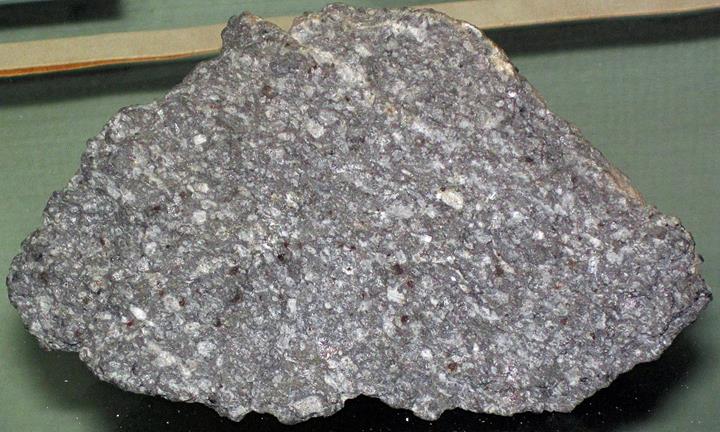
Rhyolite porphyry
Porphyry is a textural term for igneous rocks that describes the presence of larger crystals in a finer-grained or glassy texture matrix. The term doesn’t describe the chemical composition (mineralogy), chemistry, or relative sizes of the larger crystals or matrix.
The larger crystals are known as phenocrysts. But if too large, i.e., 5mm, they will be megaphenocrysts, and if 0.03mm to 0.3mm, microphenocrysts.
On the other hand, the finer-grained or glassy matrix is known as groundmass. It can have coarse, medium, fine-grain, or glassy textures.
Rhyolite porphyry rocks refer to rock with rhyolite chemical composition but with phenocrysts of quartz, oligoclase, K-feldspar, amphibole, pyroxene in a fine-grained (aphanitic), cryptocrystalline, or a glassy groundmass. In rare cases, some porphyritic rhyolite may have biotite phenocrysts and other minerals like garnet.
On the other hand, the groundmass will have minerals like quartz, feldspar or any other mineral that the specific rhyolite rock.
A good example of porphyritic rhyolite is nevadite. This rock is a variety of rhyolite varieties rich in quartz phenocrysts in a fine-grained groundmass.
How do the phenocrysts appear? Looking at porphyritic rhyolite rock, you will notice differently colored phenocrysts. For instance, quartz will appear as whitish or smoky round blebs. Other minerals may form rectangular-shaped crystals, as with felspar and hornblende.
The phenocrysts will have subhedral (partly-faced) to euhedral (with sharp, easy-to-recognize faces) crystal structures on a thin section.
Lastly, almost all other igneous rocks (intrusive and extrusive) can have this texture. Common ones include basalt, granite, diorite, and andesite porphyry.
Naming this rocks
You will encounter terms like quartz or feldspar rhyolite porphyry. In this case, quart and feldspar tell you the dominant phenocrysts mineral.
How does a rhyolite porphyry texture form?
Rhyolite porphyry formation involves two-stage cooling of granitic magma. A slow cooling stage deep within the Earth’s crust forms the larger crystals (phenocrysts), and a faster cooling rate on the Earth’s surface forms the fine-grained groundmass.
Phenocrysts form by fractional crystallization deep inside the Earth’s crust, where cooling is slow. Usually, minerals with the highest melting temperature will be the first to crystalize.
The slow cooling allows time for larger crystals growth. Also, in most cases, you will find well-formed crystals with sharp faces that you will easily recognize since the remaining magma melt doesn’t restrict growth. Such crystals are what we call euhedral.
What about the groundmass? How does it form? The groundmass forms when a volcanic eruption moves the magma with phenocrysts to the Earth’s surface. The remaining uncrystallized magma will cool rapidly, forming the fine-grained matrix or groundmass with embedded phenocrysts.
Remember, the rapid cooling will not allow enough time for larger crystal growth; in cases where it is too rapid, you will have a glassy texture.
Occurrence
Rhyolite porphyry rocks are found in most volcanic environments in continental crusts, dykes, dykes, or arcs.
Some of the notable places with porphyritic rhyolite rocks include the Mattapan Volcanic Complex (Boston Basin), North Shore Volcanic Group (Minnesota), Yellowstone Plateau Volcanic Field (Wyoming), Moat Volcanics (New Hampshire), Arbuckle Mountains in Oklahoma, etc. The list is endless.
Uses of porphyritic rhyolite rocks
While these rocks are hard with a Mohs hardness of 6, rhyolite porphyry rocks have a fractured nature just like ordinary rhyolite rocks. Therefore, these rocks don’t have many uses in construction except as a fill, and people use them when no other better stones exist.
In the past, they made projectile heads, blades, or scrappers when there was no other better option.
References
- Department of Earth Science. (n.d.). L110 – porphyritic rhyolite. University of Cambridge. Retrieved August 29, 2022, from https://wserv3.esc.cam.ac.uk/p1acollections/exhibits/show/igneous-rocks/l110
- King, M.H. (n.d.). Rhyolite. Retrieved August 29, 2022, from https://geology.com/rocks/rhyolite.shtml
- Porphyry (geology). (2022, August 6). In Wikipedia. https://en.wikipedia.org/w/index.php?title=Porphyry_(geology)&oldid=1102772210
- Universität Salzburg. (n.d.). Rhyolite-porphyry. Retrieved August 28, 2022, from http://chc.sbg.ac.at/sri/thesaurus/node.php?id=29
- The United States Geological Survey. (n.d.). Geologic units containing Rhyolite. Retrieved August 29, 2022, from https://mrdata.usgs.gov/geology/state/sgmc-lith.php?text=rhyolite