
Porphyry (pronounced as POR-fə-ree) describes any intrusive or extrusive igneous texture rock with large-grained crystals embedded in a finer-grain matrix. The finer-grained groundmass or matrix can be aphanitic or phaneritic. However, the larger crystals must be easily noticed and distinguishable. Rocks can have this texture, and such rocks are said to be porphyritic (pronounced POR-fə-rit-ik), an adjective.
Today, we will discuss porphyry’s definition or meaning and how this texture is formed. Afterward, we will give you ten porphyritic rocks with their images. Please note that this discussion is not about Porphyry, the Tyrian Neoplatonic philosopher, the porphyry house system, or the tree of porphyry. It is about petrology.
What is porphyry?
Porphyry is a textural term that describes any intrusive or extrusive igneous rock with consistently larger crystals set in a finer-grained matrix. Metamorphic rocks showing such a texture are known as porphyroblasts.
The larger and more conspicuous crystals are known as phenocrysts but megaphenocrysts if they are very large (>5mm). And if between 0.03mm to 0.3mm microphenocrysts. Phenocrysts of a single mineral, i.e., monomineralic, or more than one, i.e., polymineralic. However, in most cases, porphyry rocks have more than one kind of mineral phenocryst.
On the other hand, the finer-grained matrix is known as groundmass. It may be coarse-grained (phaneritic), fine-grained (aphanitic), microcrystalline, or glassy. Also, it will have several minerals characteristic of the specific igneous rock showing this texture.
It is worthwhile to note that igneous rocks with porphyry texture will have the same mineralogy and chemistry as those that don’t have it, i.e., the non-porphyry rocks. Even other properties like Mohs hardness don’t change.
Igneous rocks showing the porphyry texture are said to be porphyritic. It is a more accurate term, considering it is an adjective. For instance, you can have porphyritic andesite, rhyolite, granite, basalt, diorite, phonolite, etcetera.
Lastly, the abundant phenocrysts’ names may precede the rock type in naming porphyritic stones or rocks. For instance, hornblende andesite porphyry or feldspar rhyolite porphyry. In such a case, hornblende and felspar are the dominant phenocrysts.
Origin and Imperial Porphyry
The term porphyry came from an Ancient Greek word πορφύρα (Porphyra) that meant purple, a then a royalty color. This name referred to Imperial Porphyry or Imperial Red Porphyry, a then-valued, deep purple igneous rock. It had plagioclase phenocrysts and was discovered in Mons Porphyrites (Jabal Abu Dukhkhan) in Egypt in 18 AD.
This imperial porphyry rock made flooring tiles, statues, vases, urns, sarcophagi, pillars (obelisks), bathtubs (basins), buildings, and other architectural and artworks throughout the Roman Empire.
Sometimes, this rare, valued imperial porphyry was known as red, purple, or porphyry marble. Don’t confuse the name marble with metamorphic marble rock.
However, Egyptians had used similar porphyritic stones for decoration but not the Roman grade as early as 1850 BC for decorative and other uses.
Lastly, using the name porphyry to specifically refer to the purple-red stones valued in the Roman empire is non-geological.
Formation and what it indicates
A porphyry textured igneous rock indicates that the rock formed in a two-stage cooling. A first, earlier, slower cooling stage formed the larger crystals, and a later, relatively faster, final cooling stage crystallized the groundmass.
Secondly, we can deduce that there may have been magma movement, which occurred after the phenocrysts had already formed but before the groundmass formed.
Thirdly, the initial cooling stage must have happened at a greater depth inside the Earth’s crust than the final. Final crystallization for extrusive or volcanic rocks occurred on the Earth’s surface, while for plutonic or intrusive inside the Earth’s crust.
Therefore, porphyry rocks formed when initially slowly cooling magma deep within the Earth’s crust with already formed phenocrysts suddenly moved or erupted, resulting in faster cooling and crystallization of the remaining uncrystallized magma.
Let us talk a little more about groundmass and phenocryst formation. It should make everything much clearer.
1. How are phenocrysts formed?
Phenocrysts are formed by fractional crystallization, where minerals with the highest melting temperature crystalize first out of the magma melt. The slow cooling rates within the Earth’s crust allowed crystals to grow large. Also, they were well-formed, as the remaining molten magma didn’t constrict or limit their growth.
2. How is the groundmass formed?
Cooling was faster when the remaining magma and already formed phenocrysts suddenly moved to a lesser depth or on Earth’s surface. The faster cooling didn’t give enough time for groundmass crystal growth.
The grain size of the groundmass of a porphyritic rock depends on where the final crystallization occurred. You expect finer to glassy if formed on the Earth’s surface and coarser grains when formed inside the Earth’s crust.
Examples of porphyry rocks with pictures
The porphyritic texture is possible in all igneous rocks. Here are typical examples:
1. Andesite porphyry
Andesite is a fine-grained, extrusive rock with an intermediate composition. It is high in plagioclase, amphibole, and feldspar. However, it does have quartz, pyroxene, muscovite, or biotite with no olivine.
An andesite porphyry will have plagioclase (whitish to bluish), hornblende (black, brownish, or dark green), and amphibole (various colors) phenocrysts embedded in a dark-grayish aphanitic groundmass.

_(15661069958).jpg)
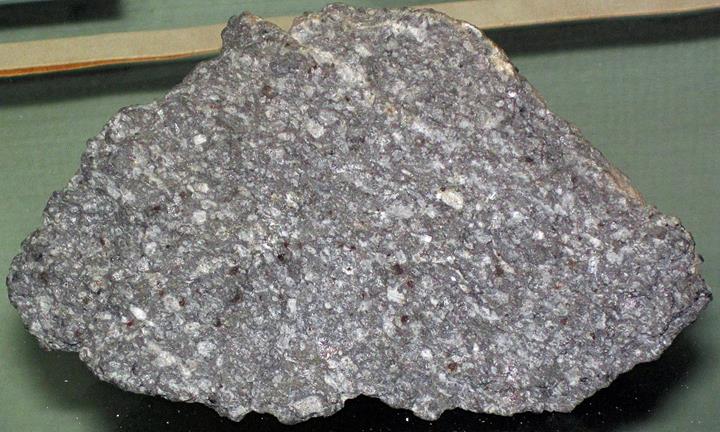
2. Rhyolite porphyry
Rhyolite porphyry textured rocks feature quartz, hornblende, feldspar, or muscovite (mica) large crystal in a fine-grained (aphanitic), glassy or cryptocrystalline groundmass.
Except for the larger crystals, this light-colored (pinkish to grayish), silica-rich volcanic rock is high in quartz, sanidine, and plagioclase and less than 15% mafic minerals like biotite, fayalite, augite, or hornblende.
3. Basalt porphyry
A basalt porphyry rock has the same chemical composition as ordinary basalt. But it will have large crystals or phenocrysts of olivine, augite, hornblende, or calcium-rich plagioclase felspar in a fine-grained (aphanitic) groundmass.
Basalt is a hard, mafic volcanic rock rich in augite (pyroxene) and plagioclase felspar. Its quartz level is low and may have other minerals like olivine, hornblende, biotite, etc. Did you know it is the volcanic equivalent of gabbro?

4.. Granite porphyry
Granite porphyry rocks usually have whitish to pinkish potassium felspar phenocrysts in a coarse-grained (phaneritic) groundmass. But it can have biotite, quartz, or plagioclase phenocrysts, and the groundmass is a typical granitic rock, i.e., 2-4 shades of pink, white, gray, or black.
Granite, an intrusive, felsic, light-colored igneous, has mainly quartz and felspar and small amounts of biotite, amphibole, hornblende, muscovite, etc.

5. Diorite porphyry
Diorite rocks with porphyritic texture will have large crystals of plagioclase, biotite, or hornblende inside phaneritic (coarse-grained) groundmass. But its mineralogy and chemistry remain the same.
For starters, diorite intrusive igneous rock with contrasting black and gray colors. Its mineral composition is between granite (felsic) and gabbro (mafic). Also, it has mainly sodium-rich plagioclase and lesser amounts of quartz, amphibole, hornblende, or pyroxene.

6. Quartz porphyry
Quartz porphyry features large quartz crystals in a fine-grained or finely crystalline or hypocrystalline groundmass (a mixture of small crystals and glass). Examples of finely grained groundmass are microgranite, microtonalite, and microgranodiorite).
The quartz phenocrysts will appear as rounded, smoky, vitreous blebs. Also, some variants may have feldspar (plagioclase or orthoclase) phenocrysts. Such are known as quartz-feldspar porphyry. Also, Leopardite is another variety with quartz phenocrysts and quartz, albite, orthoclase, and mica groundmass.
Lastly, quartz porphyry rocks occur in small intrusions such as sills and dykes and are usually acidic.

7. Trachyte porphyry
A trachyte porphyry textured rock features sanidine phenocrysts in a fine-grained groundmass. The groundmass has mainly alkali felspar and small amounts of biotite, amphibole, augite (pyroxene), biotite, sodium plagioclase, etc., typical of any trachyte rock.
Remember, trachyte is usually a light-colored intermediate (lies between mafic and felsic). It can have an aphanitic or porphyritic texture and is the intrusive extrusive equivalent of syenite.

8. Phonolite porphyry (trachyte variant with foids)
Phonolite is an intermediate (composition between mafic and felsic), fine-grained, extrusive igneous rock. The key minerals it has are alkali feldspar (sanidine or anorthoclase). However, it may have some mafic minerals like alkali pyroxene, augite, olivine, biotite, alkali amphiboles, and foids like nepheline or leucite in place of quartz.
A phonolite porphyry rock will have large crystals of sanidine or anorthoclase in a fine-grained groundmass of its various minerals. Also, it may have alkaline amphibole or pyroxene phenocrysts, while nepheline may rarely occur as microphenocrysts.

9. Microgabbro, dolerite, or diabase porphyry
Dolerite or diabase porphyry rocks have large crystals of plagioclase, quartz, or olivine set in fine to medium-grained groundmass. Besides this porphyritic texture, diabase may have a subophitic to an ophitic texture where pyroxene partially or fully encloses or molds plagioclase laths.
Diabase is a mafic subvolcanic or hypabyssal rock (intrusive rock formed at depths not more than 1.2 miles into the Earth’s crust). It is the equivalent of basalt (extrusive) or gabbro (intrusive) and forms on sills and dykes.
Regarding composition, dolerite has mainly calcium-rich plagioclase felspar with smaller amounts of pyroxene, olivine, magnetite, or ilmenite. Also, it may have hornblende, pyroxene, biotite, amphibole, etc.

10. Dacite porphyry
Dacite is an extrusive igneous rock whose composition ranges between andesite and rhyolite. It has mainly plagioclase feldspar and quartz with less amounts of hornblende, pyroxene, hornblende, or biotite. Its texture is fine-grained to porphyritic and is the intrusive equivalent of granodiorite.
Dacite porphyry will have phenocrysts of quartz (rounded graying blebs) or plagioclase in a fine-grained groundmass.

Rhomb porphyry
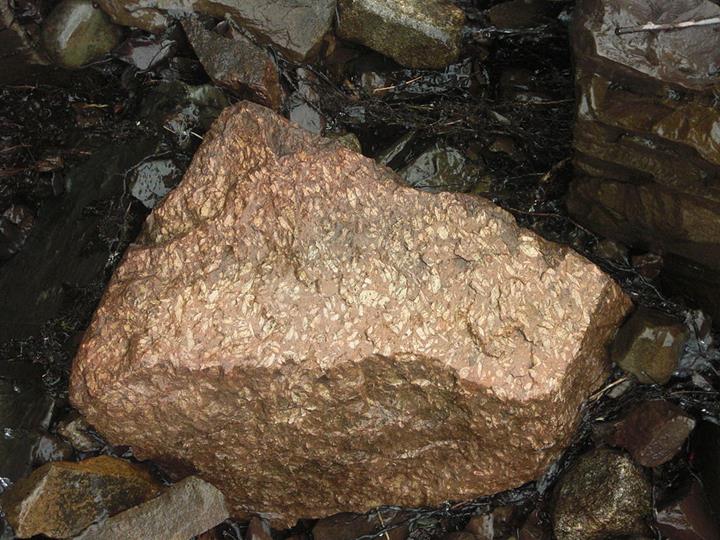
Rhomb porphyry is an extrusive rock with large, rhombus-shaped crystals, usually anorthoclase, in a fine-grained, brownish groundmass. This rock’s composition lies between trachyte and latite, emphasizing the phenocryst shape.

Note: Copper porphyry
Porphyry copper deposits are medium to low-grade hypogene copper, molybdenum, and sometimes small amounts of by-products like tin, tungsten, or silver. They are formed by hydrothermal fluids from magmatic intrusions like vertical dykes.
These deposits are called “porphyry” since they are associated genetically, spatially, and predate with the formation of intrusive (cooled within the Earth’s crust) porphyritic igneous rocks.
References
- Suerte, L. O., Imai, A., & Nishihara, S. (2009). Geochemical Characteristics of Intrusive Rocks, Southeastern Mindanao, Philippines: Implication to Metallogenesis of Porphyry Copper-gold Deposits. Resource Geology, 59(3), 244–262. https://doi.org/10.1111/j.1751-3928.2009.00094.x
- Quartz porphyry. A Dictionary of Earth Sciences. Retrieved August 28, 2022, from Encyclopedia.com: https://www.encyclopedia.com/science/dictionaries-thesauruses-pictures-and-press-releases/quartz-porphyry
- Quartz-porphyry. (2021, June 25). In Wikipedia. https://en.wikipedia.org/w/index.php?title=Quartz-porphyry&oldid=1030426437
- phonolite | rock. (1998, July 20). Encyclopedia Britannica. Retrieved August 31, 2022, from https://www.britannica.com/science/phonolite
- Department of Geology & Planetary Science (n.d.), Porphyritic textures with coarse-grained groundmasses. The University of Pittsburg, Retrieved August 27, 2022, from https://sites.pitt.edu/~cejones/GeoImages/2IgneousRocks/IgneousTextures/3PorphyriticCoarseGrained.html
I recently held a piece about 5 pounds that was found in far west Texas.