
What is geology, its main branches, and why is it important? Does geology have good career prospects, and what are the requirements to study it? If these and many other questions on geology bother you, we have answers.
What is geology?
Geology is a scientific study of how Planet Earth was formed, its structure, what it is made of, and the various processes (physical and chemical) that act on it. It also studies the Earth’s history, life for 4.5 billion years, and ways to use the world’s resources.
Geology comes from two Greek words, ‘Geo’, which means Earth, and ology, which means ‘study of. So, we can say geology is the study of Earth. However, We must clarify further by stating that Geology studies Earth’s formation, structure, compositions, processes that continually act on it, and history together with life since formation until now.
Since it is a scientific study of Earth, the study of geology involve or use physics, biology, math, and chemistry knowledge and methods. Also, it is not the study of rocks (petrology), as many assume. It has many branches like geochemistry, geophysics, marine geology, hydrogeology, etc.
How do others define it, or what do they say geology is?
Geology is a branch of natural science concerned with Earth and other astronomical objects, the features, or rocks of which it is composed, and the processes by which they change over time”.
Wikipedia
“Geology is the study of the Earth, the materials of which it is made, the structure of those materials, and the processes acting upon them. It includes the study of organisms that have inhabited our planet”.
Geology.com
Geology involves studying the materials that make up the Earth, the features and structures found on Earth, as well as the processes that act upon them. Geology also deals with the study of the history of all life that’s ever lived on or is living on the Earth now.
Study.com
“Also known as geoscience or Earth science, Geology is the primary Earth science and looks at how the Earth formed its structure and composition and the types of processes acting on it. Geology is concerned with the history of the Earth over the course of its 4.5-billion-year life”.
Geological Survey Ireland
“Geology is the scientific study of the Earth, including the materials that it is made of, the physical and chemical processes that occur on its surface and in its interior, and the history of the planet and its life forms.”
The University of Toledo
Lastly, many sources use geoscience and earth science synonymously to mean geology. However, Earth science is more of an interdisciplinary study of Earth that goes further than geology. It looks into other areas like meteorology, astronomy, oceanography, etc.
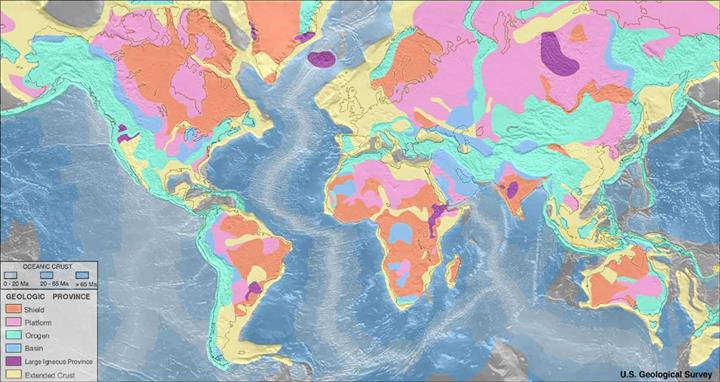
Main branches of geology or areas of study
To properly understand geology, we will look at the various areas of study, divisions, or branches of geology.
| Branch | Meaning |
| Petrology | Petrology is the scientific study of rocks and their forming conditions. It covers rock origin, history, structure, composition, texture, occurrence, classification, and distribution. As you may know, there are three main types of rocks, i.e., igneous, sedimentary, and metamorphic. |
| Lithology | Lithology is the study of physical characteristics (color, texture, composition, and grain size) of a visible rocky outcrop, core samples, and hand samples or using a microscope with low magnification. It differs from petrology, which considers microscopic details. |
| Hydrology | Hydrology is a science that studies water distribution, movement, and management on Earth. It also deals with water properties, occurrence, water cycles, the impact of human activities, and interaction with living organisms. |
| Hydrogeology | Hydrogeology is a hydrology sub-branch that scientifically studies the movement and distribution of groundwater. It deals with water in rocks, soil, or Earth’s crust. |
| Biogeology | Biogeology studies the interaction between lithosphere (rocks and rock materials on the Earth’s surface) and biosphere (Earth part with living organisms). It examines how terrestrial, biotic, and hydrologic systems interact and how they impact the geologic systems. |
| Economic geology | Economic geology is a science focusing on Earth’s material’s monetary value or industrial use. It deals not just with identifying and extracting fuel, ore, and other valuable Earth materials but also with their formation. |
| Engineering geology | Engineering geology (geological engineering) is a scientific study that applies geological knowledge to engineering issues or problems. It helps engineers to consider location, construction, operation, and maintenance from a geological perspective or consideration. These may be geological recommendations, analyses, and designs for various structures that humans make. |
| Environmental Geology | This branch of geology scientifically studies how humans interact with their geologic environment: Earth’s surface, its constituents (rocks, soil, water, sediments, or air), life, and processes acting on it. It entails using geology knowledge to solve environmental problems that man creates. |
| Geochemistry | Geochemistry is a science that uses chemistry principles, tools, and knowledge to explain geological system mechanisms. It looks at the origin, distribution, and how chemical elements on the Earth have evolved. This includes rock-forming materials, living organisms, the atmosphere, and water. |
| Geological modeling | Also known as geomodelling, geological modeling is an applied science that involves the creation of a computerized 3-dimensional representation of the Earth’s crust portion or any geological structure using geological and geophysical observation on or below the Earth. |
| Geomorphology | Geomorphology is a science that studies the origin, evolution, forms, and distribution of landforms. It deals with the physical process (mostly) and some chemical changes or biological processes on or near the Earth’s surface that create or act on the various landforms. |
| Geophysics | Geophysics is a science that uses physics principles, concepts, knowledge, and methods to study the Earth, including its atmosphere, oceans, or near-Earth space. This science mainly looks at the physical processes and properties of the Earth and its surrounding environment. |
| Glaciology | Glaciology is the scientific study of ice, especially glaciers, including its formation, structure, properties, movement, and impact on climate, organisms, and physical landscape. While focused on glaciers, it also deals with ice sheets, seasonal snow, sea ice, frozen ground, or even ice in the atmosphere. |
| Paleontology or paleontology | Paleontology is a science that studies life in the geologic past, i.e., before or at the start of the Holocene epoch, about 11,700 years ago. It involves analyzing and examining plant and animal fossils for their shape, structure, distribution, and environmental interrelation. Also, it covers taxonomic interrelations and relations to present species. |
| Marine geology | Marine geology (geological oceanography) is a scientific study of the history, structure, composition, and processes on ocean floors and beaches. It also covers the ocean floor’s impact on the environment and ways to access natural resources for our use. |
| Mineralogy | Mineralogy is a science that studies the origin, formation, crystal structure, chemistry, and physical properties of minerals. It covers the classification, distribution, and utilization of minerals. Please don’t confuse it with gemology and area in mineralogy. Gemology involves studying, cutting, and valuing precious stones, emphasizing gemstones. |
| Mining geology | Mineral geology is a science that uses economic geology and mining engineering knowledge to discover and develop mineral deposits. It covers discovery, exploration, extraction, evaluation quality, and reducing the impact created by the mining process. |
| Petroleum geology | Petroleum geology is a scientific study of the origin (formation), distribution, exploration, and production of oil and natural gas resources. It also covers these hydrocarbon fuels’ occurrence, movement, and accumulation. |
| Sedimentology | Sedimentology is a science that studies sediments like sand and silt, focusing on how they are transported and deposited. However, it also looks at how these sediments form (process involved), properties, composition, and lithification. Lithification is what forms sedimentary rocks. |
| Stratigraphy | Stratigraphy is a scientific study of rock layers and layering (arrangement in strata or stratification). It also covers the origin, composition, distribution, and interpretation of these stratified rocks on a timeline scale. The rocks studied are mainly sedimentary and layered volcanic rocks. |
| Seismology | Seismology is a science that studies earthquakes and associated phenomena like seismic waves and their effects on the environment, such as tsunamis. It also considers other seismic sources from volcanic, glacial, tectonic, oceanic, atmospheric, fluvial, or even artificial origin. |
| Volcanology | Volcanology (vulcanology) is a science that studies all volcanic phenomena aspects. It deals with the formation, distribution, classification, structures, and materials ejected (lava, magma, dust, ash, gases, etc.). Also, it covers geophysical, geochemical, and geological aspects of volcanism and its relationship with mountain building, earthquakes, and plate tectonics. |
| Structural geology | Structural geology is a branch of geology that focuses on rock deformation in response to stress. It studies rock arrangement, form, and internal structure concerning deformation and looks at submicroscopic defects present in crystals to fold and fault systems in the Earth’s crust. |
| Paleoseismology | Paleoseismology is a scientific study of ancient or prehistoric earthquakes. It uses hints from geologic rocks, sediments, faults, folded layers, and tilted, torn-apart, uplifted, or down-dropped landscapes to tell more about ancient earthquakes. |
| Seismotectonic | Seismotectonic is a science that studies relationships between earthquakes occurrence and characteristics, active tectonics, and individual faults in a given region. So, it is more of an interdisciplinary study that requires tectonic and seismic knowledge. |
| Tectonics | Tectonics is a field in geology that studies processes controlling the properties and structure of the Earth’s crust and its evolution over time. Some of these processes are mountain building, the interaction of plates (outer Earth’s shell), and the growth and behavior of cratons. |
| Soil science | Soil science studies all aspects of soil (the top layer of the Earth’s crust). It covers soil formation, properties (physical, biological, and chemical), fertility, mapping, and classification concerning its use and management. |
| Geochronology | Geochronology is a science that investigates and determines the age of Earth’s materials (minerals, rocks, fossils, or sediments) and associated geologic events or processes. It uses the various signatures in these materials. |
| Surficial study | Surficial study is a branch of geology concerned with landforms and loose (unconsolidated sediments) below these landforms. |
Note: Crystallography
Crystallography is a branch of science that studies crystals (molecular and crystalline structure) and properties. This study has many applications, including physics, chemistry, geology (mineralogy), mathematics, material science, and biology. So, it is not only an area of study of geology.
Lastly, sometimes geology is categorized into four divisions or branches: physical geology, historical geology, environmental geology, and economic geology.
Why study geology, or why is geology important?
As said earlier, geology scientifically studies Earth’s origin, formation, structure, composition, and processes acting on it. The same Planet Earth happens to our home. We, together with animals, depend on it for food, shelter, and other resources. Our future generations will rely on it, too.
Therefore, everyone needs to understand how the Earth works. This need to study geology goes beyond having a fulfilling career, which it offers. Everything you see or touch on Earth has some relationship to geology.
Teachers and educators should impart geology knowledge from elementary schools to secondary, colleges, and universities. Why? Because this knowledge concerns everyone.
Here is why geology is important or why you should study it:
- It gives geologists knowledge to discover, explore, and develop natural resources like metals, groundwater, fossil fuels, etc., to support our population growth and technological needs.
- By studying various hazards, like earthquakes, volcanic eruptions, hurricanes, floods, tsunamis, landslides, etc., geologists can predict, anticipate, and develop measures to reduce damage. These hazards often destroy infrastructure and kill animals and humans.
- Geologists working with other scientists can better understand climate and develop measures to address climatic changes. Climate change is one thorny issue that we can no longer ignore.
- No one understands the Earth better than geologists. So, they are the best equipped to devise measures to preserve the Earth by reducing pollution and environmental degradation. Such efforts include switching to renewable and geothermal energy. Also, there is a need to reduce carbon gas emissions as they cause global warming.
- Geology knowledge can help conserve soil and ensure the land remains productive agriculturally.
Requirements to study geology
Geology is an important and very exciting area of study. Let us look at some of the requirements for one to study geology for both pre-college and undergraduates. Later, we will also talk about what you will learn.
1. Pre-college students
High school students who need to study Earth science, geology, or any geology branches must major in sciences, i.e., Physics, Chemistry, Biology, and Math. Also, some closely related areas like Geography will be an added advantage.
Also, students must work hard to get the best grades in the above-core areas. Some universities and colleges have a minimum GPA to join geology. The exact GPA required varies from one institution to another.
Before admission, international students may have to sit for English proficiency tests like IELTS, Duolingo, and TOEFL. The exact requirements will depend on your country of origin and where you will study.
Finally, most universities offer tests like SAT, GRE, GMAT, PTE, etc. These tests help assess if students are ready to study their chosen areas.
2. Undergraduate students
Undergraduate students who majored in science studies like physics, chemistry, biology, or geography can also pursue a master’s degree in geology. Also, they can study any of the branches of geology if they meet entrance requirements. Again, here, students must have a good GPA score.
Geology jobs and career opportunities – where can geologists work?
Geology is a lucrative and evergreen area. Geologists earn a median salary of $91,368 with a range of $58,000 to $141,000 per year in 2022, notes Zippia. However, location, education, and other qualifications can impact your earnings.
Salary.com puts the range at $57,098 to $82,156 with a median of $64,301, and Pay Scale a range of $44k to $102k with a median of $59K. Still, this is a rewarding area of study.
Some of the areas where geologists work include the following:
- Schools (elementary and high school), colleges, and universities
- Environmental consulting companies or firms
- Local, federal, and state agencies like Environmental protection, geological survey, and other environmental regulatory agencies.
- Oil and gas companies
- Oil, gas, or petroleum industries
- Mining industry
- Energy Industries and sectors like geothermal and hydroelectric
- Geological laboratories as assistants, analysts, testers, etc
Lastly, specific to exact careers, it depends on what you studied. You can choose geology or narrow it down to some electives or branches. There are many branches, and you can work in any you specialize in during your study.