
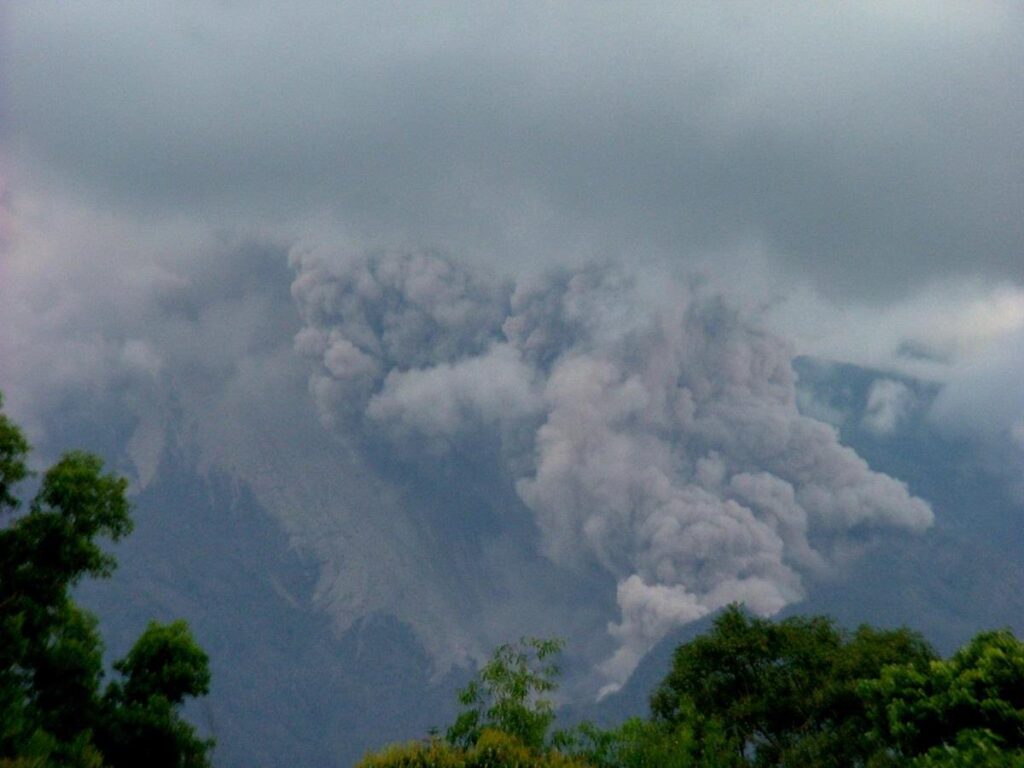
Nuées ardentes, Peléan clouds, or glowing avalanches refer to hot, sometimes incandescent turbulent clouds of expanding gas, ash, and other volcanic debris rapidly flowing downwards on the flanks of volcanoes.
These debris are buoyed in hot expanding gas. They can reach temperatures of about 1,000°C (1,832°F () and move up to 700 km (435 mi) per hour, traveling over 100 km (62 mi).
We collectively call all the fragments ejected during an explosive eruption tephra, irrespective of their size, origin, or composition. These fragments include ash, lapilli, pumice, volcanic bombs, or blocks.
Note that nuées ardentes are essentially pyroclastic flows or a type. Pyroclastic flows, clouds, or density currents are hot gas, ash, and other volcanic fragments rapidly flowing from a vent.
Some authors refer to nuée ardente as an obsolete term from pyroclastic flow. However, this term is still popular in places like the West Indies. Also, it is accepted as a type of pyroclastic flow.

Historical background and conceptualization
Alfred Lacroix, a French petrologist, coined the term nuée ardente in 1903 and amplified it in 1904. It translates to burning or glowing clouds.
He applied this term to describe the billowy pyroclastic flow that erupted from Mt Pelée, Martinique, on 8th May 1902. The previous day, there was a similar glowing avalanche from La Soufrière that had killed 1500 people.
During the explosive eruption at Pelée, a huge glowing avalanche at 700 to 1,000°C (1292-1832°F) rapidly moved over 10 km (6 miles) at 185 km (115 miles) per hour. Some estimate 500 km (311 mi) per hour.
Within 10 minutes, it reached the city of St. Pierre, where it killed nearly 29,000 people. Only a badly burnt prisoner in a lower jail cell survived. He was pulled out after two days and pardoned for his crimes afterward.
Lacroix emphasized the glowing cloud rising to the atmosphere with incandescent materials at the bottom. However, emphasis should also be on solid or magmatic fragments flowing downslope.
Therefore, a more accurate term would be glowing avalanches. The term glowing cloud seems misleading since the cloud isn’t the deposition agent of this flow.
However, the term is now accepted to have both the flow of pyroclasts and the rising cloud of gases from the flow.
Description
Nuées ardentes are fast-moving, glowing avalanches. They can flow at speeds exceeding 100 km/h (60 mi/h) and have two components.
The first component is the upper section. This section has hot expanding gases from volatiles in magma rising into the atmosphere with fine ash.
It appears as a towering, dark cloud that can reach several kilometers high and spread over a larger area than the lower section.
The second component is the lower, denser, ground-hugging part with the coarser volcanic fragment that flows rapidly downslope. It travels at speeds high speeds and causes the most damage.
The lower section forms most deposits. It moves under gravity. However, the expansion of gas trapped also propels debris present.
Usually, a nuée ardente appear as a dull red glow at dawn. However, they don’t have to be incandescent.
Most will flow to valleys and other topographically low areas during their downslope flow.
However, some surges of high velocities can blast gas and entrained particles outward, independent of topography. Such will destroy any obstruction on their path.
How do nuées ardentes form?
Nuées ardentes may form during explosive eruptions, usually Peléan Plinian or some Vulcanian.
However, some may result from effusive eruptions when a dome collapses, or plugs prevent gas from escaping raptures.
They are associated with silica-rich, highly viscous magmas, especially rhyolite, dacite, trachyte, and sometimes andesite.
Usually, nuées ardentes form from the collapse of the unstable eruption column of lava domes. Also, lateral projection or blast of tephra or some explosive eruptions may boil over instead of forming high eruption columns.
All these four ways will result in gas and tephra rapidly flowing downslope. Such flows occur in rapid succession.
When the various volcanic debris that these pyroclastic flows carry forms, volcanic rocks are called ignimbrites.
Most of this deposition may have a flat, featureless surface, as seen in the 1912 Novarupta eruption in Alaska.
Are nuées ardentes dangerous?
Yes. nuées ardentes are some of the scary, dangerous, and most devastating volcanic flows. They have previously killed tens of thousands of people.
Since they move quickly, they are the biggest enemy of volcanologists and curious observers. Also, they can kill people in nearby villages or city dwellers.
Their high velocity, temperature, and weight of magmatic debris will burn, bury, or suffocate people and animals.
Also, they will gully or sandblast vertical surfaces surface, break trees, remove their bark, demolish buildings, etc., on their path.
Some notable nuées ardentes that resulted in the loss of life include Pelée (1902) and Soufrière (1902 and 1997) in St. Vincent in the West Indies and Merapi in Indonesia (1672 and 1994).
Others are Mayon (1815) and Pinatubo (1991) in the Philippines (1815), El Chichón in Mexico (1952), and Unzen in Japan (1991).
Also, Mt. Lamington in New Guinea (1951) resulted in the loss of 2,942 lives. Even the famous Vesuvius in 79 C.E. that buried Pompeii, preserving people, animals, and artifacts in thick ash, was a nuée ardente.
References
- Tremlett, W. E. (1989). Nuée ardente. In Bowes, D. R. (ed.). The encyclopedia of igneous and metamorphic petrology (pp. 396-398). New York: Van Nostrand Reinhold.
- Kusky, T. M., & Cullen, K. E. (2005). Encyclopedia of earth and space science. Facts on File.
- Neal, V. E (2004). Nuée ardente. In Goudie, A(ed.) Encyclopedia of geomorphology (vol. 1, pp-725-726). Routledge.