
A pearly luster resembles the appearance or shine of pearls or the inner surface of mother-of-pearl (nacre). Examples include phlogopite, paragonite, amesite, nacrite, and pearl spar (dolomite). Some minerals, like orthoclase, muscovite, and calcite, will show pearly to vitreous luster.
Luster measures the kind of quality and quantity of light reflected by a mineral or crystal surface. Pearly describes reflectance or appearance in reflected light. Other common mineral lusters are metallic, submetallic, adamantine, resinous, greasy, vitreous, silky, waxy, and dull or earthy.
Let us learn more about the pearly luster, including what it means. We will also discuss some of the reasons why some minerals have this shine and give you examples.
What is a pearly luster?
Pearly luster describes minerals, rocks, and crystals that appear or reflect like pearls or nacre’s inner shell layer or that of some mollusks. Sometimes, the word nacreous describes this luster, i.e., pearl-like shine or appearance, and some of the pearly minerals may also display iridescence just like some pearls do.
Shells of natural pearls from some mollusks are made of concentric layers or sheets of mainly calcium carbonate, especially aragonite or aragonite and calcite mixture. However, there are artificial pearls or imitates too.
Pearly luster results from light reflection by multiple transparent thin sheets oriented in the same plane. Put differently, (Rutley, 1988, p. 29) notes that “it is shown by surfaces parallel to which the mineral is separated into thin plates, similar to the conditions of a pile of thin glass sheets, such as cover glasses on microscope slides.”
Minerals with a pearly shine often have perfect cleavage, and this luster is seen on surfaces parallel to the perfect cleavage plane. Such minerals include calcite, kyanite, plagioclase, stilbite, enstatite, and selenite.
Pearly luster mineral examples
Some minerals with a pearly luster include phlogopite, paragonite, and roscoelite belonging to the mica group, and phyllosilicates like amesite, nacrite, and natrosilite. Others are osakaite, tolbachite, brugnatellite, plumbonacrite, polylithionite, donbassite, perlialite, namuwite, matulaite, dypingite, and claringbullite. Moonstone also has a pearly luster and opalescent schiller.
Some minerals like margarite, portlandite, agrellite, calumetite, leiteite, margarosanite, pennantite, pseudoboleite, pyrochroite, sanbornite, theisite, and barysilite show pearly luster only on cleavage surfaces. Others like sampleite and copiapite are only pearly on specific cleavages like {010} or {001}.
Most of what you will see people listing have vitreous to pearly luster examples, including feldspars and carbonates like orthoclase, dolomite, muscovite, and calcite.
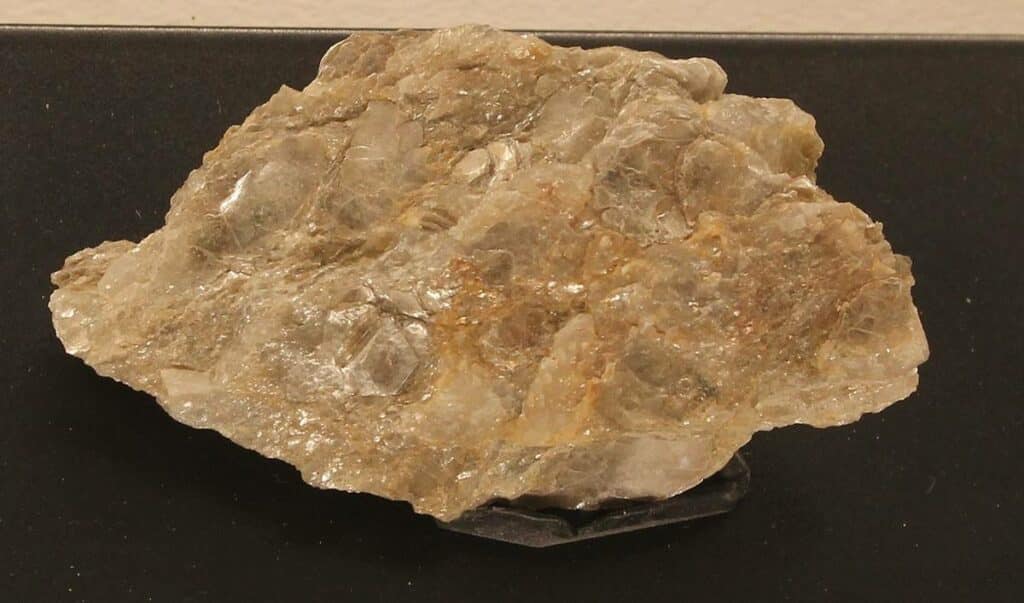
1. Paragonite
Paragonite (NaAl2(AlSi3O10) (OH)2) is a pearly sodic white, grayish-white, pale yellow, colorless, or greenish mica mineral related to muscovite. It has a density of 2.78, a Mohs scale hardness of 2.5-3, and a refractive index of 1.564-1.609. Paragonite is an important host for strontium and boron, particularly during exhumation.
.jpg)
2. Phlogopite
Phlogopite (KMg3AlSi3O10(F, OH)2) yellow, yellowish brown, brown, dark brown, reddish brown, green, gray, or white mica group minerals with a pearly luster. However, it may have a submetallic cleavage. Its Mohs scale hardness is 2-2.5, a specific gravity of 2.78–2.85, and a refractive index of 1.530 – 1.618. Some of the uses of phlogopite include plastics, heat shields, asphalt roofing, and rubber.


3. Moonstone
Moonstone ((Na, K) AlSi3O8) is a pearly feldspar group gemstone that comes in numerous colors, including blue, white, pink, grey, green, brown, peachy, or colorless that also displays opalescent schiller. Its Mohs scale hardness is 6, with a specific gravity of 2.61 and a refractive index of 1.518 – 1.526. Some specimens may also chatoyant or show cat’s eye effect.


4. Osakaite
Osakaite (Zn4SO4(OH)6·5H2O) is a pale blue, white to colorless transparent mineral with a pearly luster and a perfect {001) cleavage. It has a specific gravity of 2.70 and a one on the Mohs hardness scale.


5. Nacrite
Another mineral with pearly shine is nacrite Al2Si2O5(OH)4. This phyllosilicate clay mineral has a slight iridescence and may be grey, brownish, white, yellowish, and other colors. Its Mohs scale hardiness is 2-2.5, and its specific gravity is 2.6.

_-_Mineralogisches_Museum_Bonn1.jpg)
Minerals with pearly and other lusters
Luster isn’t a good diagnostic property in mineralogy because specimens of the same mineral can show several kinds. Also, it is very subjective since it doesn’t have well-defined boundaries.
For instance, a vast majority of pearly minerals are also vitreous. Examples include dolomite, mica, rhodochrosite, lepidolite, muscovite, prehnite, apophyllite, barite, and smithsonite. Other popular ones are hypersthene, anhydrite, cryolite, autunite, baryte, etc. We cannot exhaust the list here because it is quite long.
Also, many other minerals have a vitreous luster and are pearly only on their cleavages, such as selenite, calcite, kyanite, celestine, plagioclase, orthoclase, stilbite, enstatite, amblygonite, anthophyllite, etc. Again, it becomes difficult to diagnose minerals using luster accurately.
Besides vitreous, you will find minerals like strashimirite, tungstite, and spadaite, whose luster is pearly to greasy, while aurichalcite and misenite are pearly to silk. Also, barbertonite is pearly to waxy, and kaolinite, pyrophyllite, quetzalcoatlite, and zaherite have a pearly to earthy or dull luster.
We haven’t mentioned minerals that can be resinous or metallic to pearly or might show several kinds. For instance, gypsum can be silky, pearly, waxy, or dull, while talc may be subvitreous, vitreous, pearly, silky, or earthly.
References
- Manutchehr-Danai, M. (2009). Dictionary of gems and gemology (3rd ed.). Springer.
- Rutley, F. (1988). Rutley’s elements of mineralogy (26th ed.). Unwin Hyman. https://doi.org/10.1007/978-94-011-6832-8
- Anthony, J. W., Bideaux, R, A, Bladh, K. W., & Nichols, N. C., (Eds.) (2022). Handbook of mineralogy, Mineralogical Society of America, Chantilly, VA 20151-1110, USA. http://www.handbookofmineralogy.org/
- Price, M., & Walsh, K. W. (2005). Rocks and minerals (1st ed.). Dorling Kindersley.
- Grotzinger, J. P., & Jordan, T. H. (2014). Understanding Earth (7th ed.). W.H. Freeman and Company.
- McGraw-Hill. (2003). Dictionary of Geology and mineralogy (2nd ed.). McGraw-Hill Education.
- Nesse, W. D. (2018). Introduction to mineralogy (3rd ed.). Oxford University Press.
- Mccarthy, T. (2015). Understanding Minerals & Crystals. Struik Publishers (pty) Ltd.
- Ohnishi, M., Kusachi, I., & Kobayashi, S. (2007a). Osakaite, Zn4SO4(OH)6.5h2O, a new mineral species from the Hirao Mine, Osaka, Japan. The Canadian Mineralogist, 45(6), 1511–1517. https://doi.org/10.3749/canmin.45.6.1511