
Cinder cone volcanoes or scoria cones are small, steep-sided, conical-shaped, nearly circular, or oval hills. These hills are made of highly vesiculated, mafic to intermediate loose pyroclastic fragments or ejecta.
What are they made of? These volcanic cones mainly have cinders. However, they can also have ash, lapilli, volcanic blocks, and volcanic bombs.
Cinders colloquially refers nut- to fist-sized or larger, highly vesicular red or black rock fragments. These fragments form during explosive eruption of gas or volatile-rich magmas that cool while in flight.
Cinders means nearly the same as scoria. A reason why we also call these small conical hills are scoria cones. Scoria is a mafic to intermediate, highly vesiculated, dark-colored pyroclastic rock.
So far, the key terms you have learned are vesicular, mafic, intermediate, and pyroclasts. These terms are essential in defining cinder cones correctly.
Pyroclasts is a collective term for clasts or fragments ejected into the air during a volcanic eruption. They include cinders, ash, lapilli, volcanic bombs, and blocks.
What about vesicular? This textural term refers to rocks or fragments with many voids, pits, or cavities.
Mafic refers to low silica, dark-colored rocks rich in iron and magnesium minerals, while intermediate ones are those whose composition lies between mafic and felsic composition.
Lastly, felsic are silica-rich, light-colored rocks rich in feldspars, quartz, feldspathoids, or muscovite.

Appearance, description, and facts
Cinder cones are small, steep-sided conical hills with a characteristic concave shape and a bowl-shaped crater.
They have steep slopes because the cinder has the highest repose angle, about 33 degrees. This is the steepest angle at which materials will remain stable, i.e., not slide downslope under gravity.
Therefore, young eruptions will have a slope of up to 33 degrees. However, eroded ones will be less steep.
Scoria cones are circular or oval and nearly symmetrical around their central vent. However, they can appear elongated, or one side can be higher, usually the one downwind, during the final eruption phase.
An important fact to know is that scoria cones have relatively large and deep craters at the crater at the peak or summit compared to their overall size.
Also, cinder cone volcanoes are the smallest and simplest volcano types or eruptive landforms. They are usually 30-300 meters high and up to a kilometer (0.6 miles) across.
However, few rare examples exceed 700 meters in height, covering tens of kilometers area. Even the larger ones are still small compared to shield volcanoes or stratovolcanoes.
Composition
Cinder cones mostly have unconsolidated cinders and some lapilli, ash, volcanic blocks, or bombs of mafic to intermediate composition.
Most cinder or scoria cones are of basaltic or basalt andesite in composition. However, those of carbonatite occur.
Also, any other volatile-rich magma can form these volcanoes. However, those of felsic composition are pumice cones.
Which eruptions form scoria cones?
Cinder or scoria cone volcanoes form from mostly strombolian eruption types. However, it can form from moderate Vulcanian or gentler Hawaiian eruptions. Rarely will the form from sub-Plinian eruptions.
Most of these eruptions grow rapidly and die off, i.e., are short-lived. Those that erupt for longer will result in larger and higher cones.
If these eruptions interact with water, they will result in phreatomagmatic explosions. Such an eruption will instead form maars, not scoria cones. Maars are low relief craters.
How do cinder cone volcanoes form?
Cinder cones form during explosive eruption of magma rich in volatiles. These magmas are mostly of basaltic or mafic to intermediate composition.
Hot streaming gases throw lava fragments (blobs), ash, and other clasts into the air. Then, the exsolution and rapid gas escape from vesicles or cavities in ejected lava blobs.
These vesiculated blobs solidify while still in flight before raining down around the vent with ash, glassy shards, and other clasts. Thus, they don’t weld together.
The falling clasts will accumulate and form a pile of steep-sided oval or circular conical volcano of loose fragments and a bowl-shaped vent we call a cinder or scoria cone.
During formation, larger fragments will fall closer to the vent. Such will form stable, steeper slopes. Finer clasts, on the other hand, will travel further and create a gentle slope near the base. This forms their characteristic concave shape with a vent at the top or summit.
Most cinder cone volcanoes form from a single eruption, i.e., monogenetic eruptions. Afterward, the magma in the vent connecting to the source will solidify. These prevent future eruptions.
Most of the single-phase eruptions are short-lived. However, some can go on for years.
According to Tarbuck et. Al (2017), one study found 50% of all cinders formed in less than a month and more than 95% in less than a year.
However, some may result from polygenetic (more than one) eruptions. For instance, Cerro Negro in Nicaragua has erupted more than 20 times since 1850.
Some scoria cones may also form extensive lava fields. Lava flows during the last stage when the eruption is out of gas. This lava flows through unconsolidated base material, not from the crater.
Lastly, alteration of aligned vents during eruption may form twin cones. Also, nesting, burial, or breaching may occur if eruption power varies. Breaching occurs when lava breaks some material from the cone.
Famous cinder cone volcano examples
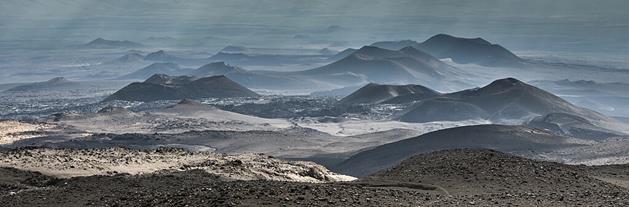
There are thousands of cinder cones around the globe, doting various landscapes. Most are monogenetic, and a few are polygenetic.
These scoria cones may occur alone or as clusters in larger groups or fields. Some are parasitic, i.e., occur on flanks of flanks of shield volcanoes, stratovolcanoes, or in calderas.
Note examples in the US:
- The San Fransico Volcanic field near Flagstaff in northern Arizona has over 600 scoria cones. Popular examples here are Sunset Crater and S P Crater.
- Many parasitic scoria cones occur at Mauna Kea, Haleakala, and Kilauea volcanoes in Hawaii and Newberry Volcano in Oregon. Newberry Volcano has over 400 scattered scoria cones.
- Red Hill-Quemado volcanic field in New Mexico has about 40 cinder cones.
- Colorado Plateau Edge and Eastern California have monogenetic cinder cones.
- Cinder Cone in Lassen Volcanic National Park, which has Fantastic Lava Beds
- Red Hill Cinder Cone is in Coso Volcanic Field, California.
- Albuquerque and Santa Fe in New Mexico have these cones.


.jpg)
.jpg)
Outside the US, notable examples are Mexico’s Michoacan-Guanajuato field with nearly 1,000 cinder cones.
Also, Mt Etna in Italy formed a cinder cone during the August 2001 eruption, attracting tourists. Another one is Cerro Negro in Nicaragua we mentioned earlier.
However, Parícutin cinder in Mexico is the most famous cinder cone example globally. It shows how volcanic landforms evolve.
Parícutin erupted in 1943 and continued for nine years, creating a 424 m tall cinder cone covering 25 km2 of Mr. Dionisio Pulido’s corn farm.
Also, it covered the village of Parícutin and caused a 10-meter thick clinkery aa flow that covered San Juan Parangaricutiro, leaving only the church steeple.
Lifespan
Weathering and erosions will continually change the shape and size of cinder cones during their lifetime.
These volcanic landforms have a short lifespan in geological time scale. This makes them temporary landscape features.
As Lopez (2005) notes, cinder volcanoes have a 1–100-year lifespan. This is relatively short compared to Complex volcanoes, which have a 1 to 10-million-year lifespan, Somma and caldera 100,000 to 1 million, and stratovolcanoes 10,000 to -100,000 years.
Their lifespan is short since they have unconsolidated to slightly sintered materials that easily succumb to erosion and weathering.
Hazards
Hazards are limited to near-vent lava fountaining, ballistics, and ass-flow. However, if it involves lava, it may travel far. Also, some eruptions like Parícutin, which had lava flow, may be hazardous.
Frequently asked questions
Both have similar shapes and structures with their difference in composition. Pumice cones have felsic or lighter, usually rhyolitic, or sometimes dacitic, light, highly vesiculated, spongy, or froth-like volcanic fragments. In comparison, scoria cones have dark mafic to intermediate denser, highly vesiculated fragments.
References
- Tarbuck, E. J., Lutgens, F. K., & Tasa, D. (2017). Earth: An introduction to physical geology (12th ed.). Pearson.
- Plummer, C. C., Carlson, D. H., & Hammersley, L. (2016). Physical Geology (15th ed.). McGraw-Hill Education.
- Huff, W.D & Owen, L.A. (2013). Volcanic Landforms and Hazards. In Shroder, J. (Ed). Treatise on geomorphology (Vol. 4 pp. 157-158). (2013). Elsevier.
- Lopes, R. (2005) The Volcano Adventure Guide (1st ed). Cambridge: Cambridge Univ. Press.