
The law or principle of cross-cutting relationships states that any geologic feature or rock body that cuts across or deforms another is the younger of the two, i.e., it is younger than the geologic structure, feature, or rock body it cuts through or deforms.
This law can help you determine the relative age of rock layers, superposition, and sequence of events. Also, it can help where radiometric techniques cannot accurately date fossils. Such cases arise in unconformity.
Learn more about cross-cutting relations, including meaning, examples with diagrams, and the various types. We will tell you its significance (what it can determine) and a possible exception.
Historical background
Nicolaus Steno (1638-1686), born Niels Stensen, was a Danish anatomist, geologist, and later Priest who first proposed the law of cross-cutting relationships in Prodromus in 1669. Steno also proposed the law of superposition, lateral continuity, and original horizontality.
Later, James Hutton (1726 -1797) formulated the idea before Sir Charles Lyell (1797–1875), English Geologist, expanded it to the current form. Lyell is renowned for publishing the then-widely used five volumes of Principles of Geology.
What is the principle of cross-cutting relationships?
The law or principle of cross-cutting relationships states that any geologic feature or rock unit that cuts or deforms another is younger than the rock body or geologic feature/structure it cuts or deforms.
It is a sensible and logical law that implies that the cutting, penetrating, or intruding rock body or geologic feature is younger than what it cuts, penetrates, or intrudes. It is like you cannot make a hole in a house wall you haven’t yet built.
From the above definition of the principle of cross-cutting relationships, we can deduce that:
- Extruding rock bodies are younger than any feature, structure, or rock body they cut but older than any above them they didn’t pass through.
- Any penetrating rock minerals are younger than the rocks they penetrate.
- Faults or fractures are younger than rock layers, features, or structures they break but older than those above that they don’t, as formation or deposition happens later after the faulting.
- Any folds and other deformations are older than events or forces that cause the deformation.
- In case of any unconformities, i.e., buried erosional surfaces, they are always younger than the rocks, structures, or features under them.
Here is a video to further explain the cross-cutting relationships:
Examples of cross-cutting relationships and diagrams
You expect cross-cutting relationships to be complex in real life or your studies. You may have several dikes, batholiths, faults, unconformities, etc. To solve any problem, you must simultaneously apply the superposition principle and the law of cross-cutting relations to determine relative rock layer ages and event sequences.
Cross-cutting relationships will tell you what event came first, and superposition tells you which layer is older than the other.
Let us start with a diagram showing cross-cutting relationships among rocks below with three sedimentary layers, a fault, and an intrusion.


Interpretation of relative age and sequence of events
- From the diagram, using the principle of superposition, we can deduce that rock layer C is the oldest, followed by B and A in that order.
- The igneous intrusion was the second event since it cut through all the layers.
- Faulting happened last since it fractured and displaced all the layers, including the igneous intrusion.
Here is a more complex diagram showing various cross-relationships that include unconformity.
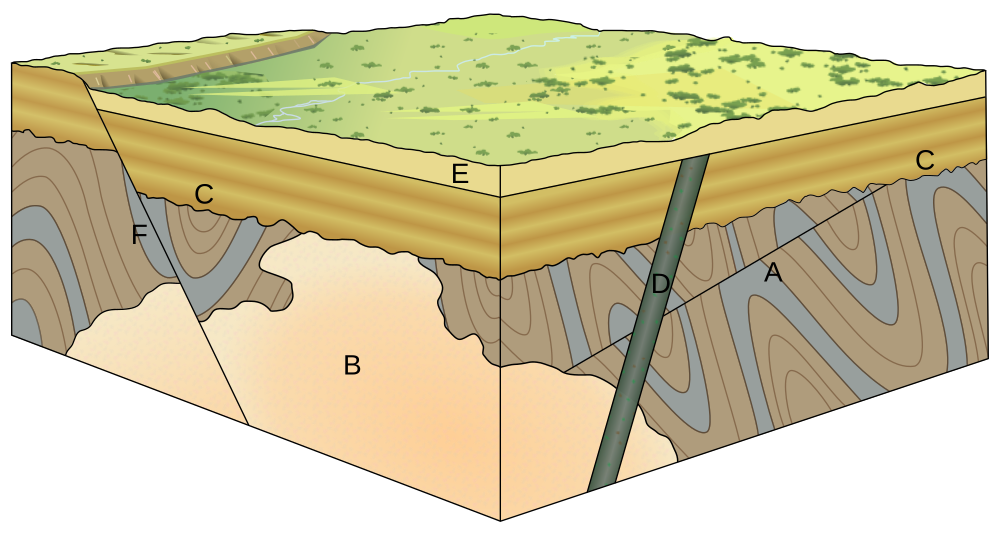

Here is the likely relative age and sequence of events:
- Layer A first formed.
- The folding of A happened.
- The thrust fault of A followed (it didn’t cut B, C, or D)
- Extrusion of B (happened after A but not before C)
- Unconformity (cuts A and B)
- C Strata C deposited above A and B
- Extrusion D happened with layers A, B, and C present but not E.
- Younger layer E formation
- Faulting (cut through all the layers, i.e., A, B, C, and E)
Type of cross-cutting relationships
Understanding the type of cross-cutting relationships is important in correctly interpreting the sequence and relative age of strata, structure, or geological features.
Here are the basic types:
1. Structural relationships
Structural relationships occur when fractures, including faults or joints, cut through an older rock body, i.e., disrupt the internal structure, form, or arrangement. A joint is when the fracture occurs with no or little displacement of rocks, while fault results in a noticeable one, i.e., it can be a heave, throw, or slip.
For structural relationships, the cut or disrupted rock layers or geologic structures/features are older than the process that results in deformation. Therefore, you can know the order of sequence. Again, if there are any rock layers without faults or fractures, it means they formed after faulting or fracturing.
2. Intrusional relationships
Intrusional relationships occur when a pluton, or intrusive igneous rock mass, intrudes through an existing rock body. Typical examples of the intrusional relationships that cut through rocks include dikes and batholiths, which are concordant.
However, it is possible to end up with discordant intrusion. Examples are lopoliths, sills, and laccoliths. These kinds will intrude parallel to an existing rock bedding.
In intrusive relationships, any rock layers, geological feature, or structures intruded on is always older than the one that cut through them.
These cross-cutting relationships will have plutonic rocks and bake the surrounding ones, making them undergo contact metamorphism, further evidence intrusion happened when surrounding rocks were present.
Lastly, intrusion can happen in various ways that, including:
- Magma moves upwards, creating and filing a crack before solidifying into intrusive igneous rocks. As this happens, it will deform (fold nearby rocks) and metamorphize them.
- Magma may fill existing fractures as it moves upward. In such a case, it may not deform neighboring rocks but will bake them.
- An intrusion may happen without forming a fracture, i.e., magma may eat (chemically react or melt) surrounding rock as it intrudes before solidifying into an intrusive igneous rock. Of course, it will bake neighboring rocks, making them metamorphic.
3. Stratigraphic relationships
Sometimes, geological features, structures, or older rock layers get cut across by surface erosion or unconformity. This disruption represents a stratigraphic relationship. Any deposition above eroded or deformed rock layers, geological features, or structures will be younger.
4. Sedimentological relationships
Sedimentological relationships can help reveal the sequence of past events or what happens first. Here the original cross-cutting relationships are sedimentary.
For instance, water or currents may erode a sedimentary rock, causing a sand-filled channel. This channel may later lithify, forming a sedimentary rock, and resembles what will happen if a rock layer fractures to the surface. Then, sediments fill the crack and lithify. Also, water (surface or underground) can fill the gap, and the minerals in the solution precipitate, forming sedimentary rock.
Another possible scenario is having several layers of sediments, including a lower one with wet sand. If a fracture on the layers above the wet sand occurs, the pressure exerted by the upper layers will make some wet sand move up and fill the fracture. If the whole structure lithifies, you will have a sedimentological relationship.
In all these cases, the cutting sedimentary structure is younger than the rock layer or sediments it cuts. Meaning filled channels or cracks are younger.
5. Paleontological relationships
Paleontology studies fossils to help classify various organisms and show how they interacted amongst themselves and their environment. Therefore, paleontological relationships concern how animal or plant activities cause disruptions or truncations in rock strata or geological features/structures.
A simple example is the burrowing of animals into a sedimentary deposit. In such a case, we can establish that the rock layers existed before burrowing, showing the sequence.
6. Geomorphological relationships
Geomorphology is the study of landforms and how the landforms have evolved. An example of geomorphological relationships is a river flowing over rock ridges or an impact crater removing top surficial rock layers.
Again, using geomorphological relationships, we should know what happened first, i.e., the sequence. For example, in the case of excavation from the impact crater, the rock layers excavated are older, i.e., were present before the event.
Occurrence magnitudes of this principle
Cross-cutting relationships can occur at various levels, from small (microscopic) to large (macroscopic) or even at a cartographic level. A microscopic cross-cutting requires a microscope to see it. For instance, you will need a microscope to see a fossil shell cutting across a rock layer as a boring animal drills.
On the other hand, a cross-cutting megascopic if it is large enough to see with an unaided eye, such as a dike that only covers a small geographic area. In contrast, we call cross-cutting relationships cartographic if they cut on a large landscape area on a map, such as a long fault cutting through an expansive landscape.
Significance
Cross-cutting relationships are important in relative age dating. By looking at the sequence of events and applying the principle of superposition, you can know the relative age of intrusions, faults, or other deformations within successive rock strata.
It is based on the fact that the deforming or intruding events happened later after sedimentary rock layers, some structures or features already existed. Therefore, they are younger.
Secondly, sometimes, radiometric techniques cannot give the age of fossils. You can employ cross-cutting relationships and radiometric age dating to get the age bracket in such a case.
To elaborate on the second use, imagine you get a fossil on a rock layer between two unconformities. Each, the lower and upper unconformities truncate dikes. Applying cross-cutting relationships and radiometric age dating, you can determine the age bracket of the fossil by determining the age of the two dikes.
Possible exceptions to this principle
When using cross-cutting relationships in relative age dating, there are some exceptions where the cutting structure didn’t necessarily form last. However, this depends on how you will look at the scenario.
Imagine a rock cutting through surrounded by sedimentary rock layers. An obvious assumption would be the outcrop cut through sedimentary rock layers and will be younger.
What if the surrounding sedimentary rock layers eroded from an initially existing outcrop rock hill, settled around it, and lithified? It means the outcrop or cutting rock is older than the surrounding sedimentary rock layers.
Another way of looking at it is that the old, eroded rock is nothing that an old, unconformity element. Why? Because it has an erosional or non-depositional surface.
References
- Levin, H. L., & King, D. T. (2016). The Earth through time, 11th edition (11th ed.). Wiley.
- Cross-cutting relationships. (2023, February 5). In Wikipedia. https://en.wikipedia.org/w/index.php?title=Cross-cutting_relationships&oldid=1137636951
- Grotzinger, J. P., & Jordan, T. H. (2014). Understanding earth (7th ed.). W.H. Freeman and Company.
- Earle, S., & Earle, S. (2015, September 1). 8.2 relative dating methods. Physical Geology. https://opentextbc.ca/geology/chapter/8-2-relative-dating-methods/
- Lutgens, F. K., Tarbuck, E. J., & Tasa, D. (2018). Essentials of geology (13th ed.). Pearson.