
The law or principle of inclusions states that a rock containing another rock fragment is younger than the rock fragment or inclusion it encloses.
For instance, a sandstone with granite fragments inside is younger than the adjacent granite. Of course, you know that sand sediments that make sandstone are older than sandstone, but you can get the relative age of sandstone and granite.
Let us examine the law of inclusions, including definition or meaning, examples, and significance. We will also give you some possible scenarios.
Overview
Sir Lyell Charles (1797–1875) was a great geology teacher and interpreter. He explained what we now call the principle of inclusions, known as the principle of inclusions and components, by discerning that a rock fragment inside another rock mass is older than the rock mass enclosing it.
Lyell wrote five volumes of Principles of Geology in the 1830s. He also explained the principle of cross-cutting relationships, which Nicolaus Steno had proposed earlier in 1669 in his dissertation, popularly known as Prodromus. Prodromus had other important stratigraphic principles, i.e., the principle of original horizontality, superposition, and lateral continuity.
Definition of the principle of inclusions in geology
The law or principle of inclusions states that a rock fragment included in or enclosed by another rock is older than the enclosing rock. It applies to rock masses in contact or adjacent, and we can use it to know relative age, including events that resulted in rock mass formation.
In other words, Lyell’s principle of inclusions implies that any rock fragments inside a host rock body are older than the host rock. Why? Because to be included in a host rock, the rock fragments had to exist during the host rock body formation. Otherwise, the fragment’s inclusion will be impossible.
The principle of inclusions is a basic, straightforward, and logical law and can apply to structures contained in others.
Lastly, don’t confuse this law with the principle of inclusion and exclusion (PIE), a technique used to compute or count several elements that satisfy at least one of several properties while ensuring you don’t recount any of the elements that satisfy more than one property.
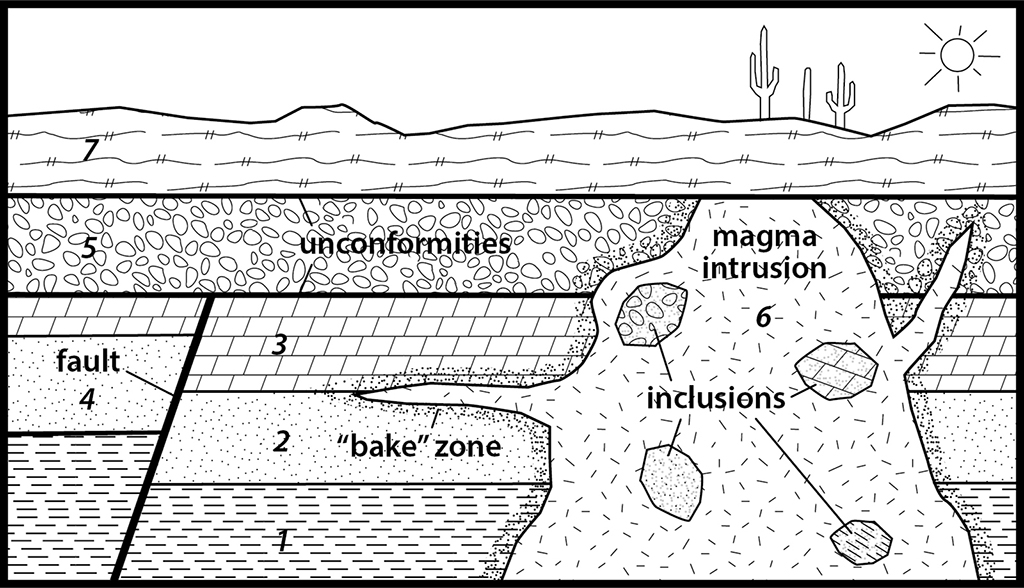
showing inclusions in magma intrusion. Applying this principle, you can deduce that the intrusion is younger than the surrounding rocks.
Here is a video to give you more on the principle of inclusions:
1. What are inclusions?
Before we go further and give you examples, we should talk a little more about inclusions. An inclusion is any rock fragment found in or enclosed in another rock. In igneous rock, we call inclusions xenoliths. If the inclusion is a mineral crystal (or crystal fragments), we call it a xenocryst.
On the other hand, inclusions in sedimentary rock are clasts or rock fragments. These clasts have different lithologies and mineral or chemical compositions from the enclosing sedimentary rock. Examples of inclusions in sedimentary rock are clasts of igneous or metamorphic rocks.
Lastly, note that the term ‘clasts’ is not specific as it refers to rock fragments from preexisting rock broken down into smaller sizes by weathering. For instance, clastic may mean particles in sediment transport, sedimentary or pyroclastic rocks.
2. Example
A basic example illustrating the principle of inclusions is imagining you want to make round cookies with nuts inside. You will take your dough, add nuts inside and make it round. Afterward, you will bake these cookies in your oven.
Therefore, you have to add nuts before you can bake the cookies, not after, meaning nuts were present before the baked cookies with nuts. Similarly, any inclusions in a rock mass must have existed before the enclosing rock lithified (sedimentary) or crystalized (igneous). Therefore, the inclusions are older.
3. Principle of inclusions explanations
The law of inclusions tells us that if you have rock fragments or inclusions A inside rock B, rock A is older than rock B. Let us look at a few scenarios to help further elaborate and correctly interpret the relative age of the involved rock bodies and events. As you do so, don’t forget to check for any baked margins if igneous rocks are involved.
1. Overlaying rock with xenoliths from the underlying rock
In this case, you will have the upper rock body having xenoliths of the lower rocks. Please note that the upper layer can be igneous (from lava flows such as basalt or rhyolite) or sedimentary. And the lower layer can be sedimentary, metamorphic, or igneous.
What does it mean? It implies that the upper rock with inclusions is younger than the lower and, if igneous, beneath the rock body/layer, predates the lava flow event.
What if the upper rock body is igneous? It means that lava flows picked or plucked xenoliths from underlying rocks. Later it crystalized, enclosing them. You should see evidence of baked margins on the lower rock layer.
On the other hand, if the top rock layer with fragments is sedimentary, it could have gotten/incorporated the inclusions from weathered or eroded lower rocks. However, in this case, you will not have baked margins adjacent to the rocks beneath.
2. Underlaying rock body having inclusions of the overlying rock
As per the law of inclusions, the lower rock body is younger. It implies the lower rock body intruded, trapping some fragments from the existing upper rock body before crystallizing. Therefore, it is an intrusive igneous rock, and the above rock will have a baked layer just above the rock mass that intruded.
In the above case, you cannot apply the principle of superposition as it is only limited to undisturbed, sedimentary rock layers.
3. Rock body with xenoliths from upper and lower layers
Sometimes, you can have a rock layer or body with inclusions from the top and beneath rock layers. Such a case occurs in sill formation. As magma pushes between existing rock layers, it picks xenoliths from the upper and lower rock layers.
Therefore, the upper and lower rock layers are older, and the one with xenoliths is younger. Also, there will be evidence of a baked layer adjacent to the top and lower rock layers.
Significance
In its most basic definition, the principle of inclusions says that for any two rock masses in contact, the one that hosts fragments of the other is younger. Therefore, we can use this principle in relative age dating.
Knowing which event preceded the other, we can develop a relative order or sequence of past events, including the formation of rocks, structures, or features. This dating method differs from absolute dating, which gives actual age estimates.
Possible exception to this principle
A challenging situation is where an intruding dike cuts through several rock layers. It means it is younger than the rocks it cuts by the principle of cross-cutting relationships.
However, if the dike is deformed or torn into small rock pieces surrounded by host rocks, it is possible to mistake the fragments from the dike as xenoliths. Such an event may make things appear as if xenoliths (from deformed dike) are older, yet they are younger.
References
- Levin, H. L., & King, D. T. (2016). The earth through time (11th ed.). Wiley.
- Nelson. A. S. (2017, October 17). Geologic time. Tulane University. https://www2.tulane.edu/~sanelson/eens1110/geotime.htm.
- Wicander, R., & Monroe, J. S. (2010). Historical geology: Evolution of the earth and life through time (6th ed.). Books-Cole.
- Panchuk, K. (n.d.). 19.2 relative dating methods. Physical Geology. First University of Saskatchewan Edition. Retrieved February 28, 2023, from https://openpress.usask.ca/physicalgeology/chapter/19-2-relative-dating-methods-2/.
- Lutgens, F. K., Tarbuck, E. J., & Tasa, D. (2018). Essentials of geology (13th ed.). Pearson.