
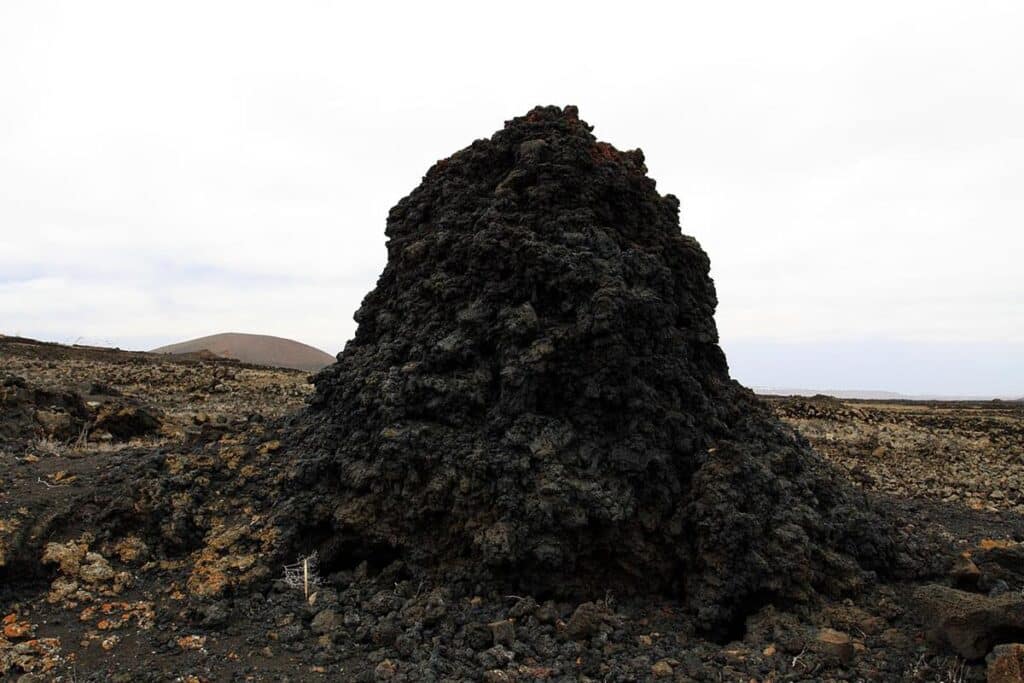
Hornitos are small, rootless, conical, or nearly vertical pipe-like volcanic landforms or structures that occur on the surface lava flow fields.
These structures form when lava spatters from cracks on roofs of tube-fed pahoehoe lava flows under magmatic pressure.
Larger ones may resemble small spatter cones. However, unlike spatter cones, they are rootless. The other rootless cones are littoral cones.
Rootless means lava isn’t fed directly from a vent connected to a magma chamber beneath the surface. Instead, they get their magma from a horizontal tube network connected to the vent.
Therefore, morphology, not size or resemblance, should differentiate spatter cones from hornitos.
What is the name’s origin? Hornitos literally means ‘little ovens’ in Spanish, while hornilla means stove or oven. These volcanic landforms resemble traditional outdoor wooden-fired ovens.
Also, these little chimneys, stacks, or pinnacles with steep slopes are known as driblets.
.jpg)
D.A. Swanson, Public domain, via Wikimedia Commons

Description and appearance
Hornitos are features of lava flow morphology common in pahoehoe lava fields.
These small mounds, conical to tube-like rootless spatter cones, occur on the upper side of lava tubes where the crust breaks. Cracking or breaking of the crust allows magma to spatter and form them.

Usually, they measure tens of meters wide and up to 10 meters high. However, some are exceptionally large.
Large ones measure a few tens of meters high and almost 100 meters wide or more. Their size is like small spatter cones.
Usually, large hornitos occur where several lava tubes intersect. This allows more lava to ooze faster due to high magmatic pressure, allowing the cracks to remain open long without freezing.
Note that size depends on how long the crack stays open, and the magmatic pressure remains significant.
While most hornitos tend to appear as rugged mounds, towers, or vertical pipes, some have lower slopes and smoother surfaces. This reflects the highly fluid magma flowing down, making it broader and the outer surface smoother.
Also, as lava flows through the opening, it may form a complex and artistic morphological structure. This may include twisted and fluid magma droplets.
Composition
Hornitos are associated with the low viscosity mafic lava flows, especially basaltic. However, any other highly fluid lava flowing in tubes can form this volcanic landform.
How hornitos form
Hornitos form when the roof of a lava tube fails or develops cracks or openings.
Magmatic pressure will then force a small amount of magma flowing in lateral tube networks to ooze or squeeze through the opening and spatter on the surface of the tubes. This spattering is what solidifies the building of these volcanic landforms.
Sometimes, the opening may close quickly enough, preventing further oozing. However, if it continues long, the spattering will form a conical to steep-sided mound-like rootless landform on top of the tube.
Usually, hornitos form as lava accumulates, layer after layer on top of each other during the spattering.
Note that the magmatic pressure comes from the difference in elevation between the magma origin at the vent and the location where the opening occurs.
Some studies consider a link between steam or vapor buildup as lava flows in wet areas to contribute to hornito formation.
Lastly, when the magmatic pressure is high, it may initiate a spectacular incandescent fountain that can build larger hornitos.
Hornito degradation
They tend to degrade faster since they occur amongst more resistant lava flows.
One reason is their porous nature and the fact that they are made of clasts. These two factors provide zones for surface water runoff to accumulate, resulting to more surface erosion than surrounding lava fields.
Hornitos occurrence
Hornitos occur in almost every major lava flow in the world, characterized by tube-fed flows.
Some places you will find them include Hawaii in the USA, such as on the eastern side of Halemaʻumaʻu crater floor and at Pu`u `O`o.
Also, they occur in the Arabian Peninsula, Patagonia in South America, Deccan in India, and Columbia River Basalts in the US
References
- Németh, K. (2015). Hornito. In Hargitai, H. & Kereszturi, Á. (ed) Encyclopedia of planetary landforms (2nd ed. pp. 940-943). Springer.