
Index fossils, also known as key, guide, or indicator fossils, are preserved remains of ancient organisms. These organisms were abundant, geographically widespread, distinctive, easily recognizable, and fast-evolving. Examples are Ammonites and trilobites like Bathyuriscus rotundatus, Graptolites, Scaphites, and Brachiopods.
Geologists and scientists use index fossils to identify and define geologic periods or faunal stages. These organisms help assign relative ages of rock layers and fossil assemblages. Also, they assist paleontologists and stratigraphers in correlating rock strata in different geographical locations.
Today, we will look at index fossils, including their meaning and characteristics or what makes a fossil a good fossil index. We will also tell you what they are used for/why they are important, how to find them, and more.
Fossils and biostratigraphy
Fossils are remains or traces of ancient organisms (plants and animals) that once lived on Earth preserved in the sedimentary rock units. They include bones, leaves, feathers, burrows, tracks, dropping, shells, and impressions. Also, they can be any other thing that proves the existence of certain faunas or floras.
Most fossils belong to an organism that once existed, with 99.9% extinct. They won’t emerge again. However, they help us glimpse into the life history of the Earth.
Lastly, the use of fossils (index fossils and fossil assemblages) to date and correlate rock strata is known as biostratigraphy. It was pioneered by William ‘Strata’ Smith, an English geologist and canal surveyor. To explain his observation, he postulated the law or principle of faunal succession.
What are index fossils?
Index fossils are remains of preserved ancient organisms. These organisms were abundant, widespread geographically, distinctive, recognizable, and with a short geologic time.
These organisms identify or define various geologic periods or faunal stages. Also, they serve as a key, indicator, or guide in telling the geologic period, i.e., when certain rock layers formed and their relative age.
Index fossils can be macrofossils (large enough to see without a microscope) or microfossils (hard to see without a microscope). Also, they can be plants or animals, but most are animals.
Here are videos to further widen your knowledge:
Let us look at which organisms made good key fossils and their characteristics.
1. Which organisms make good index fossils?
Most index fossils are from organisms that were successful in being abundant. However, they were vulnerable to extinction or evolved fast. So, their time on Earth was short, i.e., they had boom-and-bust characteristics.
Most of these organisms were pelagic (marine organisms living in the open sea or ocean). However, a few were terrestrial (land), benthos (living at ocean bottoms), or littoral (existing near shores).
Pelagic organisms are the most common index fossils because most sedimentary rocks form in the sea. Also, currents moved these pelagic or floating/swimming marine organisms, including their eggs and larvae, across the globe. Furthermore, the bottom of sea conditions didn’t affect them much.
The only thing that affected them was 1) food distribution and 2) environmental differences in water masses. But, such a change was short-term; unlike extinction, they would return when favorable.
Similarly, plants with spores or seeds moved by wind could be widespread. However, not many plant index fossils exist. Probably, they are not easy to preserve in sedimentary rocks.
Lastly, some benthic groups are good guide fossil guides. However, the bottom ocean environment affects them. Also, in recent times (Cenozoic Era), some mammals have served as key fossils but for regions. A good example is the quick-evolving rodents.
2. Examples of index fossils
Examples of macrofossils that serve as index fossils include Trilobites, graptolites, branchiopods, ammonoids, gastropods, Echinoderms, conodonts, and corals.
On the other hand, microfossils like Foraminifera, Radiolaria, and Calcareous nanofossils are index fossils. Other are ostracods, diatoms, conodonts, acritarchs, dinoflagellate cysts, conodonts, spores, pollen, foraminiferans, and chitinozoans.
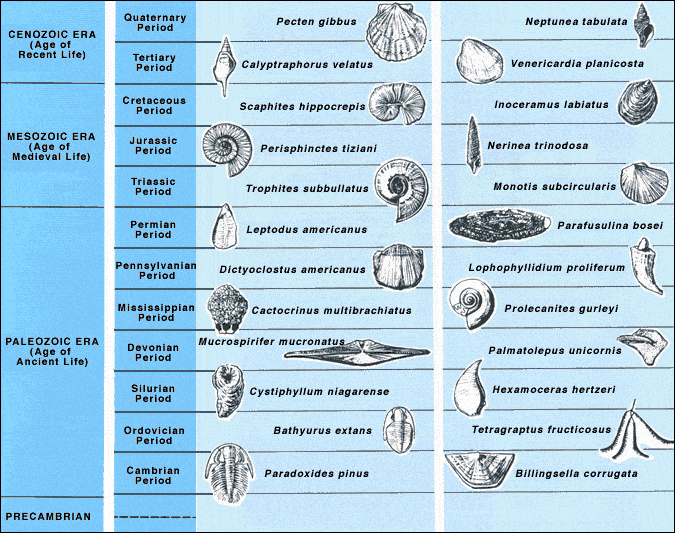

3. What makes a good index fossil?
Some of the important traits or characteristics of an index fossil include the following:
a). Be abundant
Abundance is a very important characteristic of index fossils. These organisms must be in large numbers. Otherwise, the chance of finding one in a rock formation you are studying is next to impossible.
b). Be geographically widespread
A key fossil must occur over a wide geographical area, i.e., in different continents and environments. Such organisms must tolerate various ecological regions. Also, they should be independent of facies.
Fossils widespread in certain facies indicate a paleoenvironment and cannot give relative age.
However, note that younger plate tectonic activities may give a false impression that an organism was widespread, yet it was restricted to a region in which it existed. For instance, Triassic Pacific terranes evolved in the middle of the paleo-Pacific ocean but are now in North America and Japan due to younger tectonic movements.
Also, waves may move empty shells, giving a false impression they are widespread, yet they were in one zone.
c). Have a short geologic time – be short-live/evolve fast
Ideal index fossils should exist for a short geological time to give accurate rock ages. They should appear, go extinct, and never reappear or evolve into a distinctive organism within a short geologic period. Such organisms have a short geologic range or time on Earth and will be in narrower stratigraphy columns (vertical strata).
Organisms with a higher evolution rate will take a short geologic time to show the biological change that identifies them as unique. Such organisms will give more index fossils than those that don’t.
Lastly, you cannot use organisms that lived for an Era, such as the Paleozoic, to identify a period like Silurian, which lasted 25 million years. It will not give precise relative ages.
d). Easy to recognize or identify
A guide fossil must have easy-to-recognize morphology taxonomic traits like a skeleton. For instance, ammonites have a coiled-body appearance with sutures and ornaments. Thus you can easily notice them.
Organisms that are hard to identify will require further study, making them unsuitable.
e). Distinctive
A guide fossil can be easy to recognize but not distinctive from others. Such will confuse. i.e., it is possible to assume it to be a different organism that resembles it. A good one should instead be distinctive.
f). Preservable
Guides fossils must be easy to fossilize. For instance, organisms with hard shells or bones are easier to preserve than soft-bodied ones, like jellyfish, slugs, or worms that quickly decay.
However, that is not always the case. Birds have an intercontinental range but poorly fossilizes. Their bones fall apart and degenerate fast, leaving fragments. Thus, you cannot use them to study, making them unsuitable index fossils.
Lastly, besides being easy to fossilize, actions of waves, other animals, etc., damage, destroy, or scatter the bones of some existing organisms, leaving only fragments.
3. Suitability of an organism as a key fossil
You will get questions on the suitability of a certain organism from being a guide fossil. To answer it, check if it passes the above characteristic of good index fossils, i.e., is it abundant, widespread, short-lived, preservable, distinctive, and easy to recognize?
Let us look at a few examples:
1. Why is ginkgo not an index fossil?
Ginkgo is not a good index fossil because it is not widespread (naturally occurring in China). Also, it has existed for a long geologic time (since the Permian or 270 million years). This indicates its rate of evolution is slow.
2. Is a shark a good index fossil?
No, because sharks are not widespread and have lived for a long geologic time. The earliest shark shell evidence dates back over 420 Ma, during the early Silurian. Therefore, finding a shark fossil in strata may not help give a precise relative age of the rock layer that has it.
3. Will man one day be a good index fossil?
It depends. Yes, if there is mass extinction of all men (homo sapiens) who have lived for about 300,000, they will make an excellent index fossil.
Humans are widespread, unique, and abundant. Also, their fossils will be easily recognizable and preservable.
However, since we cannot be sure how long humans will live or how it will take to evolve completely, we cannot be certain they will be a good fossil guide.
How can we find these indicator fossils?
Index fossils are preserved in sedimentary rock layers. Therefore, to find them, study your geologic maps to know where sedimentary rocks are. These will be good prospective areas.
Pick areas whose rock age you know. Those with outcrops, on cut roads, railway lines, quarries, or excavated for other constructions are the best.
Next, take your rock hammer, loupe, chisel, hand lens, and any other tools you need and visit your prospective areas. Patiently search for these fossils on various outcrops.
Lastly, contrary to what many assume, ocean beds constantly renew (subducted into the mantle). Therefore, they are not a good place to find key fossils. Instead, use those on land.
How do scientists and geologists use index fossils?
Index fossils are used in the following ways by scientists, geologists, or paleontologists:
1. To define periods of the geologic time scale
Geologic periods are time intervals that last millions of years (mostly tens of millions). When combined together, they form geological columns or time scales. From this column, you can see geologic periods in their sequence.
you can use index fossils to define geologic periods (time intervals) like Ears, periods, Epochs, Ages, etc., in a geologic time scale (GTS) or column. Also, they can form a basis for the boundaries.
For instance, some boundaries denote periods of mass extinction (mass disappearance within a short time), and the evidence is in fossils. A good example is the Permian-Triassic extinction.
2. Provide the relative age of rock and fossil assemblages
Fossilized organisms lived when the sedimentary rock layer that contains them formed. They didn’t live before or after. Thus, they existed simultaneously with any fossil assemblage present in the formation.
Therefore, index fossils help know the relative age of rock layers and fossil assemblage above or below a layer. Remember also to apply the law of superposition where a layer above is younger and below is older.
2. Stratigraphic correlation
Strata intervals with unique fossil assemblage or index fossils form a fossil zone, not restricted by formation boundaries. Therefore, similar fossil zones in different parts of the world or continents have the same age. The assumption is that the same organisms lived in the same geologic period, irrespective of location.
Consequently, stratigraphers can correlate different strata worldwide to see how the globe was at any interval of its past. Correlation can reveal tectonic activities, past environments, and other geologic events.
Lastly, when applying fossil correlation, ensure you look at the position of a fossil in strata. Is it at the bottom, middle, or top? That will have an impact on when it existed.
Identifying good index fossils on stratigraphic column diagrams
You may get diagrams (stratigraphy columns) with rock layers containing different fossils. To know which the ideal index fossil is, consider one that 1) abundant, 2) is widespread (occurs in many locations in different continents or several stratigraphic columns), 2) is very distinctive, 3) is easy to identify, and 4) lived a short geological time (found in only one layer or fewest).
Rock layers don’t have to be at the same level in a stratigraphic column. Also, some may be missing due to unconformities. However, you can still match the layers and determine the index fossil.
Let us use the example below to tell you which index fossils would be best.


From the above diagram, we can deduce the following:
- Gastropod is widespread but not short-lived (occurs in many layers). Therefore, it is not a good key fossil.
- Crinoid is widespread. However, it occurs in several rock layers (not short-lived), making it unsuitable too.
- Fern occurs in several rock layers (not short-lived). Also, it is not widespread geographically, i.e., it is found in one region. Therefore, it is not an ideal key fossil.
- Trilobite occurs only in a single layer. However, it is not widespread. Thus, it will not tell you how old other rock layers far away are.
- Ammonite is widespread (occurs in various regions), short-lived (occurs in one layer), easy to identify, and distinct, making it a good fossil index. We know they lived between the Jurassic and Cretaceous part of Earth’s history, i.e., 201-66 million years ago. So, the rock layers with it are about that age.
We know ammonite is 201-66 million years old, and by the law of superposition, we will assume the lower low is older and the upper younger by the law of superposition.
Conclusion
While fossils are important, don’t forget lithology is still important. It gives more information on rocks and not just the presence of fossils.
References
- Brookfield, M. E. (2004). Principles of stratigraphy. Blackwell Pub.
- Kusky, T. M., & Cullen, K. E. (2010). Encyclopedia of earth and space science. Facts on File.
- Levin, H. L., & King, D. T. (2016). The Earth through time, 11th edition (11th ed.). Wiley.
- Plummer, C. C., Carlson, D. H., & Hammersley, L. (2016). Physical Geology (15th ed.). McGraw-Hill Education.
- Tarbuck, E. J., Lutgens, F. K., & Tasa, D. (2017). Earth: An introduction to physical geology (12th ed.). Pearson.
- Prothero, D. R., & Schwab, F. (2014). Sedimentary geology: An introduction to sedimentary rocks and Stratigraphy (3rd ed.). W.H. Freeman and Company.