
Biostratigraphy is a branch of stratigraphy that uses fossil content to correlate and determine the relative ages of strata. Its basic units are biozones; you can have taxon-range, abundance, interval, lineage, and concurrent-range biozones.
In our first part, we look at biostratigraphy, significance, historical background, and something on biochronology. We also have something separate on biostratigraphic correlation, biocorrelation, and biozones/biostratigraphic zones and units.
This discussion will take a more practical approach by looking at biostratigraphy in the field and guide you on defining boundaries. We will also discuss events resulting in fossil appearance/disappearance and the time significance of biostratigraphic events. Finally, you will have the challenges of using biostratigraphic fossil records.
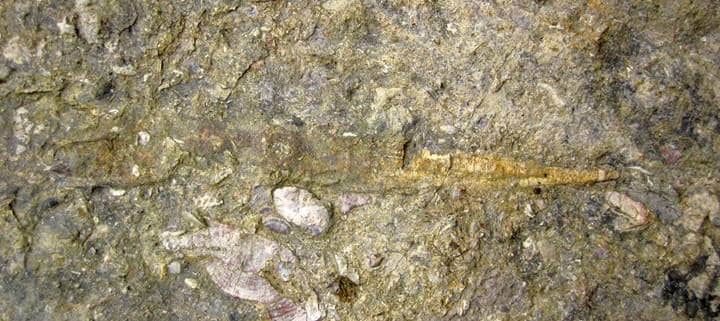
_(Lower_Mercer_Limestone,_Middle_Pennsylvanian;_Rock_Cut,_Muskingum_County,_Ohio,_USA)_3_(34373741635).jpg)
Biostratigraphy in the field
To recognize and define biozones, you need an accurate description of fossil taxa in the preliminary study. This should allow for quick, easy, and correct identification of individual fossils.
Furthermore, to use fossils as a geologic time marker, plot a vertical stratigraphic range or distribution of every fossil. Otherwise, your data will not be helpful. Of course, you also need a fossiliferous study area.
During this process, you need a pen, paper, hand lens, cold chisel, geologist’s hammer, scale, etc. Once on site, start by getting an accurate, large database of as many fossils as possible from one or more sections in your local area. As you collect fossils, accurately indicate each specimen’s stratigraphic data.
Step two: clean and identify each fossil correctly. Some distinctions require an expert, and some will be challenging if they haven’t been studied for a long time. Such will have information on where they lived and when. Also, poor preservation may result in incorrect identification and, consequently, a miscorrelation of strata.
Step three, compile your data into zonation. Each fossil divides geologic time into 1) the time before it appeared, 2) the duration of its existence, and 3) the time since it disappeared.
Lastly, note that the local range is a fossil’s partial range zone or teilzone and serves as an empirical database for biostratigraphy. However, it doesn’t represent any fossil’s total spatiotemporal (time and space) range.
Biostratigraphic boundaries
The next task will be establishing biostratigraphic boundaries or biohorizons. These surfaces indicate a change in a stratigraphic section’s fossil content or biostratigraphic character. It could be the appearance, disappearance, or relative abundance change.
1. Events that cause fossil appearance/disappearance/change in abundance
Evolution, migration, extinction, and local environments affect appearance, disappearance, or variation in quantity.
1. Organic evolution
Speciation of phyletic evolution results in the disappearance and appearance of fossils in stratigraphic records in an area, region, or worldwide. It helps us correlate rock strata and the relative age of these strata.
2. Extinction
Local, regional, or global extinction results in the disappearance of fossils locally, regionally, or globally.
3. Migration (immigration or emigration)
Organism migration away or to the place of study may cause a disappearance or appearance that has no time significance. Also, it can cause a change in abundance.
4. Depositional environment
The depositional environment can affect the appearance and disappearance of fossils of sensitive organisms’ stratigraphic record. Also, it can influence relative variation in abundance.
However, if the environment remains constant, then an appearance would indicate speciation that is time significant and disappearance extinction or evolution because organisms wouldn’t migrate if the climate has not changed.
2. Boundary terminologies
When establishing boundaries, understanding these terminologies will make your work precise.
1. FO and LO
First occurrence (FO) represents when the organisms first appeared in strata by evolution or immigration – stratigraphically the lowest point within a local succession. FO may not indicate the first instance of speciation since it may start at one end, and the taxa must be abundant enough to appear in strata in various places.
The last occurrence (LO) represents the last appearance by extinction or emigration – stratigraphically, the highest point within a local succession. Again, it doesn’t mean the last occurrence globally.
2. FAD and LAD
The first appearance datum (FAD) or first occurrence datum (FOO) represents the first known appearance of a species or organisms in a geologic record globally. It is the oldest fossil species found up to date and helps designate segments in the geologic time scale. Also, it can be used to define Global Boundary Stratotype Section and Point (GSSP).
On the other hand, the last appearance datum (LAD) or last occurrence datum (LOO) represents the last known up-to-date appearance of a fossil taxon in a stratigraphic record.
LAD represents extinction or phyletic extinction/pseudoextinction (where a species evolves into a different one, i.e., the original species goes extinct, but its daughter continues with lineage).
Time significance of Biostratigraphic events
Biostratigraphic events that make biozone boundaries or markers, i.e., the appearance and disappearance of fossils, include organic evolution, immigration/emigration, and extinction. They can be time-significant or not.
One assumption by stratigraphers is that biostratigraphic events are synchronous. Some studies and experiments have shown they can be homotaxis (not contemporaneous) or asynchrony/heterochrony. But still, there is robust evidence to support the synchronous assumption.
Let us look at these biostratigraphic events and how they affect biozone boundaries.
1. Organic evolution: Phyletic evolutionism vs. punctuated equilibria
Evolutionary first occurrences don’t repeat and happen in a unique place and time. Thus, they make a good boundary. However, they are rare and may not occur in sections of the study.
There are two theories of organic evolution, i.e., phyletic gradualism (slow, uniform, and gradual speciation), punctuated equilibrium, or both. Punctuated equilibria theorize that evolution occurs via short bursts of speciation followed by a stasis (a long period of stability with little evolutional change).
How does each affect biozone boundaries?
a). Phyletic gradualism boundaries
The phyletic gradualism model presents difficulties in choosing boundaries, i.e., you need to pick an arbitrary point. When do you decide on the first occurrence? Is it when 50% of the population shows a new character or, in the first instance, something unnatural in biology?
Also, if you consider gradualism, it means you must treat statistical morphological variability to define species. An example will be looking at the shells’ length-to-width ratio.
Lastly, gradualism can result from repeated immigrations, not in situ evolutionary lineage change, and may be ambiguous.
b). Punctuated equilibria boundaries
Since, in practice, it assumes the appearance and disappearance of species without intermediaries. Thus, the appearance of fossils will define boundaries.
2. Migration – emigration and immigration
Immigration and emigration events can be unambiguous and abrupt and thus don’t make good boundaries. As a time marker, it presents a challenge since organisms can immigrate severally at different times.
3. Extinction
Extinction is unreliable as some organisms linger long in one place after they disappear in another place. However, they can be good as these boundaries occur around mass extinction that marked a major happening or episode major history of life.
Challenges of using stratigraphic fossil records
Some of the challenges of using stratigraphic fossils include the following:
1. Migration
Migration affects stratigraphic fossil records. For instance, immigration followed by speciation and immigration to the original site may result in no fossils. Similarly, emigration and regional extermination before worldwide extinction will indicate a wrong last appearance.
Also, limited migration after the first appearance (evolutionary first appearance from an ancestor) will affect the stratigraphic fossil record.
2. Fossilization and preservation issues
A depositional environment and diagenetic history may alter or remove fossils. This may be via a chemical process, physical compaction, dissolution, metamorphism, etc.
Also, only a small population of organisms may be fossilized, or unfavorable facies and rock types may fail to preserve fossils.
3. Hiatuses
Incomplete records from unconformities (intermitted deposition or erosion), except for deep marine, often affect fossil records.
4. Sampling:
Various aspects of sampling can affect stratigraphic fossil records. These aspects include sampling interval (what is their smallest size to detect boundaries of species effectively), inaccessibility of strata for sampling, and accidental omission of fossils in sampling.
Also, sedimentation constancy and rates will affect the sampling interval. For instance, you need smaller intervals when the speed is slow.
5. Mode of taxonomic classification and biostratigraphic zonation
To recognize evolution and biostratigraphic zonation, we use taxonomic classification based on morphological similarities (shell or skeletal) and development and assume genetic relationships. The genetic connection is inapplicable due to possible degradation in the fossil record.
Unfortunately, morphological similarities or differences may result in incorrect classification and zonation. For instance, birds or dogs may have different forms but the same genetically. Such a variation means placing species in different taxonomies when they are not.
References
- Prothero, D. R., & Schwab, F. (2014). Sedimentary geology: An introduction to sedimentary rocks and Stratigraphy (3rd ed.). W.H. Freeman and Company.
- Boggs, S. (2014). Principles of Sedimentology and stratigraphy (5th ed.). Pearson Education.
- MacLeod, N. (2005). Biozones. In Selley, R. C., Morrison, C. L. R., & Plimer, I. R. (Eds.). Encyclopedia of geology (Vols. 1-5). Elsevier Academic.
- North American Commission on Stratigraphic Nomenclature. (2021). North American stratigraphic code. Stratigraphy, 18(3), 153-204. https://ngmdb.usgs.gov/Geolex/resources/docs/NACSN_Code_2021.pdf
- Brookfield, M. E. (2004). Principles of stratigraphy. Blackwell Pub.