
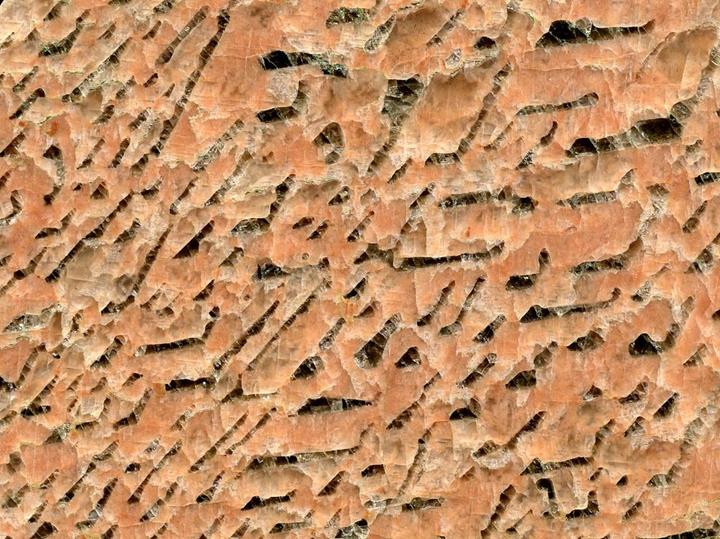
Graphic granite refers to granitic rocks with quartz-alkali feldspar intimate intergrowths whose texture or pattern resembles ancient cuneiform or runic writings or inscriptions. These rocks have somewhat parallel, tubular, long, rod-like quartz crystals in a feldspar (alkali feldspar or sodic plagioclase) matrix.
Feldspar may have microscopic to several inches of euhedral to subhedral crystals, while quartz will have several inches of subhedral skeletal crystals. Therefore, quartz crystals are readily visible with an unaided eye.
While these crystallographically parallel, including in patches of quartz rods, may appear disjointed and dendritic, “it is clear that the network of quartz stringers is almost entirely interconnected in three dimensions through the feldspar host” (London, 2008).
Graphic granites are almost exclusive to granite pegmatite. They are said to be leucocratic (light-colored) since they lack mica and any of the mafic (iron or magnesium-rich) dark minerals.
As you know, pegmatites are intrusive or plutonic igneous rocks with unusually large crystals. These rocks form from a low-viscosity fluid phase formed during the crystallization of the last portion of magma melt.
Most of these pegmatite-textured rocks are granitic, but others are intermediate or mafic. Also, some may have unusual minerals or elements like beryl, boron lithium, tourmaline, spodumene, etc.
Lastly, besides granite, it is possible to have graphic texture from other exsolved (unmixed) minerals like magnetite, pyrite felspar, or pyroxene. However, they are rare.
What is the origin of the term graphic granite?
The term graphic originates from the Greek word Graphos or the Latin word Graphus, which means to write. It denotes the script-like appearance that resembles cuneiform or runic writings where the darker, glassy quartz appears as letters or characters written on a lighter or whitish feldspar groundmass.
Sometimes, people use terms like runic, Schriftgranit, or Hebraic pegmatite to describe the appearance of this inscription-like texture. Some do resemble Arabic writings.
At times, the graphic texture is sometimes known as exsolution texture. It occurs when homogenous solid solutions separate into distinctive crystalline minerals with no materials added or removed.
For our case, we have alkali feldspar with exsolved (unmixed) quartz, resulting in intimate intergrowths of these two minerals. You will have crystals of skeletal habit quartz rods in the feldspar matrix.
Pictures or images


_(Precambrian;_Zhitomir,_Ukrainian_Shield,_northwestern_Ukraine)_1_(15002243092).jpg)
_(Paleoproterozoic_intrusion_in_the_Belomorian_Terrane_of_the_Baltic_Shield;_Enskoye_area,_east_of_Kovdor,_southwestern_Kola_Peninsula,_far-nw_Russia)_1_(14815902989).jpg)
Mineral composition
Graphic granite is a bimeneral rock of a leucogranite (light-colored or leucocratic granite) composition. It primarily has feldspar – alkali feldspar (especially K-feldspar or microcline) or sodic plagioclase – and quartz with no dark minerals like mica (muscovite, biotite or lepidolite), amphibole, etc., which usually occur in granitic rocks.
A microscopic examination reveals that alkali feldspar and plagioclase form a perthite. Perthites are irregular intimate intergrowth of these two unmixing or exsolution minerals. However, However, it may be a macroperthite with visible exsolution minerals. Also, the amount of K-feldspar is more than plagioclase.
Lastly, the composition of quartz to feldspar ratio ranges from 10:90 to 50:50, with the felspar more in most granitic rocks with this texture.
What are the graphic granite rock colors?
A granite graphic is a light-colored rock made of off-white, tan, salmon, pinkish, or cream feldspar (host) and glassy or vitreous colorless, smokey, or grayish rod-like quartz crystals.
While the exact colors may vary, quartz will appear a little darker and have a glassy texture, while quartz will be lighter. Also, quartz forms rod-like crystal structures.
How is graphic granite formed?
A graphic granite rock will form from simultaneous crystallization under conditions that favor quartz to grow rods and feldspar to have a planar growth. And being intrusive, the cooling is slow.
Since this texture forms on pegmatitic rocks, probably, these two crystals probably grew together as the last portion of magma melt crystallized. Such magma has low viscosity and is water-rich. This low-viscosity, water-rich magma allows faster and larger mineral crystal growth.
As feldspar crystals grow, the disparity between this crystal growth rate and silica diffusion rate in bulk magma creates a silica-enriched boundary. This enrichment may trigger a degradation from the planar to a cellular interface.
Any further feldspar growth on the cellular interface will enrich the in-between grooves with silica. This will result in forming (nucleation) and growing quartz crystals alongside feldspar.
The rhythmic quartz-feldspar intergrowth is a possible result of undersaturation and oversaturation of silica. Quartz crystals will grow only when there is an oversaturation of silica and won’t in case of an undersaturation.
Another possible explanation for the occurrence of graphic granite is a partial replacement of alkali feldspar (orthoclase, K-feldspar, or potassium feldspar) by quartz in hydrothermal conditions.
Graphic granite uses
Since they don’t occur in large masses, their uses are limited. In most cases, graphic granite rocks mainly serve as decorative stones or gemstones. Their uses include spheres or pendants.
Also, they may be incorporated in architectural designs such as on façades, as with Vitelli family Palaces built in the 15th or early 16th century.
References
- Fenn. P. M. (1986). On the origin of graphic granite. American Mineralogist, 71 (3-4), 325–330.
- Dietrich. R.V. (2005, August 16). Graphic granite. Central Michigan University. http://stoneplus.cst.cmich.edu/graphic.htm
- Graphic granite. (n.d.). Mindat.org. Retrieved September 13, 2022, from https://www.mindat.org/min-39400.html
- Barker D. S. (1970). Compositions of Granophyre, Myrmekite, and Graphic Granite. GSA Bulletin, 81 (11): 3339–3350. doi: https://doi.org/10.1130/0016-7606(1970)81[3339:COGMAG]2.0.CO;2
- London D. & Mineralogical Association of Canada. (2008). Pegmatites. Mineralogical Association of Canada.