
Pegmatites are intrusive or plutonic igneous rocks with wholly crystalline, unusually large, or coarse crystals that may sometimes interlock. These rocks form from a low-viscosity fluid phase rich in volatile compounds formed during the crystallization of the last magma portion.
Usually, pegmatitic rocks will have crystals that are at least 0.4 inches (1 cm) in diameter, with the larger ones more than 1.2 inches (3 cm) and some as large as 10 m (33 feet). Did you know that pegmatites host the largest crystals, like mica, microcline, spodumene, beryl, quartz, and tourmaline? Some are several feet in size and weigh thousands of tons.
The other thing is that these crystals may vary in size. But some may be equigranular – have nearly equal crystal sizes. Also, they may be spatially zoned and directionally oriented.
Most pegmatites have quartz, feldspar, and mica, with a silicic composition similar to granites. However, this texture can be shown by mafic rocks like basalt, gabbro, syenite, etc.
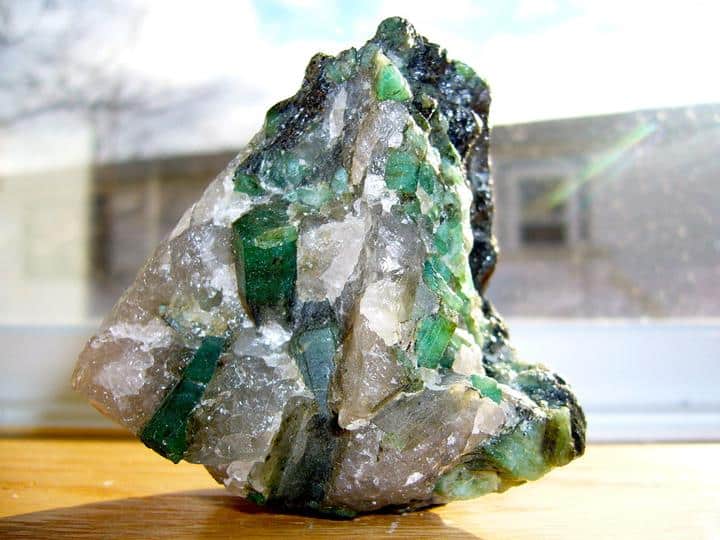
Lastly, while not common, some pegmatites have compositions like nepheline syenite. Also, some may be of intermediate to mafic composition. Gabbro is a mafic example.
Origin and history
The word pegmatite comes from a Homeric Greek word πήγνυμι (pēgnymi), which means to bind together, denoting the intertwined quartz and feldspar crystals.
René Just Haüy, a French mineralogist, first used it as a synonym for graphic granite to describe the intertwined quartz and feldspar crystals that resembled writings.
However, a few years later, in 1845, Wilhelm Karl Ritter von Haidinger used it as it currently means – a rock with abnormally large crystals formed from a fluid phase as the last part of magma crystallizes.
How are pegmatitic rocks named?
Pegmatite or pegmatitic texture only describes the texture, not the mineral composition.
Therefore, we may use the rock name as a prefix to indicate the mineral composition. For instance, granite pegmatite, diorite pegmatite, or gabbro pegmatite suggest that the said rock has granite, diorite, and gabbro composition, respectively.
However, there is no unanimity on naming. For instance, the British Geological Survey prefers using abundant minerals as prefixes. For example, instead of granite, it prefers biotite-quartz-feldspar pegmatite.
Secondly, sometimes, they are named according to their valuable or exploitable gemstones, elements, or minerals. Examples are emerald, spodumene, tourmaline, lepidolite, beryl, aquamarine, or lithium pegmatite. This method will not tell you information about composition.
Lastly, since the word pegmatitic is an adjective, it is right to use this adjective then the rock type. For instance, you can have pegmatitic granite or gabbro.
How and where do pegmatites occur?
Pegmatite bodies are smaller than usual magma intrusion and may be pod-like, tubular, cigar-shaped, inverted teardrop, or irregular-shaped.
They can occur as segregated small pockets or bodies within a large intrusive rock body or extrude into country rock, forming sills, lenses, or even pegmatite dike – a dike composed of pegmatitic textured rock.
Therefore, you will commonly find pegmatite as small pockets, veins, dikes (including dike swarms), or lenses, especially at the margins of batholiths.
Geographically, you will find pegmatites anywhere in the world, and they commonly occur on cratons and greenschist-facies (Barrovian facies) metamorphic belts. Unfortunately, not much information is available on geographic distribution, as only those with economic significance are well documented.
Lastly, some areas with notable pegmatitic rocks in the US include South Dakota, Colorado, California, and New England. Outside the US, they occur in Brazil, Pakistan, Afghanistan, Mozambique, Burma, Madagascar, South Africa, Russia, Germany, Canada, and Norway.
What are the pegmatite colors?
Since most have a granitic composition, pegmatites are pinkish, gray, or whitish. However, you can find those that are colorless or darker (dark gray or black) if they have mafic minerals. Also, depending on the unique mineralogy, you will find some with red, brown, green, or other colors.
Pegmatite composition or mineralogy
Pegmatite can have a simple mineral composition typical of igneous rock or a complex one.
1. Simple pegmatite mineral composition
Most simple pegmatite will have mainly granite to granodiorite composition. Such rocks will mostly have large crystals of feldspar, quartz, and mica (like lepidolite, biotite or muscovite). Also, they may have any other minerals associated with granitic rocks like aplite.
However, some will have nepheline syenite composition. It is like granitic with quartz replaced with nepheline, a feldspathoid. And in rare cases, you may have pegmatite with intermediate to mafic rock composition.
2. Complex pegmatite mineral composition
Most complex pegmatites have a composition like granite but are enriched with some incompatible elements and minerals not typically found in most igneous rocks. Some may also be of intermediate to mafic composition.
Incompatible elements are those with a too-large or small atomic number or very high or low ionic charge or size. So they cannot participate in the rock formation. Instead, they will remain dissolved in water and eventually form their minerals.
Examples of incompatible elements in pegmatites are uranium (U), niobium (Nb), boron (B), yttrium (Y), phosphorus (P), fluorine (F), lithium (Li), zirconium (Zr) and beryllium (Be). Others are Strontium (Sr), Barium (Ba), scandium (Sc), Tantalum (Ta), thorium (Th), cesium (Cs), Tin (Sn), Titanium (Ti), Bismuth (Bi), and some Rare Earth Minerals (REEs).
These incompatible elements may form minerals such as pollucite (Cs), spodumene (Li), Beryl (Be), tantalite-columbite (Ta, and Nb), tourmaline (Li, B), cassiterite (Sn)
Also, complex pegmatites may also have beryl, lepidolite, topaz, apatite, garnet, emerald, spodumene, tourmaline, mica, monazite, and fluorite. Other minerals are amblygonite, triphylite, molybdenite, scapolite, columbite etc. These minerals are not typical in ordinary igneous rocks.
Lastly, the large crystal size of some pegmatitic rocks makes it hard to determine mineral composition accurately. It is hard to collect a representative sample.
How are pegmatites formed?
Geologists believe that pegmatitic rock from the low-viscosity superheated fluid phase that separates from the last portion of magma melts to crystallize and does not necessarily have a slower cooling rate. Of course, the cooling is slow, being intrusive.
At the initial stages following a significant magma intrusion, minerals with higher melting points will start crystallizing and slowly be depleted from the magma.
As the process continues, remaining magma increasingly remains with minerals with lower melting, water, and volatiles. These volatile compounds include carbon dioxide, boron, fluorine, chlorine, and phosphorus. Also, any incompatible minerals or elements will remain in this melt, specifically in water.
At the final stage of magma crystallization, the exceptionally high amount of dissolved water causes a phase separation. So, you will have the last magma melt and fluid phase or superheated water pockets rich in silica, alkalis, volatiles, and incompatible trace elements. The fluid phase is what forms pegmatites.
The presence of volatiles, i.e., water, carbon dioxide, chlorine, and fluorine, will tremendously lower the viscosity of the fluid phase (hydrous fluid). So, ions or molecules can move, migrate, or diffuse quickly to the crystal growth site.
Also, the crystal growth rate (ions or molecules joining a growing crystal) exceeds nucleation (formation of new nuclei or sites for crystallization). Otherwise, you will end up with many smaller crystals.
Lastly, pegmatite formation isn’t associated with intrusive rocks or magma. Such cases may be from melting or anatexis of metamorphic rock under high pressure and temperature. The melting will make fluids, volatiles, and trace elements sweat out, forming a fluid phase pocket seen in felsic gneiss.
Examples of pegmatites with images (pictures)

_5_(24151201317).jpg)

_(48751570932).jpg)

_1_(26214856670).jpg)


Mining operation
Exploitation of pegmatites for minerals and gemstones is a small mining operation that will employ a dozen people. The mining will follow dikes, sills, pockets, etc.
What are the uses of pegmatites?
Pegmatites are mainly a source of valuable gemstones or rare elements, some with industrial uses. Their use as architectural stones isn’t widespread.
Here are the main uses:
1. As architectural stones
Pegmatites don’t have many uses in construction or architecture. However, some, like granite, can be a dimension stone if attractive. For instance, it can be cut and polished to make slabs, countertops, tiles, etc. I have seen a granite pegmatite countertops. They look awesome!
2. May have valuable gemstones
Pegmatites contain some of the best gemstones, i.e., large crystals of excellent quality. These gemstones include emerald, amazonite, beryl, aquamarine (blue and pink), kunzite, morganite, topaz, zircon, tantalite, and tourmaline.
Goshenite, heliodor, lepidolite, spodumene, rubellite, indicolite, brazilianite, spessartine, chrysoberyl, fluorapatite and columbite.
3. Source of rare minerals
Complex pegmatite contains elements you can commercially exploit via small-scale mining operations. These minerals include beryllium, boron, lithium, molybdenum, tantalum, niobium, tin, tungsten, titanium, etc.
Getting fine or nice crystals may help facet rough or serve as mineral specimens instead of being sold as ores.
4. Industrial uses
Pegmatites with valuable elements like lithium or rare earth minerals (REEs) or minerals like mica sheets, commercial feldspar, quartz, or apatite have many industrial uses.
These uses include nuclear power, electrical and electronic (TV, cameras, mobile phones, computers, tablets), automotive (catalytic converters), ceramic, chemical industries, rechargeable batteries, etc.
References
- London, D. (2021). Pegmatites. Encyclopedia of Geology, 184–195. https://doi.org/10.1016/b978-0-12-409548-9.12489-3
- pegmatite | rock. (1998, July 20). Encyclopedia Britannica. Retrieved September 7, 2022, from https://www.britannica.com/science/pegmatite
- Pegmatite. (n.d.). Berkeley University of California. Retrieved September 9, 2022, from https://nature.berkeley.edu/classes/eps2/wisc/peg.html
- London, D. (2014, January). A petrologic assessment of internal zonation in granitic pegmatites. Lithos, 184–187, 74–104. https://doi.org/10.1016/j.lithos.2013.10.025
- Pegmatite. (n.d.). Mindat.org. Retrieved September 9, 2022, from https://www.mindat.org/min-50315.html
- Department of Geology & Planetary Science. (n.d.). Pegmatitic textures. University of Pittsburg. Retrieved September 9, 2022, from https://sites.pitt.edu/~cejones/GeoImages/2IgneousRocks/IgneousTextures/5Pegmatitic.html
- Introduction to pegmatites. (2015, April 15). The Arkenstone. https://www.irocks.com/whats-the-deal-with-pegmatites-fine-minerals-rocks
- Pegmatite. (2022, July 29). In Wikipedia. https://en.wikipedia.org/w/index.php?title=Pegmatite&oldid=1101203092
This is so well written, thank you. The pictures with descriptions following the material in the text are helpful.