
Hydrothermal metamorphism occurs when hot, water-rich fluids cause a change in the mineral assemblage and/or texture of existing parent (protolith) rocks. It usually has a local extent and often takes place with metasomatism. However, its effects may be regional, especially on the ocean floor.
Coombs (1961), a New Zealand mineralogist and petrologist, introduced this type of metamorphism. He is the one who also proposed burial metamorphism.
Today, we will look more into hydrothermal metamorphism, elaborating on what it is and how it occurs. We will also mention commonly associated facies, rocks, and more.
However, before that, let us look at metasomatism vs. metamorphism. It will prove more than important in grasping everything else we will discuss.
Metasomatism vs. metamorphism
Metasomatism occurs when externally derived fluids or flux of materials infiltrate and cause chemical reactions that alter or transform the chemical and mineral composition of igneous, metamorphic, or sedimentary rocks. During this alteration, temperature and pressure changes from tectonic events play a lesser or negligible role.
How does it occur? Usually, these fluids will introduce new external chemical components and remove some of those existing in parent rocks. They do so by simultaneously dissolving some minerals in a parent rock while incorporating new ions or crystallizing new minerals. This changes the overall composition or chemistry of involved rocks.
On the other hand, metamorphism is a change in the mineral assemblage and texture of parent rocks (protoliths) in response to changes in temperature and pressure (P and T). This process usually involves chemically active fluid.
Strictly speaking, rock chemistry doesn’t change during metamorphism, i.e., no new constituents are added or existing ones removed. The chemically active fluids only facilitate the recrystallization of new minerals, i.e., act as catalysts or fluxes to promote recrystallization.
However, in real life, metamorphism occurs with metasomatism. According to Fettes & Desmons (2007), metasomatism may produce similar rocks. However, it differs from hydrothermal metasomatic processes and with various metallogenic associations, creating difficulty. Thus, a separation of these two processes is necessary.
What is hydrothermal metamorphism?
Hydrothermal metamorphism occurs when hot, water-rich fluids (aqueous solutions and gases) transform rocks’ mineral assemblage and texture.
It happens when water percolates downwards into rocks through fractures or fissures, pores, grain boundaries, joints, faults, or shear zones. This water gets heated, dissolves some minerals present, and rises convectively.
As it rises convectively, the hot water will promote ion transport from one mineral to another, enhancing recrystallization. Recrystallization will then change mineral assemblages and sometimes the texture of parent rocks.
For instance, the hot water may react with amphiboles, feldspars, pyroxenes, and other rock-forming minerals to form clays and micas. This will alter mineralogical assembly and texture.
Usually, this metamorphism occurs in narrow zones adjacent to pores, fissures, or cracks where hot, water-rich fluids flow. However, in geothermal fields, it is extensive.
The water source may be from near or far and include underground or seawater. Also, magma’s rise, decompression, and crystallization may release ion-rich hot fluids. These fluids will infiltrate the surrounding rock and participate in prograde and retrograde reactions, notes Philpotts & Ague (2022).
Besides metamorphosis and metasomatism, ions in hydrothermal fluids may precipitate to form pegmatites (very coarse-grained igneous rock). Also, they may create valuable ores within the rock cracks or voids by concentrating minerals like iron or lead sulfide.
Last but not least. Winter (2014) observes that it is challenging to constrain hydrothermal metamorphism since hot, water-rich fluids participate in other metamorphism types, i.e., burial, contact, regional, etc.
Conditions and facies
Hydrothermal metamorphism is mostly low-grade, i.e., at low temperatures and pressure or shallow depths. However, it can occur at high temperatures.
Luckily, it is not hard to know in what conditions it occurred. Bucher (2023) states that boreholes can help study the composition of fluids and conditions (temperature and pressure).
Also, considering mineral assemblages in fluid-free metamorphic outcrops makes it possible to know the P, T, and fluids involved.
Since it mostly occurs at low grade, this metamorphism involves volcanic and volcaniclastic rocks high in glass (volcanic glass). These rocks may include volcanic tuff and rhyolites, andesites, or dacites. It also occurs in sedimentary rocks like greywackes, slates, shale, and marl.
Furthermore, being low-grade, complete, or perfect, recrystallization usually doesn’t happen. Thus, igneous and sedimentary textures of protoliths remain, i.e., they show no metamorphic evidence. Only hydrothermal metamorphism at greenschist facies or beyond will show metamorphic evidence.
Facies are mostly zeolite and prehnite–pumpellyite where involved rocks don’t crystallize thoroughly to achieve equilibrium. Most authors treat these facies as sub-greenschist facies.
Zoolite facies represent the lowest metamorphic grade. Minerals like mordenite, analcime, laumontite, wairakite, albite, and adularia mark zoolite facies. They start at 50° to 150 °C.
On the other hand, prehnite-pumpellyite facies will have slightly higher temperatures but still a low grade. It starts at about 250°C with the elimination of laumontite marking it. Also, prehnite, pumpellyite, calcite, and quartz may appear.
Lastly, as mentioned earlier, hydrothermal metamorphism can also occur at moderate to high temperatures. Barker (1998, p. 32 ) notes that “assemblages containing forsterite + diopside require high-T conditions and characterize metamorphosed siliceous dolomites from the innermost parts of contact metamorphic aureoles, and situations of very high T hydrothermal metamorphism.”
Where does it occur?
Hydrothermal metamorphism occurs in mid-ocean ridges or geothermal hotspots with susceptible rocks.
These hotspots have a high geothermal gradient and are abundant in large-scale hot, water-rich fluids or vapor emission. Such places may have hot springs or geysers and can generate hydrothermal electricity.
Some hydrothermal hotspots occur in New Zealand (especially Wairaki and Reykjanes thermal field), California (Colorado River delta in Salton Sea geothermal field), Mexico, Iceland, Japan (Onikobe and Hakone), Italy, and the Philippines, notes Bucher (2023).
Hydrothermal metamorphism is also widespread in Yellowstone National Park in Wyoming, USA. This National Park has a high geothermal gradient of 700-1000 °C km-1.
Additionally, ophiolites like Troodos ophiolite in Cyprus have low-grade hydrothermal metamorphic rocks that resemble that in oceanic crusts, notes All (1999)
However, it can occur anywhere where hot water or hydrothermal fluids circulate upwards convectively.
What is its extent?
Hydrothermal metamorphism usually has a local or small-scale extent, like contact metamorphism. It relates to certain settings like igneous intrusions mobilizing hot, mineral-rich water to surrounding country rock.
However, it occurs worldwide in the continental and oceanic crust or upper mantle since the mineralogical assemblage changes are developed more pervasively on a regional scale.
Also, it may be regional if you consider the sea floor with repeated hot fluid circulation.
Examples of hydrothermal metamorphic rocks
Examples of hydrothermal metamorphic rocks include pegmatites, serpentine, spilite, chloritolite, and soapstone.
Chloritolite is chlorite rock (chloritite) that occurs in veins and may have altered inclusions of the host rock.
On the other hand, spilite is a basalt that has undergone hydrothermal metamorphism and sodium metasomatism. In this rock, albite and chlorite replace plagioclase (An50–60) and augite, respectively. Also, it may have calcite, chalcedony, epidote, prehnite, and accessory minerals, says Oskruch & Frimmel (2020).
Ocean floor metamorphism
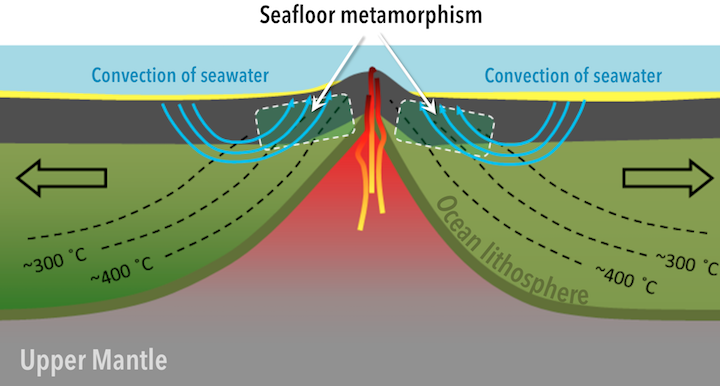
Ocean floor metamorphism is an example of hydrothermal metamorphism. It occurs mostly near the mid-ocean ridge (ocean spreading centers) axes. These axes have hot pockets of upwelling magma that create a new, young oceanic crust.
Some authors call it ocean ridge metamorphism since it is localized, i.e., it occurs mostly near mid-ocean regions. However, it has a regional extent since affected rock will spread throughout the entire ocean crust.
Ocean floor metamorphism happens when seawater percolates into fissures, cracks, or faults on the ocean’s crust, i.e., through mafic and ultramafic rocks (basalts, peridotites, gabbros, etc.). The water gets heated and dissolves some ions in these rocks.
Afterward, these hot fluids rise convectively to cause hydrothermal metamorphism and metasomatism. For instance, rising or circulating ion-rich fluids will metamorphosize rocks like basalt on the ocean’s crust into soapstone and serpentinite.
Also, the fluids will cause serpentinization of olivine. Olivine serpentinization occurs at 50–300 °C to form serpentine group minerals, especially lizardite. Other products may include brucite, awaruite, hydrogen, and magnetite.
Sometimes, water may get heated to over 350 °C gush from the seafloor, forming submarine hot springs or hydrothermal vents. These hydrothermal vents are associated with black and white smokers.
Lastly, during this metamorphism, anhydrous minerals like pyroxenes and olivine may recrystallize into hydrous amphibole. Such may later contribute to magma generation at subduction zones.
Significance
Hydrothermal metamorphism may produce economically important metal ores. For instance, hydrothermal fluids may precipitate cobalt, nickel, silver, gold, iron, and copper ores in veins and porous and highly fractured rocks. According to Tarbuck et al. (2017), it may be how copper ores mined on the Island of Cyprus in the Mediterranean Sea formed.
Also, hydrothermal vents may deposit valuable minerals. For instance, black smokers may deposit chimneys of sulfide-bearing minerals like iron Cu, Zn, Pb, Ag, and Au sulfides. In contrast, a white smoker chimney will precipitate barium, calcium, and silicon.
References
- Plummer, C. C., Carlson, D. H., & Hammersley, L. (2016). Physical Geology (15th ed.). McGraw-Hill Education.
- Tarbuck, E. J., Lutgens, F. K., & Tasa, D. (2017). Earth: An introduction to physical geology (12th ed.). Pearson.
- Fettes, D. J., & Desmons, J. (Eds). (2007). Metamorphic rocks: A classification and glossary of terms (1st ed.). Cambridge University Press.
- Bucher, K. (2023). Petrogenesis of metamorphic rocks (9th ed.). Springer.
- Winter, J. D. (2014). Principles of igneous and Metamorphic Petrology. Pearson Education.
- Philpotts, A. R., & Ague, J. J. (2022). Principles of igneous and Metamorphic Petrology (3rd ed.). Cambridge University Press.
- Okrusch, M., & Frimmel, H. (2020). Mineralogy: An introduction to minerals, rocks, and mineral deposits (1st ed.). Springer.
- All, J. C. (1999). Very low-grade hydrothermal metamorphism of basic igneous rocks. In Frey, M., & Robinson, D. (Eds). Low-grade metamorphism (pp168-201). Blackwell.
- Barker, A. J. (1998). Introduction to metamorphic textures and microstructures (2nd ed.). Stanley Thomes (Publishers) Ltd.
- Coombs, D. S. (1961). Some recent work on the lower grades of metamorphism. Australian Journal of Science, 24, 203-215.