
Obsidian is a natural volcanic glass often called a volcanic or extrusive igneous rock. IUGS considers it a mineraloid since it has > 80% glass.
This mineraloid or volcanic glass is usually jet black, dark gray, or dark brown. However, there are various obsidian types with other colors, sheens, and patterns, including swirls.
I guess your next question is where these obsidian types originate from. Let us briefly tackle that question before we can give you the various types.
While predominantly glassy, obsidian rock may have nano-inclusions, crystallites, and microlites that may be rod-shaped, globular, coiled, or fused into chains. Also, they can have bubbles of various shapes, including rounded, needle-shaped, torpedo-shaped, etc.
These microlites and crystallites include alkali feldspar, plagioclase magnetite, hematite, hornblende, pyroxene, etc.
Some of these crystallites, microlites, and nano or microscopic inclusions may impart various colors to obsidian. Also, those arranged parallel may reflect light, creating various sheens.
Here are the various obsidian types, varieties, colors, patterns, or sheens, most of which are valued gemstones with others associated with metaphysical properties.
1. Black obsidian
It is the most common type of obsidian, which is blackish in color. The dark gray to black color is due to the presence of crystallites of plagioclase, biotite, pyroxene, magnetite, and hornblende in a groundmass of glass. These minerals are mafic (dark-colored) due to iron and magnesium.
2. Snowflake obsidian
Snowflake obsidian has attractive white, radially formed blobs or eye-like spots embedded in a dark or black matrix or groundmass. This variety is also known as starry night or flowering obsidian and is common in Yellow Stone Caldera in Wyoming, Black Spring in Utah, and Glass Butte in Oregon, USA.
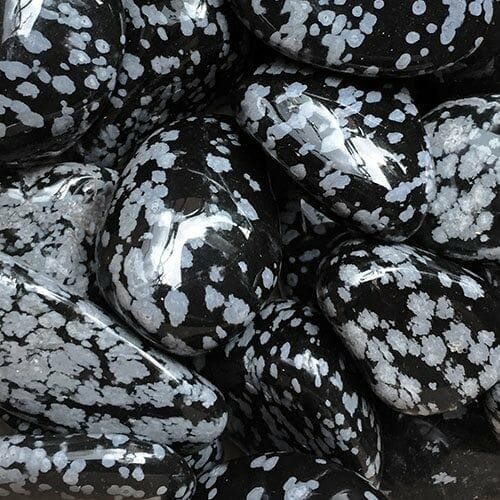
Usually, snowflakes have white cristobalite spherulites (small crystals clustered radially) or sanidine inclusions. Cristobalite (tetragonal polymorph of silica) spherulites form from partial devitrification of silica in a black glass at some spots. These white spherulites make it appear to have snowflake patterns or blotches.
However, some dark-green snowflake glass with cristobalite inclusions from Denmark is artificial and resulted from an error in the glass-making industry.
Lastly, a similar rock with white cristobalite spherulites in a reddish or hematite-colored rock is known in Gyumishkoe in Armenia
3. Gold and silver sheen or sheen obsidian
Gold and silvery sheen obsidian type is commonly from Mexico and Morocco. It has a golden or silky silvery iridescent effect or sheen due to trapped minute gas bubbles forming various patterns visible to the naked eye.
Usually, some of these bubbles stretch nearly flat along flow bands and cause silky silver or golden sheen or reflectance.
4. Fire obsidian
Fire obsidian is the most expensive iridescent variety with light pink to dark red color bursts due to the inclusion of magnetite.
The fire effect is due to a thin magnetite layer with a width comparable to light’s wavelength or thin-film interference.
This very rare, glassy gemstone occurs in Glass Butte in the USA.
5. Rainbow obsidian
Rainbow obsidian is a colorful or multicolored iridescent variety with hedenbergite, pyroxene nanorods, and probably some feldspars or micas with preferred orientations along flow layers.
It has stripping effects of various colors, including blue, green, purple, bronze, etc., from thin film interference caused by these inclusions. These colors are more vivid in samples with thicker volumes and are the second most expensive in the USA.
Rainbow obsidian rock occurs in Glass Buttes in Oregon, Rainbow Mine near Davis Creek in California in the USA, and La Revoltosa Mine in Jalisco, Mexico.
6. Apache tears
Apache tears are smoky, gray-brown, dark-gray, or black, tear-shaped, often indented round to subangular obsidian balls. They are usually up to 2 inches, occur in perlite masses, and form from partial obsidian hydration.
7. Macusanite or Macusani glass
Macusanite (named after Macusani Basin, Peru, where it was first described) is a greenish obsidian variety high in aluminum oxide, i.e., 16-20 wt. % and fluorine. It has andalusite and sillimanite phenocrysts and rarely cordierite or staurolite.
8. Saffordite or arizonaites
Saffordite and other rocks pseudotektites (classified so due to their resemblance to tektite) like Colombianites, Philippine Amerikanites Healdsburgites are obsidian glass fragments.
9. Cali glass
Cali glass is a rhyolitic volcanic glass from Cali City, Colombia, sold as Colombianites or Piedra Rayo to jewelers or as a healing crystal.
It often occurs as small (a quarter an inch to a few inches) spheres of ovals whose edges have grooves reminiscence of hedgehog appearance of moldavite.
Usually, cali glass appears as an opaque and solid rock but will have a transparent smoky to yellowish color when viewed against a light source, notes the Hudson Institute of Mineralogy.
10. Mahogany obsidian
It has swirls, splashes, or patterns of black and reddish-brown. The reddish-brown color results from iron impurities like hematite. Some people call it red ribbon black or mountain mahogany obsidian.
11. Chatoyant specimen
Some gray to light-gray varieties of transparent obsidian may show chatoyancy or cat’s eye effect when cut en cabochon.
This optical phenomenon occurs due to the inclusion of parallel cavities. Sometimes, such a rock is known as a tiger’s eye or cat’s eye obsidian, depending on coloration.
11. Other varieties
More obsidian varieties available in the gems market include:
- Leaf green: It is a rare transparent leafy-green glassy rock. However, true green obsidians are rare; most are just glasses or moldavites.
- Midnight lace: Midnight lace has highly contorted streaks. It forms as bands stretch and roll as magma moves slowly during a lava flow.
- Lightning bolt or spiderweb obsidian: It is a dark-colored variety with whitish webbing or veins that resemble a spider’s web from Mexico.
- Tri or Tripple obsidian: This variety has three flow colors, usually black, red, and clear.
- Pumpkin obsidian: It is a brownish variety with a pumpkin color that resembles mahogany with beige or darker veins or bands.
- Seafoam, velvet peacock, or blue pearl obsidian: This variety comes from Mexico and is colorful, like a peacock’s tail. It has undulating lavender, green, pink, violet, bluish, or gold patterns, apparent once polished.
- Peanut obsidian: This type has spherulites that have radiating feldspar fibers. It occurs in Sonora, Mexico, and resembles marekanite.
- Onyx obsidian: It features parallel bands.
References