
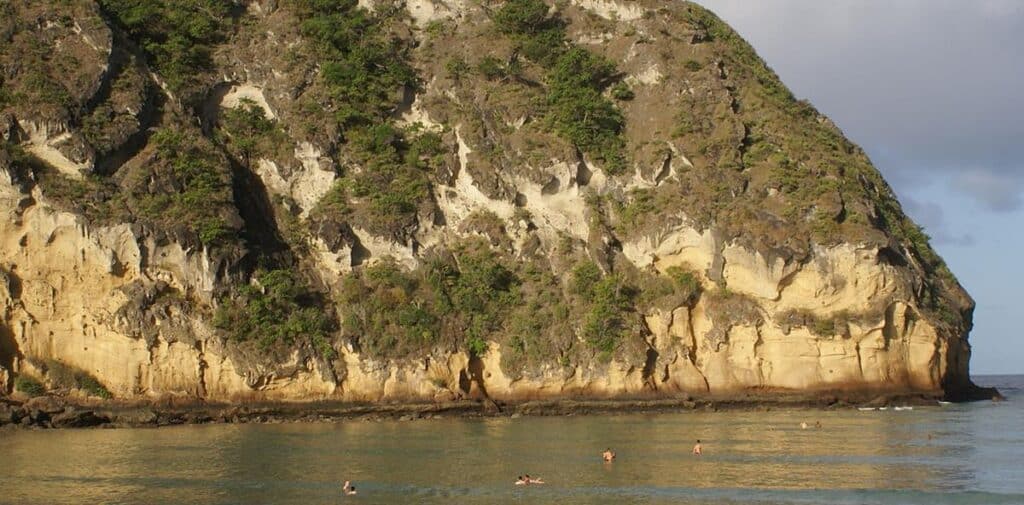
Palagonite is a yellow, yellow-orange, or brownish material formed from the alteration of basaltic or glass with a chemical composition like basalt.
However, it may also form from water interacting with hot magma or lava of basalt-like composition.
Wolfgang Sartorius von Waltershausen, a German geologist, applied the term palagonite in 1945. He used it to refer to this resin-like yellowish-brown deposits on marine tuff at Hyblaean Mountains, Sicily, Italy. This alteration product is named after Pelagonia, a nearby town.
At first, Waltershausen thought it was a new mineral. However, it wasn’t a mineral but a resinous material from the low-temperature hydration of sideromelane.
Sideromelane is a clear or transparent basaltic glass formed by quenching basalt magma in water. It occurs in tuffs, hyaloclastites, and pillow lava.
Let us discuss this process, composition, appearance, and much more.
.JPG)
Palagonitization
Palagonitization is a hydration reaction that changes volcanic glasses or glassy tuff with a composition as basalt, including sideromelane, to palagonite.
This reaction occurs at low temperatures and is isovolumetric. Isovolumetric means it doesn’t result in significant volume change.
Usually, these glasses lose silicon, magnesium, sodium, calcium, potassium, and sometimes aluminum and gain water during this reaction. Also, during this process, Iron (II) oxide (FeO) is oxidized to iron III oxide (Fe2O3).
Whatever is lost from the rock during this process forms secondary minerals. These minerals include calcium carbonate (calcite), smectite (montmorillonite groups), or zeolites that fill any void left.
The filling of voids seals water off the remaining sideromelane, reducing porosity. This explains why this material mostly occur only as rims around sideromelanes.
Additionally, magma and hot water can interact to form palagonite tuff cones. These are light-colored and occur from the interaction of steam. This steam forms as water flashes into steam upon meeting hot magma. A good example is the Galapagos Islands’ pyroclastic cones.
Lastly, slow weathering of basaltic lava can form palagonite. These lava rocks will have a yellow-orange rind on its surface.
Appearance and properties
Palagonites are heterogeneous materials. Their color, appearance, optical, and structural properties vary.
Usually, palagonite is a dull, waxy, or resinous material with yellow, orange, brown, or grayish shades. On younger basaltic glass deposits, it will be patchy.
However, it may be dark red or reddish-brown on rare occasions, especially in tropical climates.
These materials have a lower density and refractive index. However, density increases with age as secondary minerals form.
Palagonite tuff or breccia
Palagonite tuff or breccia describes any rock formed from angular volcanic fragments (volcaniclastic) rich in palagonite. For instance, you can have coarser basaltic rock pieces in a palagonitic matrix.
This tuff or breccia is usually massive and will have a conchoidal fracture. Also, as secondary minerals form, this tuff becomes less porous, and its bulk density increases.
Composition
Palagonitization is the first stage of alteration that forms a complex mixture of clay minerals and zeolite, especially phillipsite minerals and ferric oxides.
These minerals include montmorillonite (smectite), kaolinite, smectite, illite, chlorite, and mixed-layer clay minerals. Others are goethite and limonite.
Types or varieties
There are two palagonite types or varieties, namely gel-palagonite and fibro-palagonite.
Gel-palagonite is yellow, clear, transparent, and optically isotropic. It is smooth and has a 15-30% water content. Also, its refractive index is lower than the fresh glass it touches and it shows concentrically bands.
On the other hand, fibro-palagonite is microcrystalline, usually granular, fibrous, or lath-like. It is translucent, has a higher refractive index, and has less water.
Also, it is strongly to slightly birefringent and occurs between gel-palagonite and sideromelane.
Occurrence
Occurs in any basaltic glass, including tuff. However, it is more widespread in submarine sideromelane than tachylite. Tachylite is an opaque basaltic glass. It is opaque because it has minute magnetite crystals.
Usually, palagonite occurs on the pillow rims, fractures, hyaloclastite particles, fractures, and vesicle walls.
It may occur in Mars
Regolith of palagonite may occur on Mars, proving water presence. This Martian dust resembles Mauna Kea palagonite in composition and origin.
References
- Fisher, R. V., & Schmincke, H.U. (1984). Pyroclastic rocks (1st ed.). Springer-Vlg.
- Walker, G.P.L (1989). (1989) Palagonite. In Bowes, D. R. (ed.). The encyclopedia of igneous and metamorphic petrology (p. 428). New York: Van Nostrand Reinhold.
- Stroncik, N. A., & Schmincke, H. (2001a). Evolution of palagonite: Crystallization, chemical changes, and element budget. Geochemistry, Geophysics, Geosystems, 2(7). https://doi.org/10.1029/2000gc000102
- Haldar, S. K., & Tisľjar, J. (2014). Introduction to Minerology and petrology (1st ed.). Elsevier.
- Best, M. G. (2013). Igneous and metamorphic petrology (2nd ed.). Blackwell Publishers.