
Neptunism is an obsolete geological theory by Abraham Gottlob Werner, a German mineralogy professor. It stated that granitic and basaltic rocks formed from crystallizing mineralized fluids in the first oceans that covered the entire Earth.
This theory became popular due to the charisma of Werner and the fact it supported Biblical Scriptures. However, with evidence from the field and the rise of plutonism and uniformitarianism, it collapsed.
Discover more about neptunism, including its meaning and how it stratigraphically divided the Earth. We will also talk about decline and some of its wrong assumptions.
What is neptunism?
Neptunism was a once-holding but now superseded or obsolete geology theory which stated that nearly all rocks, including granites and basalts, crystalized or precipitated from mineralized fluids in primeval or early/first Earth’s oceans. It was named after Neptune, a Greek god of the Sea, Poseidon, and believers or supporters of this idea or school of thought were Neptunists.
Abraham Gottlob Werner (1749-1817), a German mineralogy professor, proposed the theory of neptunism. It gained popularity in the late 1700s since it resonated well with naturalists, the Church, and the Scriptures. Also, his brilliance, charisma, and inspiration to students popularized the theory and made him one of Europe’s foremost geologists.
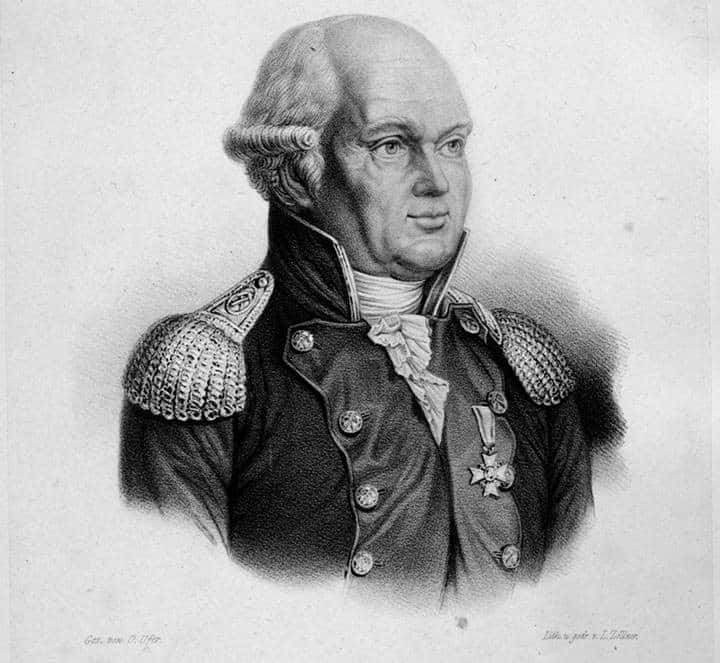

Werner didn’t travel much, leading him to assume the rock sequence at his birthplace, Saxony, and nearby Silesia, was the same in Europe and the entire world. He also believed that the Earth was young geologically and was once covered by a universal turbid ocean, i.e., a worldwide flood, consistent with biblical deluge or Noachian flood.
That is not all. Werner also rejected the theory of uniformitarianism and the idea that the Earth had a molten core. Their reason was if you cool molten magma, it will form glass, not a crystalline rock.
In his Classification and Description of Rocks of 1787, he categorized rocks of Europe and the world into five stratigraphic series sequentially according to their formation age. These series are as follows in the order of formation (his geological time scale):
- Primitive: They were the oldest and consisted of crystalline granites, gneiss, schists, etc. These crystallized in the sea or ocean when water covered the Earth, i.e., before land emerged. They formed during the Noachian floods at great depths with calm water on uneven ocean floors.
- Transition: These were dikes, sills, limestones, and graywackes, which he opined were universal formations worldwide.
- Secondary/stratified/ Flöetz: It had fossiliferous rocks and lava flows. Werner said they were from mountains emerging from the primeval sea that deposited whatever erosional sediments they had on their flanks which had fossils. These happenings created stratified or layered rocks.
- Alluvial or tertiary rocks: The alluvial rocks had gravels, sands, and clays that were poorly consolidated. They formed from the withdrawal and recession of the sea from the various continents.
- Volcanic (younger): Werner said they formed from subterranean coal fires to account for the younger lava flows or volcanic.
Transition and Flöetz happened when shallow stormy oceans alternated with deep calm seas. These created a broken, layered appearance. So, the deposition was chemical and mechanical in nature.
Lastly, the above lithostratigraphic classifications became popular and were almost considered universal standard geologic columns.
Abraham Gottlob Werner Wrong assumptions
Nicolaus Steno (1638-1686) greatly contributed to early geology with his four principles: lateral continuity, cross-cutting relationships, original horizontality, and inclusions. However, back then, any geologic interpretation needs to align with literal Scripture interpretations. The Earth was geologically young.
In the mid-18th century, the evidence of fossils in the rock made some naturalists create ideas that were divergent from Creation, as in Genesis in the Bible. One such person was Georges de Buffon, who proposed that Earth was 75,000 years or older.
This revelation triggered geologists to try to explain the history of Earth. Some wanted to hold on to the idea that Earth was young. This assumption of a young Earth led to the rise and fame of Neptunism and catastrophism.
Some of the supporters of neptunism included Christian Leopold von Buch, his student, who later denounced the theory, and Johann Wolfgang von Goethe. Also, Robert Jameson, a Scottish Professor of Natural History and geologist at Edinburgh University, defended the idea.
The other person who vehemently supported neptunism while opposing Hutton from scientific and religious views was Richard Kirwan, an Irish chemist and then Royal Irish Academy president. He said erosion would make significant changes, and the heat wasn’t important in consolidating sediments. He also cast doubt that granite couldn’t crystallize from a melt.
Catastrophism was proposed by Baron Georges Cuvier (1769–1832), a French zoologist. He said Earth’s biological and physical history was from widespread and sudden catastrophic events. He even said six catastrophic events shaped the Earth’s appearance, corresponding to the six creation days. Being supported by the Bible, his theory became popular in Europe at one point.
However, not everyone agreed with these two theories. One of the vocal critics of neptunism and catastrophism was James Hutton (1726-1797), a Scottish geologist and farmer. Through his observations on the Scottish coast, he concluded that Earth was not simple or static but dynamic, with ongoing events like erosion and weathering, sediment transportation and deposition, and volcanism.
Hutton came up with the principle or doctrine of uniformitarianism. It states that the physical laws and natural processes that exist today existed in the past and will exist in the future and with the same intensity. Later, Charles Lyell (1797–1875) popularized using the phrase “the present is the key to the past.”
Some of the assumptions that Werner made that led to the collapse of neptunism include the following:
1. Origin of granites and basalts
Werner’s book “On the External Characters of Minerals” argued that granites and basalts crystallized in the ocean/sea. This idea didn’t go well with plutonism/vulcanism, a concept spearheaded by Hutton but pioneered by Abbé Anton Moro (1687-1750). Plutonists considered these rocks to form from rock melting at great depths, and their theory was named after Pluto, an underworld Roman god.
Also, Plutonists disagreed with the idea of younger volcanic occurring from subterranean coal fires. Evidence and observation showed that some lava flows happened in areas without coal beds.
Lastly, Nicolas Desmarest (1725- 1815), a French geologist, discovered that the origin of basalt was volcanic, disapproving Neptunist theory. Also, basalt didn’t have fossils, as observed by John Playfair.
2. A hypothetical universal ocean was implausible
When Werner talked about a hypothetical universal ocean covering the whole Earth or universe, he couldn’t account for such huge volumes of water. Also, he couldn’t explain where it went to. Instead, he said it evaporated to space or escaped.
The other issue was the sighting of basalt overlaying a sandstone on a hill near Freiberg. He imaged a mineral-bearing ocean rose to the hilltop, depositing basalts.
Considering these two scenarios, the theory of a universal ocean seemed unconvincing chemically and physically.
3. Failed to explain some field evidence
Isle of Arran exposure could support both Hutton’s and Werner’s theories. However, at Siccar Point, only Hutton’s hypothesis could explain unconformity (angular unconformity) and the granitic veins at Glen Tilt.
Secondly, the discovery of young volcanic rocks interbedded with the secondary or primitive granites proved the theory was unlikely, and vulcanicity occurred throughout the history of the world.
Lastly, Werner proposed five simplistic lithostratigraphy sequences. However, the actual sequence in the field varied in different parts of the world. For instance, he classified rocks into unique lithology formed during the Noachian floods and were universally distributed. However, actual field evidence proved otherwise.
Decline of neptunism
The difference in opinion on Neptunism between Professor Robert Jameson and James Hutton resulted in many controversies at Edinburgh. This theory lasted longer than expected, i.e., it lasted for several decades going into the 1800s due to the following reasons:
- A failed attempt to vindicate Hutton’s theory by Sir James Hall failed became another hurdle. After fusing and slowly cooling, the granitic didn’t form a rock looking like the original rock.
- Hutton was not a good writer, and his ideas were not accepted or were poorly disseminated.
However, more field evidence and works of Lyell popularized uniformitarianism. In the 1820s, neptunism popularity declined; by the 1830s, most people abandoned it.
Plutonism vs. neptunism
Neither plutonism nor neptunism of these theories fully explained the origin of rocks as we know them today. They were partially right since most sedimentary rocks precipitate from the sea, but not all rocks come from mineralized sea fluids – some form from volcanic activities.
However, if you consider primordial rocks, plutonism wins since the original rocks were from molten magma, i.e., igneous. The rest (sedimentary and metamorphic) formed from igneous rocks.
Here is more on plutonism vs. neptunism:
References
- Kusky, T. M. (2005). Encyclopedia of earth science (1st ed.). Facts on File.
- Oldroyd, R D (2005). History of geology from 1780 to 1835. In Selley, R. C., Morrison, C. L. R., & Plimer, I. R. (Eds.). Encyclopedia of geology (Vols. 1-5). Elsevier Academic.
- Wicander, R., & Monroe, J. S. (2010). Historical geology: Evolution of the earth and life through time (6th ed.). Books-Cole.
- Kusky, T. M., & Cullen, K. E. (2010). Encyclopedia of earth and space science. Facts on File.