
Pele’s tears are small jet-black teardrop, obovoid, spherical, or cylindrical-shaped volcanic glass droplets formed when tiny blobs of ejected magma cool quickly. They often precede or connect to one (or sometimes more) Pele’s hair, and you will find them together hidden in these fibers. However, some break off and fall closer to the vent as they are heavier and more compact than hairs.
These tiny teardrop-like volcanic glasses are named after Pele (pronounced [ˈpɛlɛ]), often known as Tūtū Pele or Madame Pele. She was the Hawaiian mythological goddess of fires, creator of the Hawaiian Islands, and ruler of fire, volcanoes, lightning, and wind.
Today we will discuss Pele’s tears, their occurrence, and how they form. We will also mention their significance to volcanologists.
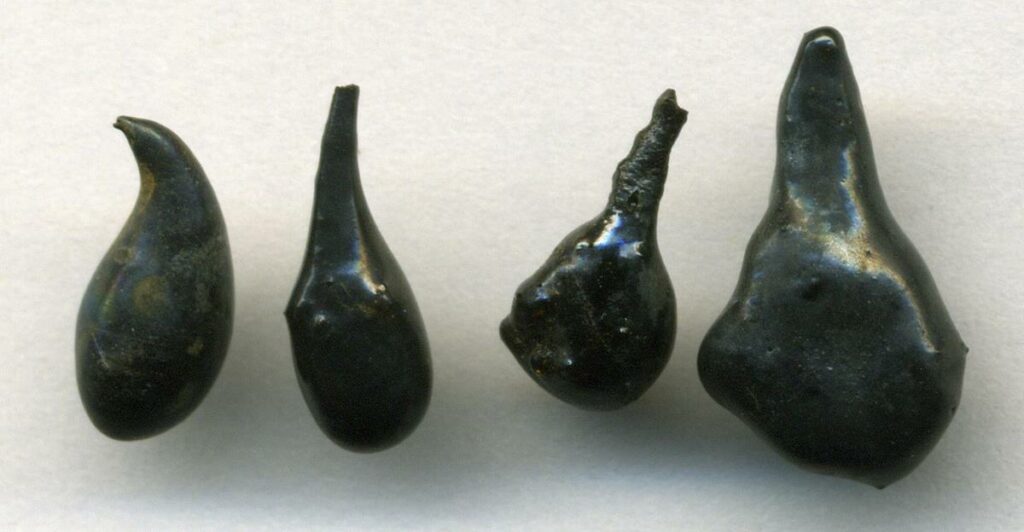
Image showing teardrop-shaped to obovoid Pele’s tears. Although delicate, you can handle them without any injury risk unless they are attached to the delicate hairs. Photo credit: James St. John, CC BY 2.0, via Wikimedia Commons.
_(unrecorded_eruption_of_Kilauea_Volcano,_Hawaii).jpg)
Quick facts
- Names: Pele’s tears
- Other names: Achneliths or Waimaka-o-Pele
- Appearance: Small (smaller than a dime) teardrop, spherical, cylindrical-shaped solidified volcanic glass
- Color: jet black like obsidian
- Texture: Glassy or vitreous
- Associated with: May be attached to tips of Pele’s hair.
- Magma type: Low viscosity basaltic
- Eruption type: Mainly Hawaiian but also possible in other low-viscosity basaltic eruptions.
Occurrence
Pele’s tears and hairs often occur together, with some tears usually attached to the ends of Pele’s hair. They form commonly in subaerial, low-viscosity explosive basaltic lava melts, especially in Hawaiian eruption types. Popular examples are craters in Hawaii Volcano National Park like Kīlauea and Mauna Loa.
However, they can occur in other types of low-viscosity basaltic eruption, including some seen at Mt. Etna (Italy), Piton de la Fournaise (France), Erta’ Ale (Ethiopia), Masaya (Nicaragua), etc. Also, they can occur in submarine environments and marine environments.
How do Pele’s tears form?
Pele’s tears from during a low viscosity basaltic volcanic eruption that ejects small bits of lava melt solidifying rapidly into small droplets without stretching. The rapid quenching forms the glassy texture; some draw thread-like strands of Pele’s hair behind them.
Usually, the rapid exsolution of water and gas in lava will violently blast, and spurts molted lava blobs into the air. However, unlike Pele’s hair which is spun or drawn into hair-like strands, they don’t. Instead, they will quickly solidify, forming nearly spherical, water-drop-shaped, or cylindrical small solids. These shapes result from these aerodynamic shapes.
Factors that control Pele’s tears and hair formation in low-viscosity magma types include surface tension, acceleration (spurting velocity), and friction with the air. Also, factors like time of flight, environmental conditions (cooling rate), magma geometry, and vesicle content of the initial ejected droplet have an impact.
For instance, high velocity will allow the drawing of magma droplets into thin filaments while low favors the formation of tears. Also, bubbles can affect cooling rates.
Significance
Studying morphology, minerals, vesicles, and mineralogy of Pele’s tears and hairs will help volcanologists understand the process happening deep inside the Earth, conditions, how magma moved, and its behavior.
You can know things like temperature by studying crystal structure, and chemical composition will tell you more about magma composition. Also, it is possible to know magma storage and movement inside the volcano and timescales.
References
- Moune, S., Faure, F., Gauthier, P.-J., & Sims, K. W. W. (2007). Pele’s hairs and tears: Natural probe of Volcanic Plume. Journal of Volcanology and Geothermal Research, 164(4), 244–253. https://doi.org/10.1016/j.jvolgeores.2007.05.007
- Gill, R. (2010). Igneous rocks and processes: A practical guide (1st ed.). Wiley-Blackwell.
- Moyer, S., & Sahagian, D. (2023). Cry me a Pele’s tear: New insights on the internal structures of Pele’s tears. Frontiers in Earth Science, 11. https://doi.org/10.3389/feart.2023.1184027
- Shimozuru, D. (1994). Physical parameters governing the formation of Pele’s hair and tears. Bulletin of Volcanology, 56(3) pp. 217-219. https://doi.org/10.1007/BF00279606
- Bonewitz, R. (2012). Rocks and minerals (1st ed.). DK Pub.
- Zahbi, M., Singh, A. K., Pati, J. K., Dwivedi, M. M., Dwivedi, S., & Anand, A. (2023). Experimental formation of Pele’s hairs and tears at 1200°C under atmospheric pressure from natural alkali olivine basalt. Journal of Earth System Science, 132(2). https://doi.org/10.1007/s12040-023-02061-w