
Pele’s hair is a formal geological term that volcanologists give to the golden-brown, fiber or thread-like strands of volcanic glass formed naturally from blowing out or stretching of ejected molten lava blobs. It mainly forms from low-viscosity basaltic Hawaiian eruptions but can occur in other basaltic eruptions.
Pele (pronounced peh-ley or [ˈpɛlɛ]) is a mythical goddess of fire and volcanoes and the creator of Hawaii Island. The legend goes that Madame Pele lived at Halemaʻumaʻu in Kīlauea’s summit caldera, one of the most active volcanoes in the world, with her domain over all volcanic activities in the Island. Evidence of her existence was these hair-like volcanic glasses.
Learn more about Pele’s hair volcanic glass, including what it is, how it is, and its significance. We will also let you know if they are dangerous or not.
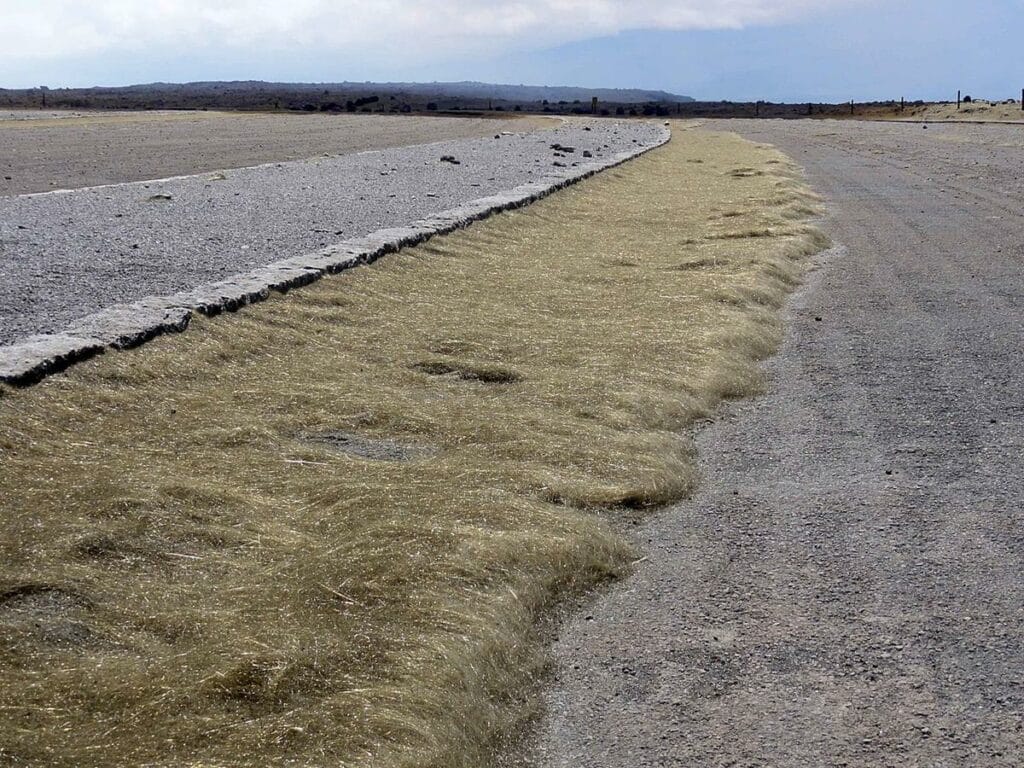
Golden-brown Pele’s hair volcanic glass on the downwind of Halemaʻumaʻu covering a curb ground in a parking lot on May 3, 2012. Photo credit: Matthew Patrick, Public domain, via Wikimedia Commons.

Quick facts
- Name: Pele’s hair
- Other names: Capillary ejecta, filiform lapilli, Lauoho o Pele, Lauoho Pele, or Lauoho ehuehu a Pele
- What are they: Golden brown, thin, flexible but fragile hair-like filaments of volcanic glass fibers, less they 1/16 inch in diameter up to 2 meters long.
- Texture: Glassy or vitreous
- Magma type: Low viscosity basaltic
- Type of volcanic eruption: Mostly Hawaiian, with some in other basaltic eruptions
- Association with: Often preceded by Pele’s tears on their tips
What is Pele’s hair
Pele’s hair refers to thin, filament or thread-like golden-brown basaltic volcanic glass spun from molten basaltic magma. Under the sun, they appear shimmery and golden; some may contain olivine inclusions, and others may appear blackish.
These soft, delicate, and flexible hair-like volcanic glass measure less than 1/16-inch (than half a millimeter) to as little as a micron (0.001 mm) in diameter and can be as long as six and a half (2 meters) feet long.
Pele’s hairs are common among the active craters in Hawaii Volcano National Park, especially downwind of Halema‘uma‘u lava lake at the Kīlauea Volcano summit and in the Kaʻu Desert. This park also has Mauna Loa.
Lastly, the hairs can remain in place for several decades but easily shatters if you touch them. However, in most cases, the wind blows and strips them from the various surfaces.
How does Pele’s hair form?
Pele’s hair forms when gas bubbles violently blast low-viscosity basaltic lava lake, ejecting fluid bubble skin into the air. Then the fast-flowing escaping gases and wind will blow out, spin, draw out, or stretch the bursting molten lava skin or blobs into thin, hair-like fibers or strands that quickly cool and solidify.
One explanation is that as the magma blobs split, they draw out a thin strand, as chewing gum or viscus adhesive creates a strand if you try to separate it. Initial droplet size, surface tension, air friction, and acceleration in the air influence the deformation of the low-viscosity basalt droplet shape in the air.
For instance, if spurting speed is high, you have Pele’s hairs, and if low, Pele tears. Similarly, if it cools fast or doesn’t stretch out, you will also have the teardrop-shaped volcanic glass or the so-called Pele’s tears, which are common on the ends of the hairs. However, these two often occur together.
Once created, since it is light, these hairs can travel tens of miles downwind from the original vent. They are common downwind of the ejection vents strewn all over the landscape, including on curbs, gullies, trees, electric poles, and ground or trapped on small rocks as intertwined mats, some appearing woven. Birds can use them to make nests.
Pele’s hair is associated with subaerial, effusive, low-viscosity Hawaiian eruptions with little gases, volcanic ash, and high vent temperatures. These are relatively gentle, low level and less dangerous than other volcanic eruptions.
These unique pyroclastic products can form from lava fountains, vents, spatter cones, cascades, or even vigorous lava flows. Also, they can occur in littoral explosions, submarine activity, strombolian eruptions, and passive lava lake outgassing.
Lastly, besides Hawaiian volcanic eruptions, other basaltic eruptions like Etna, Piton de La Fournaise, Piton de Neige, Masaya, Holuhraun, and Stromboli form Pele’s hairs.
Yes. Pele’s hairs are fragile, brittle, and sharp strands of glass that can cause tiny cuts and get lodged beneath our skin. Their removal isn’t easy; they will break further as you try to extract them from a wound. Also, they can scratch the cornea, and those shattered into small pieces can present respiratory problems.
Therefore, we strongly recommend wearing gloves, protective glasses, and a KF94/N95 mask when examining these hairs. Don’t forget to wear closed shoes as they are often almost impossible to avoid stepping on them.
Significance
Studying Pele’s hair and tears, including their mineralogy, crystal structure, and gas bubbles present, can give insight or help predict eruption velocities, timescales, conditions, magma movement, and behavior.
For instance, you know temperatures by looking at how minerals exist. If you find euhedral plagioclase crystals, you can conclude that an eruption temperature was below 2,220°F (this is the temperature it will start crystallizing). Such magma wasn’t superheated.
Similarly, when studied microscopically, vesicles in these hairs prove their formation involves syneruptive volatile exsolution and is efficient even after magma extrudes. Also, you can predict velocity as strands form under higher speeds and tears at lower.
Lastly, lab investigation into their chemistry can reveal more information about magma composition since it cools quickly.
References
- Gill, R. (2010). Igneous rocks and processes: A practical guide (1st ed.). Wiley-Blackwell.
- Hawaiian Volcano Observatory (2016, October 20). Volcano Watch — Amber waves of … Pele’s hair? USGS. https://www.usgs.gov/news/volcano-watch-amber-waves-peles-hair
- Symes. R. F. (2008). Eyewitness rock & mineral (1st ed.). DK Pub.
- National Parks Service. (2021, January 22). Pele’s hair. U.S. National Parks Service. https://www.nps.gov/havo/learn/nature/peles-hair.htm
- Shimozuru, D. (1994). Physical parameters governing the formation of Pele’s hair and tears. Bulletin of Volcanology, 56(3) pp. 217-219. https://doi.org/10.1007/BF00279606
- Cannata, C. B., De Rosa, R., Donato, P., Donato, S., Lanzafame, G., Mancini, L., & Houghton, B. F. (2019). First 3D imaging characterization of Pele’s hair from Kilauea Volcano (Hawaii). Scientific Reports, 9(1). https://doi.org/10.1038/s41598-018-37983-9
- Bonewitz, R. (2012). Rocks and minerals (1st ed.). DK Pub.
- Lopes, R. (2005). The Volcano Adventure Guide (1st ed.). Cambridge Univ. Press.
- Moune, S., Faure, F., Gauthier, P.-J., & Sims, K. W. W. (2007). Pele’s hairs and tears: Natural probe of Volcanic Plume. Journal of Volcanology and Geothermal Research, 164(4), 244–253. https://doi.org/10.1016/j.jvolgeores.2007.05.007